

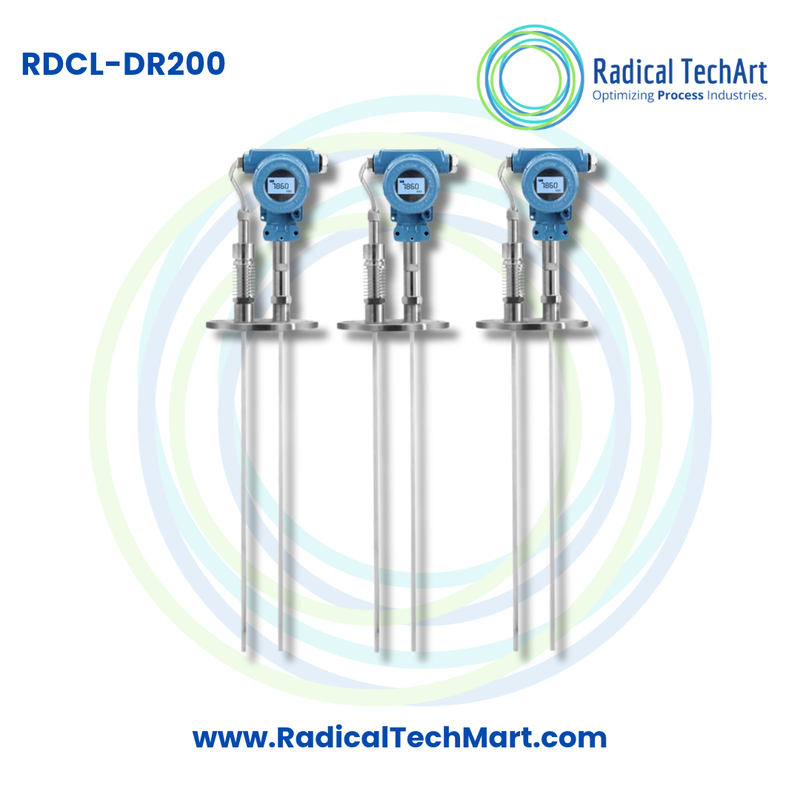
RDCL Two-Electrode Capacitive Level Transmitter RDCLDR200
The RDCL Two-Electrode Capacitive Level Transmitter RDCLDR200 is an industrial continuous level measurement instrument designed for monitoring liquids, oils and compatible solid materials in storage tanks and process vessels. Using advanced capacitance sensing technology, it detects changes in material levels and converts them into a standard 4 to 20 mA output signal with HART communication support. Featuring a measuring range of up to 1.5 meters, IP65 protection and a stainless steel sensing probe with an insulating coating, the RDCLDR200 is suitable for chemical processing, oil storage, water treatment, industrial automation and small to medium-sized non-metallic tanks.
Customize
Share :
A. Product Overview
The RDCL RDCLDR200 Two-Electrode Capacitive Level Transmitter continuously measures liquids and compatible solids in tanks and vessels by detecting capacitance changes as levels rise or fall, unlike fixed-point level switches.
Designed for small and medium non-metallic containers, it can monitor compatible oils, non-conductive liquids and low-moisture materials, subject to dielectric properties, probe choice and calibration. Insulated stainless steel electrodes have no moving parts. Its 4 to 20 mA output with HART integrates with PLCs, indicators and SCADA. Uses include water and oil tanks, chemical vessels and automated handling.
Important Technical Specifications
Parameter | Specification |
|---|---|
Product / Brand / Model | Two-Electrode Capacitive Level Transmitter / RDCL / RDCLDR200 |
Principle / Type | Electrical capacitance / Continuous level measurement |
Measuring range | Up to 1.5 m |
Capacitance range | 20 to 2000 pF |
Accuracy | ±1% full scale or ±0.5 pF |
Output / Communication | 4 to 20 mA / HART |
Power supply | 18 to 30 VDC |
Sensing material | SUS304 stainless steel with insulating coating |
Process connection | DN50 flange (reference configuration) |
Medium temperature | −40°C to 200°C |
Process pressure | Listed as −1 to 40 bar |
Temperature drift | Less than ±0.2% full scale/°C or 0.1 pF/°C |
Junction box / Protection | Painted aluminum alloy / IP65 |
Suitable media | Compatible liquids, oils and solids |
Applications | Small tanks, chemical vessels, oil storage, industrial level monitoring |
Specification note: These figures are based on a corresponding reference product. Confirm the actual RDCLDR200 pressure rating, probe coating, process connection, accuracy and configuration before treating them as guaranteed specifications.
B. Working Principle
Capacitance is measured between a sensing electrode and a reference electrode, which may be a suitable conductive tank wall or a separate electrode in non-metallic tanks. The material and air act as dielectrics.
Measurement process:
Installation: Install an insulated probe and suitable reference electrode.
Formation: Electrodes form a capacitor with material and air as dielectrics.
Level change: Rising or falling material changes probe coverage and capacitance.
Detection: Electronics measure capacitance changes.
Processing: Calibration converts capacitance to level.
Output: A proportional 4 to 20 mA signal and compatible HART communication.
Monitoring: PLC, SCADA or indicators use the measurement.
4 to 20 mA scaling (when configured linearly): 4 mA = 0%, 8 mA = 25%, 12 mA = 50%, 16 mA = 75%, and 20 mA = 100% of the measuring span. At a calibrated 1.5 m span, 12 mA is about 0.75 m, assuming linear scaling.
C. Why Is It Used?
Continuous monitoring: Reports actual level throughout the range rather than a single high or low point.
Non-conductive liquids: Can measure compatible oils and other low-dielectric media with the correct setup.
Compact tanks: Up to 1.5 m range suits smaller vessels, including non-metallic tanks with an appropriate reference electrode.
Low mechanical wear: No float or moving measurement parts to jam.
Automation: Analog output integrates with PLCs, indicators and SCADA; HART enables compatible digital access.
Oil storage: Monitors suitable oils and lubricants with medium-specific dielectric calibration.
Chemical processing: Suitable when the probe and insulation are chemically compatible.
Elevated temperatures: Reference medium rating reaches 200°C, subject to the complete assembly's suitability.
Industrial protection: Reference IP65 housing resists dust ingress and water jets.
Filling and emptying: Level feedback can help controllers operate pumps, valves and inventory systems.
D. Suitable Buyers
Suitable for chemical manufacturers (storage tanks), oil and lubricant producers (oil levels), water and wastewater plants (treatment vessels), automation companies and system integrators (PLC monitoring), OEMs (machine tanks), refrigeration manufacturers (circulating liquids), air compressor manufacturers (water replenishment), food processors (compatible liquid ingredients), pharmaceutical companies (process liquids), lithium battery equipment manufacturers (liquid storage), boiler manufacturers (compatible water monitoring), instrumentation engineers (level instrumentation) and plant maintenance departments (transmitter replacement and service).
E. Frequently Asked Questions
1. What is the RDCL RDCLDR200 Two-Electrode Capacitive Level Transmitter?
The RDCL RDCLDR200 is an industrial continuous level measurement instrument designed to monitor liquids, oils and compatible solid materials in tanks and storage vessels.
It uses electrical capacitance sensing technology to detect changes in material level and converts these variations into a proportional 4 to 20 mA output signal for industrial monitoring and automation systems.
2. How does the RDCLDR200 Two-Electrode Capacitive Level Transmitter work?
The RDCLDR200 operates by measuring changes in electrical capacitance between a sensing electrode and a reference electrode.
As the liquid or material level rises or falls, the dielectric properties between the electrodes change. The transmitter detects these variations and converts them into a corresponding level measurement.
This allows continuous monitoring without mechanical moving parts.
3. What is the measuring range of the RDCLDR200 Capacitive Level Transmitter?
The referenced RDCLDR200 design supports continuous level measurement up to 1.5 meters, making it suitable for small and medium-sized industrial storage tanks.
The actual measuring range depends on the sensing probe length, material dielectric properties, calibration settings and installation configuration.
4. Can the RDCLDR200 measure oil levels in industrial storage tanks?
Yes. The RDCLDR200 can be used to measure levels of compatible non-conductive liquids, including certain industrial oils and lubricants.
Since different oils have different dielectric constants, proper calibration and probe selection are necessary to achieve reliable level measurement.
5. Is the RDCLDR200 suitable for water level measurement?
Yes. The RDCLDR200 can be used for continuous water level monitoring in compatible storage tanks and industrial process vessels.
6. Can the RDCLDR200 Capacitive Level Transmitter measure powders and granular materials?
The referenced RDCLDR200 transmitter is designed for compatible liquids and solid materials, including certain powders and granular substances.
However, measurement suitability depends on the dielectric constant, moisture content, material buildup and sensing probe configuration. The application should be evaluated before installation.
7. What output signal and communication options are available in the RDCLDR200?
The referenced RDCLDR200 design provides a standard 4 to 20 mA analog output with HART communication support.
The analog output represents the measured material level continuously, while HART communication enables compatible industrial instruments and control systems to access digital transmitter information.
8. Can the RDCLDR200 be connected to a PLC or SCADA system?
Yes. The RDCLDR200 can be integrated with PLCs, SCADA systems and digital level indicators using its standard 4 to 20 mA output.
When connected to a compatible PLC analog input module, the transmitter provides continuous level data that can be used for tank monitoring, pump automation, filling operations and level-based process control.
9. What is the difference between a two-electrode and a single-electrode capacitive level transmitter?
The primary difference is the electrode arrangement used to measure electrical capacitance.
A two-electrode capacitive level transmitter uses a defined sensing electrode and reference electrode, making it useful where the tank wall cannot provide a suitable electrical reference.
Some single-probe capacitive measurement systems use a conductive tank wall as the reference electrode.
The appropriate selection depends on tank construction, material properties and installation requirements.
10. Can the RDCLDR200 be installed in plastic or non-metallic storage tanks?
Yes. The referenced RDCLDR200 design is particularly suitable for small and medium-sized non-metallic containers, including compatible plastic storage tanks.Since plastic tank walls cannot function as conductive reference electrodes, a suitable two-electrode sensing arrangement is required to establish stable capacitance measurement.
This makes the transmitter useful for continuous level monitoring in appropriately configured non-metallic industrial vessels.