

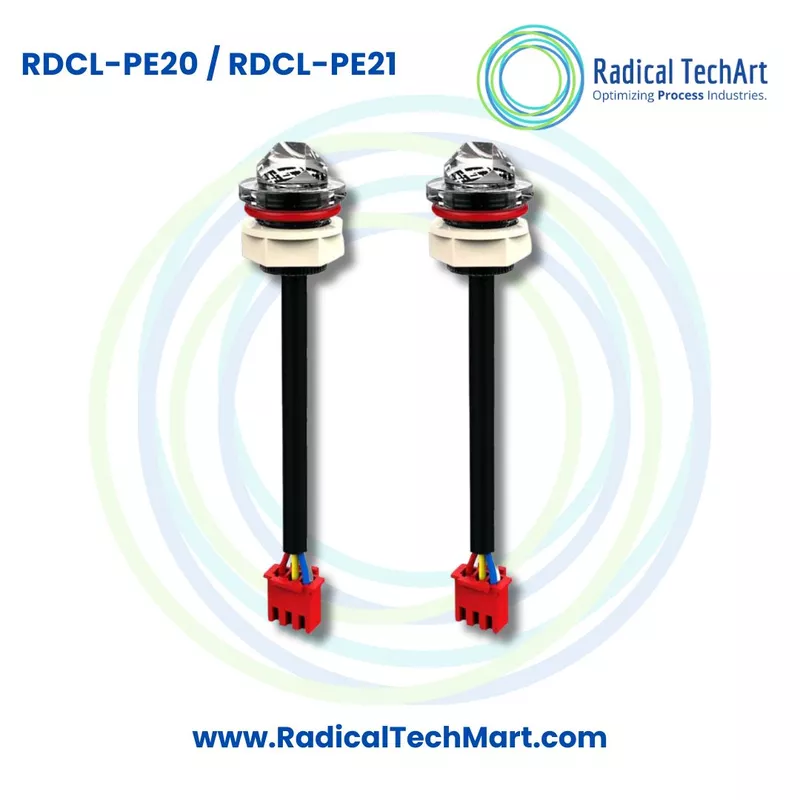
RDCL Water Tank Optical Level Switch Series
The RDCL Water Tank Optical Level Switch RDCLPE Series, featuring models RDCLPE20 and RDCLPE21, is a compact electronic liquid level detection sensor designed for water tanks, water purification systems, wastewater treatment equipment, and industrial automation applications.
It operates using infrared photoelectric sensing technology to detect the presence or absence of liquid without requiring mechanical moving parts.
The RDCLPE Series features a 5V DC operating supply, fast response, high repeatability, and an operating temperature range of -25°C to 85°C, ensuring reliable liquid level detection.
The RDCLPE Series is suitable for high-level alarms, low-water detection, overflow prevention, and automatic liquid level control applications.
Customize
Share :
A. Product Overview
The RDCL RDCLPE Series Optical Water Tank Level Switch detects liquid at a selected point in tanks and equipment using infrared reflection and refraction.
The series includes two models:
- RDCLPE20: Intended for water purification systems, wastewater treatment, industrial water tanks and liquid handling equipment.
- RDCLPE21: An electronic alternative to mechanical float switches for compact equipment, medical instruments, laboratories and automated liquid processing.
Without moving floats, both models signal liquid presence to compatible controllers for refilling, overflow alarms and low-water protection.
Important Technical Specifications
| Specification | Details |
|---|---|
| Product Name | Water Tank Optical Level Switch |
| Brand / Series | RDCL / RDCLPE Series |
| Model Numbers | RDCLPE20 and RDCLPE21 |
| Sensor Type | Infrared photoelectric liquid level switch |
| Detection Principle | Infrared light reflection and refraction |
| Operating Voltage | 5V DC |
| Output, Water Present | 0V typical |
| Output, Water Absent | 5V typical |
| Current, Water Present | 15 mA typical |
| Current, Water Absent | 20 mA typical |
| Operating Temperature | -25°C to 85°C |
| Detection Method | Point level detection |
| Response / Repeatability | Fast response / High repeatability |
| Mechanical Moving Parts | None |
| Multi-Point Detection | Possible with multiple sensing points |
| Applications | Water tanks, purification, wastewater, medical equipment |
Technical Note: Electrical values are typical at 5V DC and 25°C. Confirm dimensions, wiring, process connection and liquid compatibility for each variant.
B. Working Principle
The RDCLPE20 and RDCLPE21 contain an infrared emitter and receiver. Air and liquid create different reflected light intensities at the sensing tip due to their refractive indices. Electronics detect the change and switch between wet and dry output states.
Step-by-Step Working Process
- Infrared Light Generation: The emitter directs infrared light toward the optical sensing surface.
- Dry Condition Detection: Air around the tip produces a characteristic reflected signal.
- Liquid Contact Detection: Water or compatible liquid changes the optical boundary and reflected intensity.
- Signal Detection: The photoelectric receiver detects the change in light intensity.
- Electronic Processing: Internal circuitry converts the detection result into an electrical switching signal.
- Level Control: A compatible controller uses the signal for alarms, filling control or low-water protection.
Typical Output Conditions
| Liquid Condition | Typical Output |
|---|---|
| Water present at sensing tip | 0V |
| Water absent from sensing tip | 5V |
These values apply at a 5V DC supply and 25°C.
Important: These are point level switches, not continuous level transmitters. For high-level and low-level detection in the same tank, install separate sensing points at different heights.
C. Why Is the RDCL Water Tank Optical Level Switch Used?
1. Accurate Water Level Detection
The optical tip detects water presence with high repeatability in tanks, reservoirs and automated equipment.
2. Water Tank Overflow Prevention
At a high-level position, the sensor can trigger an alarm or stop filling through a controller.
3. Low-Water Level Detection
At a low-level position, it can alert controllers in purifiers, pumps, water heaters and processing equipment.
4. Alternative to Mechanical Float Switches
Infrared sensing avoids moving floats and associated sticking or wear.
5. Fast Response for Automation
Electronic switching detects liquid reaching or leaving the sensing area. The RDCLPE21 is described as supporting millisecond-level response, although the exact response time must be confirmed for the selected configuration.
6. Water Purification and Wastewater Treatment
The RDCLPE20 supports level alarms, automatic filling and drainage control. In wastewater service, deposits and suspended solids may affect the optical tip, so cleaning requirements must be considered.
7. Compact Installation
The compact design suits small tanks, appliances, laboratories and OEM machinery.
8. Reduced Mechanical Maintenance
No moving floats means less mechanical wear, but scale or deposits on the optical tip may require cleaning.
9. Multiple Liquid Level Detection
Separate sensors at different heights support high and low-level control of filling and emptying.
D. Suitable Buyers and Industrial Applications
The RDCLPE Series suits OEMs, water treatment suppliers, automation firms, integrators and maintenance teams.
| Suitable Buyers | Typical Applications |
|---|---|
| Water Purification System Manufacturers | Tank levels and automatic refilling |
| Wastewater Treatment Companies | Wastewater tank monitoring |
| Water Treatment Plant Operators | High-level and low-level alarms |
| Chemical Processing Industries | Compatible chemical tank monitoring |
| Petrochemical Industries | Compatible liquid handling equipment |
| Food and Beverage Manufacturers | Processing equipment water levels |
| Coffee Machine Manufacturers | Low-water detection and refill alerts |
| Dishwasher Manufacturers | Water presence monitoring |
| Water Heater Manufacturers | Water shortage detection |
| Medical Equipment Manufacturers | Liquid monitoring in validated equipment |
| Dialysis Equipment Manufacturers | Compatible fluid handling systems, subject to validation |
| Laboratory Equipment Manufacturers | Reagents and cleaning liquids |
| Biochemical Analyzer Manufacturers | Cleaning solution and waste liquid detection |
| Sterilization Equipment Manufacturers | Purified water and compatible disinfectants |
| Industrial Automation Companies | Liquid level control integration |
| OEM Machine Manufacturers | Compact electronic level detection |
Medical use: Appropriate equipment validation and applicable safety compliance are required. Product specifications alone do not establish suitability for patient-critical equipment.
Common Applications
Water purification and wastewater tank monitoring, high-level and low-water alarms, automatic water replenishment, overflow prevention, electronic float switch replacement, sewage tank liquid detection, water heaters, dishwashers, coffee machines, laboratory cleaning solutions, biochemical analyzers, medical equipment, reagent bottles, filling control and multi-point water level detection.
E. Frequently Asked Questions (FAQ)
1. What is the RDCL Water Tank Optical Level Switch RDCLPE Series?
The RDCLPE Series comprises compact electronic switches for detecting liquid presence or absence at a specific position inside a tank or equipment. Both RDCLPE20 and RDCLPE21 use infrared photoelectric sensing rather than a moving mechanical float.
2. What is the difference between RDCLPE20 and RDCLPE21?
Both models share the same optical principle and listed nominal electrical specifications. RDCLPE20 is primarily intended for water purification, wastewater treatment and industrial tank monitoring. RDCLPE21 is positioned as an electronic float switch alternative for compact machines, laboratory equipment and suitable medical instruments.
3. How does the RDCLPE20 Optical Level Switch work?
The RDCLPE20 directs infrared light toward its sensing tip. When liquid contacts the tip, its refractive index changes the intensity of reflected light. Internal electronics detect the difference and generate a switching signal indicating wet or dry conditions.
4. How does the RDCLPE21 Electronic Water Level Switch work?
An infrared emitter and photoelectric receiver monitor light reflected at the sensing surface. Contact with liquid changes the optical boundary and reflected intensity, allowing the RDCLPE21 to electronically detect water presence without a mechanical float.
5. What is the operating voltage of RDCLPE20 and RDCLPE21?
Both models have a listed nominal power supply of 5V DC. Wiring and electrical compatibility should be verified for the specific product variant and connected controller.
6. What is the operating temperature range of the RDCLPE Series?
The specified operating temperature range for RDCLPE20 and RDCLPE21 is -25°C to 85°C. The selected sensor and installation must remain within the applicable operating limits.
7. Can the RDCLPE20 be used for wastewater treatment?
Yes. RDCLPE20 is intended for water purification and wastewater tank level detection. Suspended solids, fouling and deposits can interfere with the optical sensing tip, so application suitability and routine cleaning should be considered.
8. Can the RDCLPE21 replace a mechanical float switch?
Yes, in suitable point level detection applications. The RDCLPE21 offers electronic sensing without moving float parts, but its power supply, output signal, mounting arrangement and liquid compatibility must match the equipment requirements.
9. What is the output voltage when water is present?
At the specified 5V DC supply and 25°C test conditions, the typical output is 0V when water is touching the sensing tip. Confirm the electrical behavior of the selected variant before integration.
10. What is the output voltage when water is absent?
Under the same 5V DC and 25°C conditions, the typical output is 5V when the sensing tip is surrounded by air. This change allows a compatible electronic controller to distinguish wet and dry conditions.