

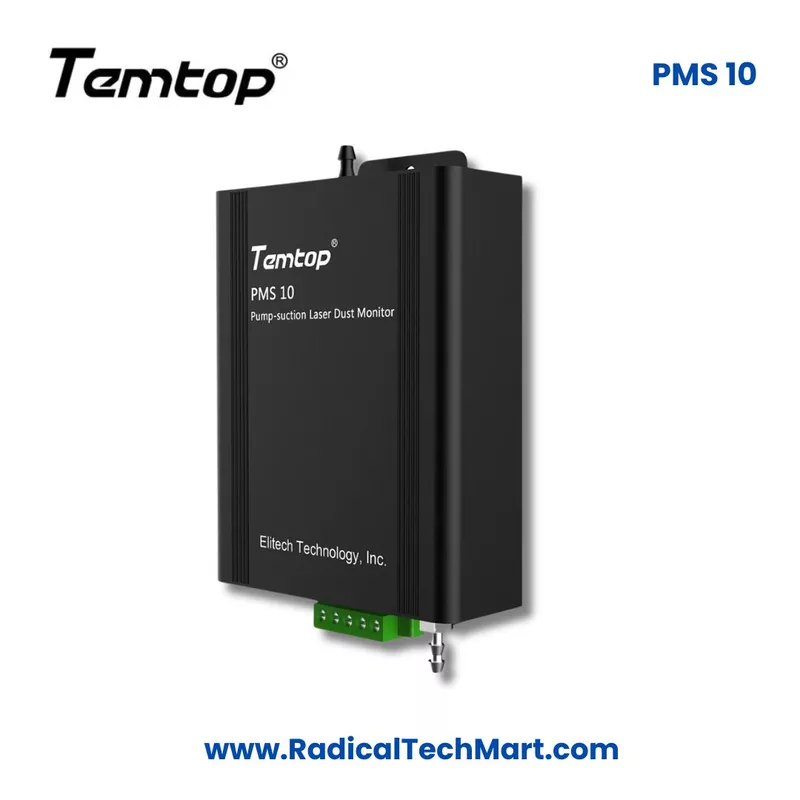


Temtop PMS10 Pump Suction Laser Particle Sensor
Temtop PMS10 is a pump-suction laser particle sensor designed for accurate monitoring of PM1.0, PM2.5, PM10, and TSP concentrations. Using MIE scattering principle and active air sampling with a built-in vacuum pump, it ensures reliable particle detection for micro air monitoring stations, dust monitoring, oil-smoke monitoring, and environmental air quality systems.
Download the manual here!!!
Customize
Share :
A. Product Overview
The Temtop PMS10 is a pump-suction laser particle (dust) monitor designed to provide solutions for online monitoring of atmospheric environments. It is used in applications such as micro air monitoring stations, dust monitoring systems, oil-smoke monitoring, and other air quality monitoring systems.
The device uses a precise optical-mechanical structure and is equipped with a four-wire brushless vacuum pump for efficient air sampling. It is compact in size, suitable for integration into multiple devices, and supports continuous operation for up to 10,000 hours under normal conditions.
B. Working Principle
The PMS10 operates based on the MIE scattering principle to monitor particle concentration.
When air passes through the light collection chamber, particles scatter light from the beam. A photoelectric collection unit converts this scattered light into voltage pulse signals. These signals are then converted into digital signals through pre-amplification and analog-to-digital conversion.
- The number of voltage pulses corresponds to the number of particles
- The amplitude of the pulses represents the particle size
After calibration using standard substances, the system determines the particle concentration in the environment.
MIE scattering occurs when particle diameter is comparable to the wavelength of radiation, with stronger forward scattering and directional characteristics.
C. Why It Is Used
The PMS10 is used for monitoring particle concentration in atmospheric environments where continuous and accurate measurement is required.
It is applied in systems such as the following:
- Micro air monitoring stations
- Dust monitoring systems
- Oil-smoke monitoring systems
- General air monitoring systems
The use of pump-suction sampling improves sampling efficiency and ensures consistent airflow for measurement.
D. Suitable Buyers
Based on its described applications and integration design, the PMS10 is suitable for:
- System integrators developing air monitoring systems
- Manufacturers of environmental monitoring equipment
- Developers of micro air monitoring stations
- Industrial users requiring dust and oil-smoke monitoring systems
E. FAQ (SEO-Optimized, PDF-Based)
1. What parameters does the PMS10 measure?
The PMS10 measures particle concentrations, including PM1.0, PM2.5, PM10, and TSP.
2. What is the measurement range of the PMS10?
- PM1.0: 0–2000 μg/m³
- PM2.5: 0–5000 μg/m³
- PM10: 0–5000 μg/m³
- TSP: 0–10000 μg/m³
3. What is the accuracy of PM2.5 measurements?
- 0–100 μg/m³: ±10 μg/m³
- Above 100 μg/m³: ±10%
4. What sampling method is used?
The PMS10 uses a pump-suction method with a built-in brushless vacuum pump for air sampling.
5. What is the working principle of the PMS10?
It operates based on the MIE scattering principle, where scattered light from particles is converted into electrical signals and processed to determine particle concentration.
6. What is the service life of the device?
The device supports continuous operation for approximately 10,000 hours under normal conditions.
7. What is the airflow rate of the sensor?
The airflow rate is 1.1 L/min with an error of ±5%.
8. What communication interface does PMS10 support?
The device supports RS485 communication and operates as a slave device responding to host commands.
9. What are the operating conditions of the device?
- Working temperature: -10°C to 60°C
- Working humidity: 0–95% RH (non-condensation)
10. How should the sensor be installed for accurate measurement?
The air inlet should be connected to an external probe with a hose length within 30 cm to ensure accurate sampling results.