

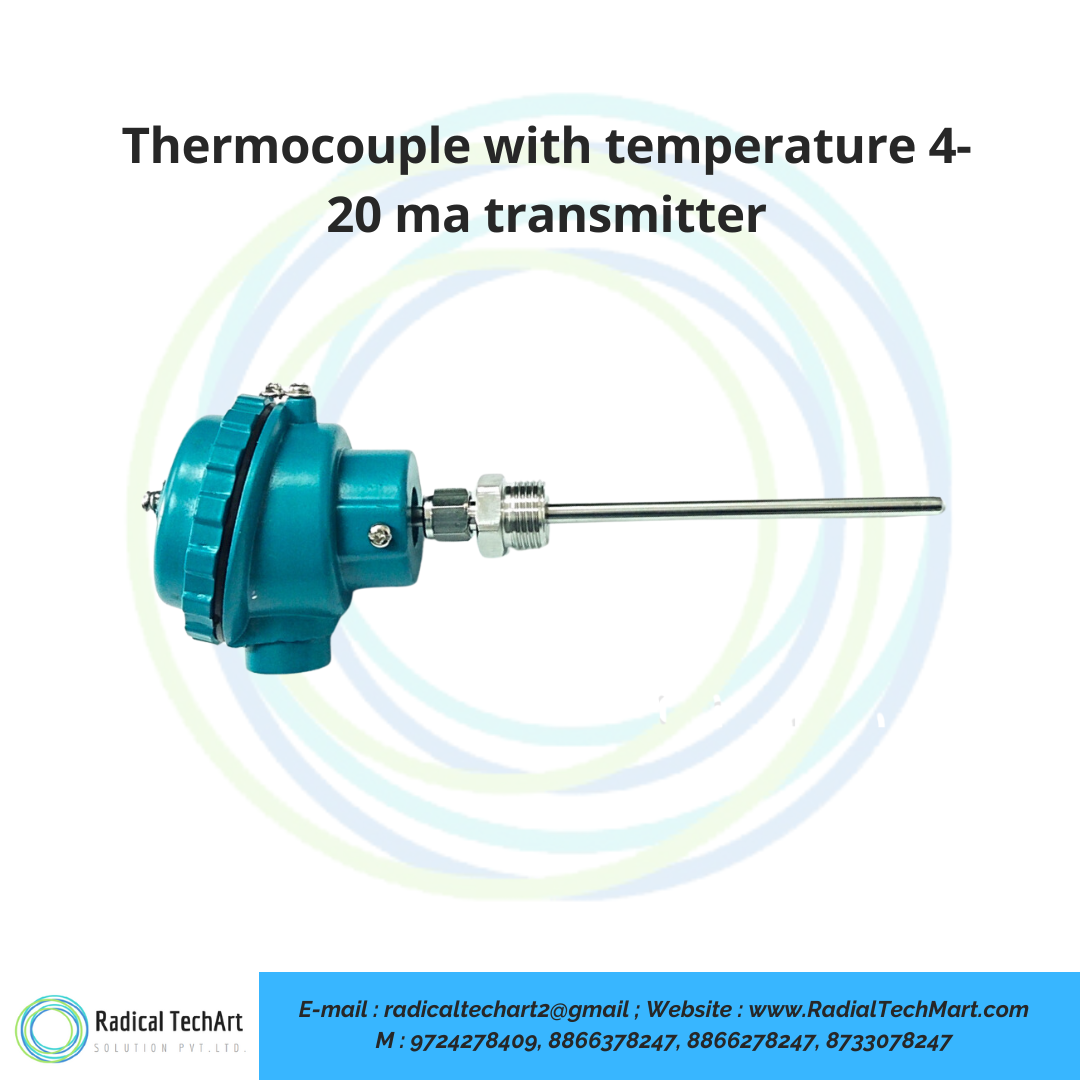
Thermocouple with Temperature 4-20 mA Transmitter
Pt100 temperature sensor with 4 to 20 mA transmitter is designed for accurate and reliable temperature measurement in industrial applications. It converts temperature signals into a stable 4 to 20 mA output, making it suitable for PLC, SCADA, control panels and automation systems.
Customize
Share :
A. Product Overview
The Pt100 temperature sensor with 4 to 20 mA transmitter is used for precise temperature monitoring in liquids, gases and solid surfaces across industrial processes. It combines a high-quality Pt100 sensing element with a temperature transmitter that converts the sensor signal into a standard 4 to 20 mA analog output.
This output signal can be easily connected to PLCs, temperature controllers, indicators, data loggers, SCADA systems and process control panels. The sensor is available in simplex and duplex options, with multiple probe diameters, connection types and thread sizes to match different installation requirements.
This product is suitable for industries where stable temperature measurement and long-distance signal transmission are required.
Technical Specifications
Type: Pt100 Simplex and Duplex
Temperature Range: -50 to 500 °C
Connection: Without, Fixed and Adjustable
Probe Diameter: 5 mm, 6 mm, 8 mm, 10 mm and 12 mm
Transmitter Output: 4 to 20 mA
Thread Size: 1/4 inch, 3/8 inch, 1/2 inch and 3/4 inch BSP and NPT
B. Working Principle
The Pt100 sensor works on the resistance temperature detection principle. The resistance of the Pt100 element changes according to the temperature. As the temperature increases, the resistance also increases in a predictable way.
The built-in or connected temperature transmitter reads this resistance signal and converts it into a standard 4 to 20 mA output signal. This signal is then sent to a PLC, controller, indicator or monitoring system.
In this system, 4 mA usually represents the minimum temperature range and 20 mA represents the maximum temperature range. This makes temperature monitoring easier, more stable and more suitable for industrial automation.
C. Why It Is Used
This temperature sensor with 4 to 20 mA transmitter is used because it provides a stable and easy-to-integrate signal for industrial temperature monitoring.
It helps reduce signal loss over long cable distances and provides better noise immunity compared to direct sensor wiring. The 4 to 20 mA output is widely accepted in automation systems, making it ideal for PLC and SCADA integration.
It is also useful in applications where temperature needs to be continuously monitored for process safety, product quality, machine protection and energy efficiency.
Common uses include temperature monitoring in tanks, pipelines, machines, furnaces, boilers, HVAC systems, chemical processes, food processing equipment and industrial control panels.
D. Suitable Buyers
This product is suitable for buyers who need accurate temperature measurement with standard analog output for automation and control systems.
Suitable buyers include:
Industrial automation companies
Panel manufacturers
Machine manufacturers
PLC and SCADA system integrators
Process industries
Chemical plants
Food and beverage manufacturers
Pharmaceutical companies
HVAC contractors
Boiler and furnace manufacturers
Water treatment plants
Maintenance departments
OEM equipment manufacturers
Instrumentation engineers
Purchase managers looking for temperature sensors with 4 to 20 mA output
FAQ
1. What is a Pt100 temperature sensor with 4 to 20 mA transmitter?
It is a temperature sensor that uses a Pt100 sensing element and a transmitter to convert the temperature signal into a standard 4 to 20 mA analog output for industrial monitoring and control systems.
2. What is the output of this temperature sensor?
The output is 4 to 20 mA, which is commonly used in PLC, SCADA, temperature controllers, process indicators and data acquisition systems.
3. What is the temperature range of this sensor?
As per the given specification, the temperature range is -50 to 500 °C.
4. Where can this sensor be used?
It can be used in tanks, pipelines, furnaces, boilers, machines, HVAC systems, chemical plants, food processing units, pharmaceutical plants and industrial control panels.
5. What is the benefit of 4 to 20 mA output?
The 4 to 20 mA output provides stable signal transmission, better noise resistance and reliable performance over long cable distances.
6. Can this sensor be connected to a PLC?
Yes, this sensor can be connected to PLC analog input modules that support 4 to 20 mA current input.
7. What probe diameters are available?
The available probe diameters are 5 mm, 6 mm, 8 mm, 10 mm and 12 mm.
8. What thread sizes are available?
The available thread sizes are 1/4 inch, 3/8 inch, 1/2 inch and 3/4 inch in BSP and NPT options.
9. What is the difference between simplex and duplex Pt100?
Simplex Pt100 has one sensing element, while duplex Pt100 has two sensing elements inside the same sensor assembly. Duplex is useful when two separate instruments or backup measurement points are required.
10. Is this product suitable for industrial automation?
Yes, it is suitable for industrial automation because it provides a standard 4 to 20 mA output that can be easily integrated with PLC, SCADA, controllers and process monitoring systems.