

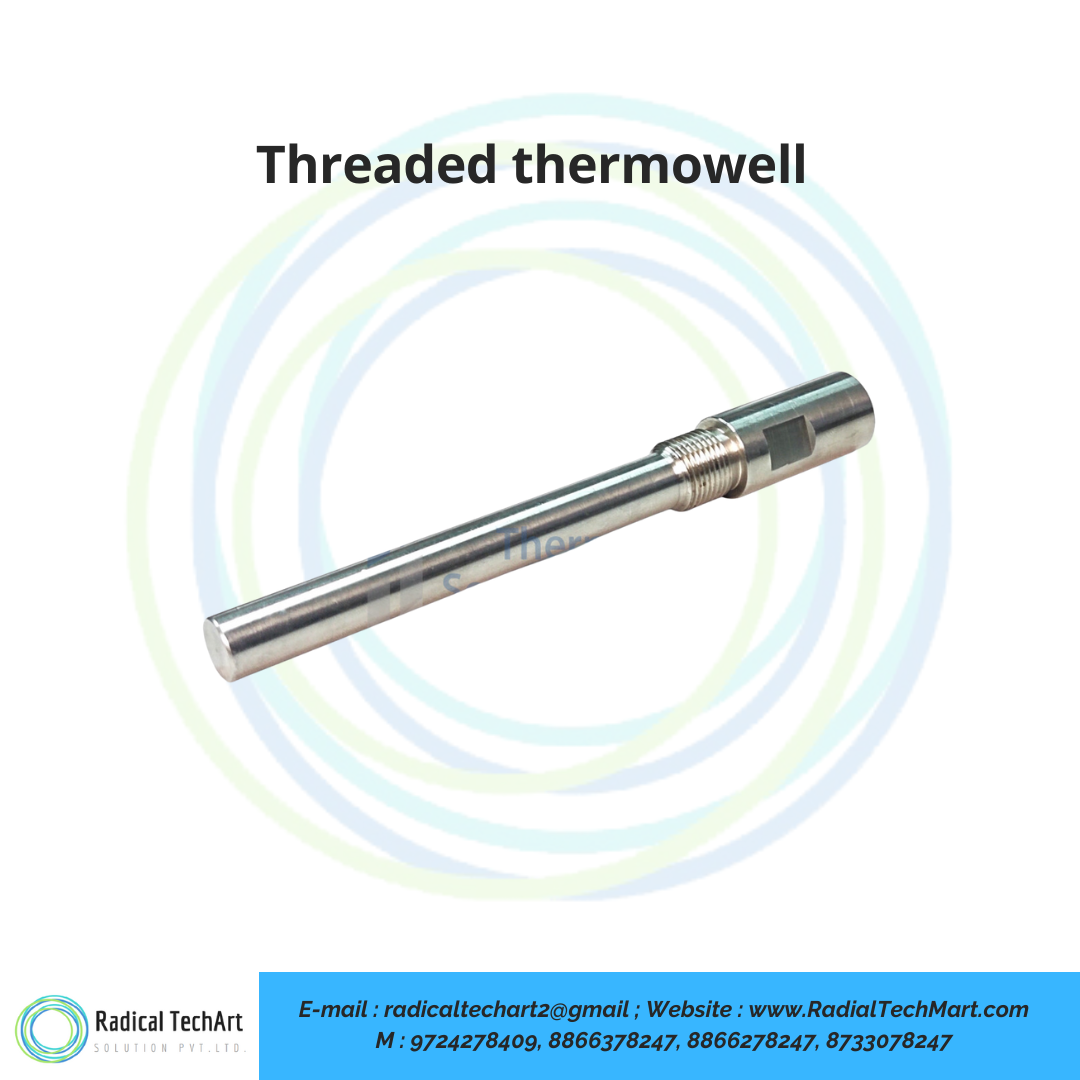
Threaded Thermowell for RTD and Thermocouple Sensors
Threaded thermowell is a stainless steel protective fitting used to protect RTD, thermocouple and temperature sensors from pressure, flow, corrosion and harsh process media while allowing accurate temperature measurement in industrial applications.
Customize
Share :
A. Product Overview
A threaded thermowell is an industrial temperature measurement accessory used to protect temperature sensors such as RTD sensors, thermocouples and temperature probes from direct contact with process media.
It is installed into a threaded opening on a pipe, tank, vessel or process equipment. The temperature sensor is inserted inside the thermowell, allowing it to measure process temperature safely without being exposed directly to pressure, vibration, corrosive fluids or high flow conditions.
Threaded thermowells are commonly made from stainless steel materials such as SS304, SS316 and SS316L. They are available in different process connections, shank styles, insertion lengths and probe diameters depending on the application requirement.
Common options include:
Process connection: 1/2 BSP, 1/2 NPT and 3/4 BSP
Female thread: 1/4 BSP, 3/8 BSP, 1/2 BSP, 3/4 BSP, 1/2 NPT and 3/4 NPT
Shank style: Stepped, straight and tapered
Material: SS304, SS316 and SS316L
Insertion length: As per application requirement
Probe diameter: 10 mm, 12 mm, 14 mm and 16 mm
B. Working Principle
The threaded thermowell works as a protective barrier between the process media and the temperature sensor.
First, the thermowell is screwed into a threaded process connection on a pipe, tank or vessel. After installation, the RTD sensor, thermocouple or temperature probe is inserted into the internal bore of the thermowell.
The process fluid transfers heat to the metal body of the thermowell. This heat is then transferred to the temperature sensor placed inside the thermowell. The sensor reads the temperature without coming into direct contact with the process fluid.
This design helps the sensor measure temperature accurately while remaining protected from mechanical damage, chemical attack, pressure and flow impact.
C. Why It Is Used
Threaded thermowells are used to improve the safety, reliability and service life of temperature measurement systems.
They are mainly used because they protect temperature sensors from harsh process conditions. In many industrial applications, the process media may be hot, pressurized, corrosive, viscous or fast-moving. Direct exposure can damage the sensor or reduce its accuracy.
Another major advantage is easy maintenance. Since the temperature sensor is installed inside the thermowell, it can be removed, replaced or calibrated without shutting down the process or draining the system.
Threaded thermowells are also preferred where flange-type installation is not practical, especially in smaller pipelines, compact systems and applications where space is limited.
D. Suitable Buyers
Threaded thermowells are suitable for buyers who need safe and reliable temperature measurement in industrial process applications.
They are commonly required by:
Industrial automation companies
Process instrumentation engineers
Chemical plants
Pharmaceutical plants
Food and beverage industries
Oil and gas industries
Water treatment plants
HVAC system manufacturers
Boiler and heating system manufacturers
OEM machine builders
Panel builders
Maintenance departments
Temperature sensor manufacturers
System integrators
Power plants
Dairy and beverage processing plants
Refinery and petrochemical plants
FAQ
1. What is a threaded thermowell?
A threaded thermowell is a protective metal tube installed into a process line, tank or vessel to protect temperature sensors such as RTD sensors and thermocouples from harsh process conditions.
2. Why is a thermowell used with temperature sensors?
A thermowell is used to protect the temperature sensor from pressure, corrosion, vibration, high flow and mechanical damage while allowing accurate temperature measurement.
3. Can a sensor be removed without stopping the process?
Yes. One of the main benefits of using a threaded thermowell is that the temperature sensor can be removed, replaced or calibrated without disturbing the process line.
4. Which sensors can be used with threaded thermowells?
Threaded thermowells are commonly used with RTD sensors, thermocouples, temperature probes and industrial thermometers.
5. Which materials are available for threaded thermowells?
Common materials include SS304, SS316 and SS316L. The material is selected based on process temperature, pressure, corrosion level and media compatibility.
6. What are the common shank styles in threaded thermowells?
The common shank styles are straight shank, stepped shank and tapered shank. Each style is selected based on response time, strength and process flow conditions.
7. Where are threaded thermowells used?
They are used in chemical plants, food processing plants, pharmaceutical plants, water treatment systems, oil and gas plants, boilers, HVAC systems and general process industries.
8. What is the difference between threaded and flanged thermowell?
A threaded thermowell is screwed directly into a threaded connection, while a flanged thermowell is mounted using a flange. Threaded thermowells are commonly used in smaller pipelines and compact installations.
9. How do I select the right threaded thermowell?
Selection depends on process connection size, female thread size, insertion length, shank style, material, probe diameter, pressure, temperature and type of process media.
10. Is SS316 better than SS304 for thermowells?
SS316 offers better corrosion resistance than SS304, especially in chemical, marine and corrosive process environments. SS304 is suitable for general industrial applications.