

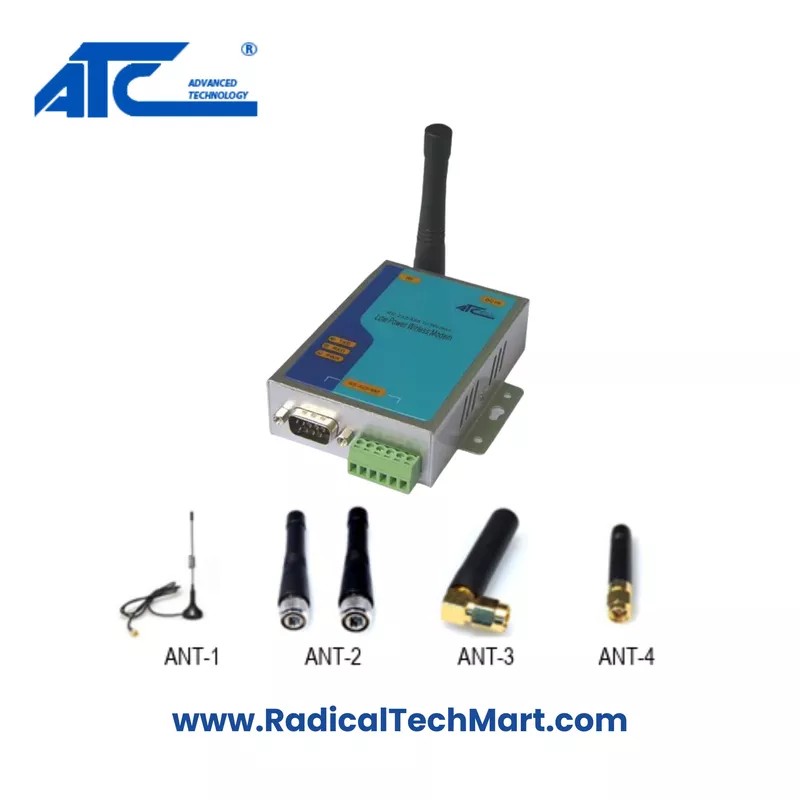
ATC-863 / ATC-871 / ATC-873 / ATC-875 RF Data Converter Modules
ATC-863 / ATC-871 / ATC-873 / ATC-875 RF Data Converter Modules
Industrial RF data converter modules with RS-232/RS-485/TTL interfaces and wireless range from 300 m to 2 km. Ideal for point-to-point and point-to-multipoint SCADA, RTU, and automation communication at 9600 bps.
Customize
Share :
The ATC-863 / ATC-871 / ATC-873 / ATC-875 RF Data Converter Series are industrial wireless transmission modules designed to convert RS-232/RS-485/TTL serial data into long-range RF communication. With ranges from 300 m to 2 km (line-of-sight) and a standard 9600 bps baud rate, these modules are ideal for RTU, SCADA, PLC, and distributed automation systems requiring reliable wireless serial links.
They support half-duplex communication and point-to-point, point-to-multipoint, and multipoint-to-point networking. The RF channel itself is transparent to the user, simplifying upgrades from wired RS-232/485/TTL communication to wireless solutions.
Key Features (Bulleted)
RF serial data converter series: ATC-863 / ATC-871 / ATC-873 / ATC-875
Supports RS-232, RS-485, and TTL/UART interfaces
Standard baud rate: 9600 bps
Wireless range (line-of-sight):
ATC-863: >300 m
ATC-871: >500 m
ATC-873: >1000 m
ATC-875: up to ~2 km
Operates using FSK/GFSK modulation with low bit error rate
Half-duplex RF channel, suitable for point-to-multipoint networks
Transparent data transmission – no change to upper-layer protocol
Supports point-to-point, point-to-many, and many-to-point communication
Carrier frequency 433 MHz (other options 315/868/915 MHz on request)
Optional I/O ports and external antenna support
Low-power RF data transmission for industrial applications
Technical Specifications (Table)
| Parameter | Value |
|---|---|
| Series Models | ATC-863 / ATC-871 / ATC-873 / ATC-875 |
| Function | RF Serial Data Converter / RF Modem |
| Interfaces | RS-232 / RS-485 / TTL (UART) |
| Baud Rate | 9600 bps (typical) |
| RF Modulation | FSK / GFSK |
| Carrier Frequency | 433 MHz (315/868/915 MHz available on request) |
| Communication Mode | Half-duplex |
| Network Types | Point-to-point, point-to-multipoint, multipoint-to-point |
| Line-of-Sight Range | 300 m (863), 500 m (871), 1 km (873), 2 km (875) |
| Power Supply | Adapter included (DC, model dependent) |
| Distance Range (Series) | 500–1500 m typical, up to 2 km max |
| Operating Use | Wireless serial data communication |
| Storage / Weight | Approx. 200 g per module |
| Warranty | 1 Year |
| Brand | ATC |
| Status | In Stock |
(Where exact missing values exist, treat as generic industrial specs and keep text conservative.)
Applications (Bulleted)
SCADA and RTU wireless communication
Wireless PLC networking and telemetry
Remote monitoring and data acquisition systems
Wireless sensor networks and I/O expansion
Upgrading wired RS-232/485/TTL links to wireless
Point-to-multipoint control in industrial automation
Building management systems and utility monitoring
What’s in the Box
1× RF Data Converter Module (ATC-863 / 871 / 873 / 875 – as ordered)
1× Power adapter (as per model)
1× User/installation guide
1× Antenna (if supplied with model)
FAQ (4–6 Q&A)
1) What is the main difference between ATC-863, 871, 873, and 875?
The primary difference is wireless communication distance:
ATC-863: >300 m
ATC-871: >500 m
ATC-873: >1000 m
ATC-875: up to 2 km (line-of-sight)
2) Which serial interfaces are supported?
The ATC RF series supports RS-232, RS-485, and TTL/UART interfaces, allowing direct connection with PCs, PLCs, RTUs, and microcontroller-based systems.
3) Can these modules work in point-to-multipoint networks?
Yes. The RF channel is half-duplex and supports point-to-point, point-to-multipoint, and multipoint-to-point communication, controlled by the upper-layer protocol and addressing.
4) What is the typical baud rate for communication?
The standard baud rate is 9600 bps, suitable for most industrial data acquisition and control applications.
5) Are these modules suitable for upgrading from wired RS-232/485?
Yes. The modules are designed for transparent transmission, so existing RS-232/RS-485/TTL protocols can be shifted from wired to wireless with minimal changes.
6) What frequency do these modules use?
The standard carrier frequency is 433 MHz, with options for 315 / 868 / 915 MHz available on request.