

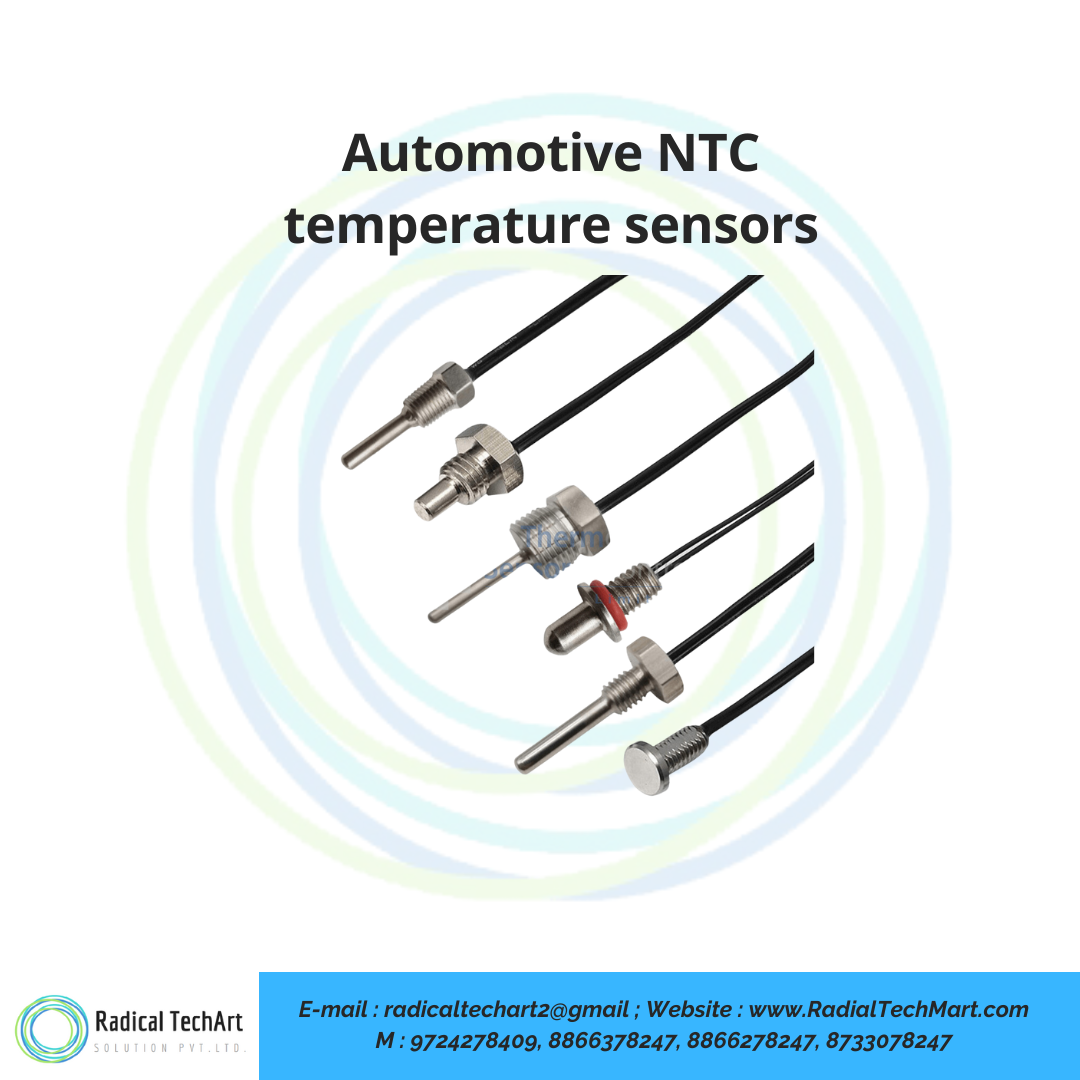
Automotive NTC Temperature Sensors
Automotive NTC temperature sensors are compact thermistor based sensors used for accurate temperature measurement in engine coolant, intake air, ambient air, oil, transmission, and battery monitoring applications. They are suitable for ECU based automotive systems where fast response, high sensitivity, and reliable performance are required.
Customize
Share :
A. Product Overview
An Automotive NTC Temperature Sensor is a temperature measuring sensor specially designed for vehicle applications. NTC stands for Negative Temperature Coefficient, which means the sensor resistance decreases when temperature increases.
These sensors are commonly used in automotive systems to monitor engine coolant temperature, intake air temperature, ambient temperature, oil temperature, transmission temperature, and battery temperature. Because of their small size, high sensitivity, and fast response, NTC temperature sensors are widely used in modern vehicles, electric vehicles, hybrid vehicles, and automotive electronic control systems.
Automotive NTC sensors are designed to withstand harsh working conditions such as vibration, heat, moisture, chemicals, and engine compartment contamination. They are often protected with epoxy potting, metal housings, threaded probes, or sealed cable assemblies to improve durability and heat transfer.
B. Working Principle
An automotive NTC temperature sensor works on the resistance change principle. The sensor contains an NTC thermistor element whose resistance changes according to temperature.
When the temperature increases, the resistance of the NTC thermistor decreases. When the temperature decreases, the resistance increases. This resistance change is measured by an ECU, controller, Wheatstone bridge, voltage divider circuit, or other signal conditioning circuit.
For example, many NTC thermistors have a resistance value of 10,000 ohms at 25°C, which is commonly known as a 10K NTC thermistor. Based on the resistance value, the control system calculates the actual temperature and uses it for monitoring, control, or safety functions.
In vehicles, this temperature signal helps the ECU control fuel injection, cooling fan operation, engine performance, emission control, battery safety, and other temperature dependent functions.
C. Why It Is Used
Automotive NTC temperature sensors are used because temperature monitoring is critical for vehicle performance, safety, and efficiency.
They help measure engine coolant temperature, intake air temperature, ambient air temperature, oil temperature, transmission fluid temperature, and battery temperature. This allows the ECU and control system to take correct decisions based on real time temperature data.
These sensors are preferred because they are compact, sensitive, cost effective, reliable, and suitable for harsh automotive environments. They offer fast temperature response and can be easily integrated into different vehicle systems.
In automotive applications, accurate temperature measurement helps prevent overheating, improves engine efficiency, supports emission control, protects batteries, and ensures stable performance of vehicle electronics.
D. Suitable Buyers
Automotive NTC temperature sensors are suitable for:
Automotive OEM manufacturers
Automotive spare parts manufacturers
Engine and vehicle testing companies
Electric vehicle manufacturers
Battery pack manufacturers
Automotive sensor manufacturers
ECU and control system manufacturers
Automotive wiring harness manufacturers
Automotive maintenance and service companies
Industrial automation companies working with vehicle systems
Automotive research and development labs
Suppliers of customized temperature sensor assemblies
These sensors are also suitable for companies looking for customized NTC probes, threaded temperature sensors, cable type NTC sensors, sealed NTC sensors, and compact automotive temperature sensing solutions.
FAQ
1. What is an Automotive NTC Temperature Sensor?
An Automotive NTC Temperature Sensor is a thermistor based temperature sensor used in vehicles to measure temperature in engine, air, oil, transmission, coolant, ambient, and battery applications.
2. What does NTC mean?
NTC means Negative Temperature Coefficient. It means the sensor resistance decreases when the temperature increases.
3. Where are automotive NTC temperature sensors used?
They are commonly used in engine coolant temperature sensing, intake air temperature sensing, ambient temperature sensing, oil temperature monitoring, transmission temperature monitoring, and battery temperature monitoring.
4. Why are NTC sensors used in vehicles?
NTC sensors are used because they are small, accurate, sensitive, reliable, and suitable for harsh automotive conditions such as heat, vibration, moisture, and chemical exposure.
5. What is a 10K NTC thermistor?
A 10K NTC thermistor has a resistance of 10,000 ohms at 25°C. It is one of the most commonly used thermistor values in temperature sensing applications.
6. How does an NTC temperature sensor work?
The sensor changes its resistance according to temperature. The ECU or control circuit reads this resistance and converts it into a temperature value.
7. Can automotive NTC sensors be used in electric vehicles?
Yes, automotive NTC sensors are suitable for electric vehicles and hybrid vehicles. They are used in battery packs, motor systems, charging systems, and thermal management systems.
8. Are these sensors suitable for harsh environments?
Yes, automotive NTC temperature sensors are designed to handle vibration, high temperature, moisture, chemicals, and contamination commonly found in vehicle environments.
9. What package styles are available?
Automotive NTC temperature sensors are available in cable type, threaded probe, surface mount, through hole, leaded, epoxy coated, metal housing, and customized assemblies.
10. Can these sensors be customized?
Yes, automotive NTC temperature sensors can be customized based on resistance value, cable length, housing material, probe size, connector type, mounting style, and application requirement.