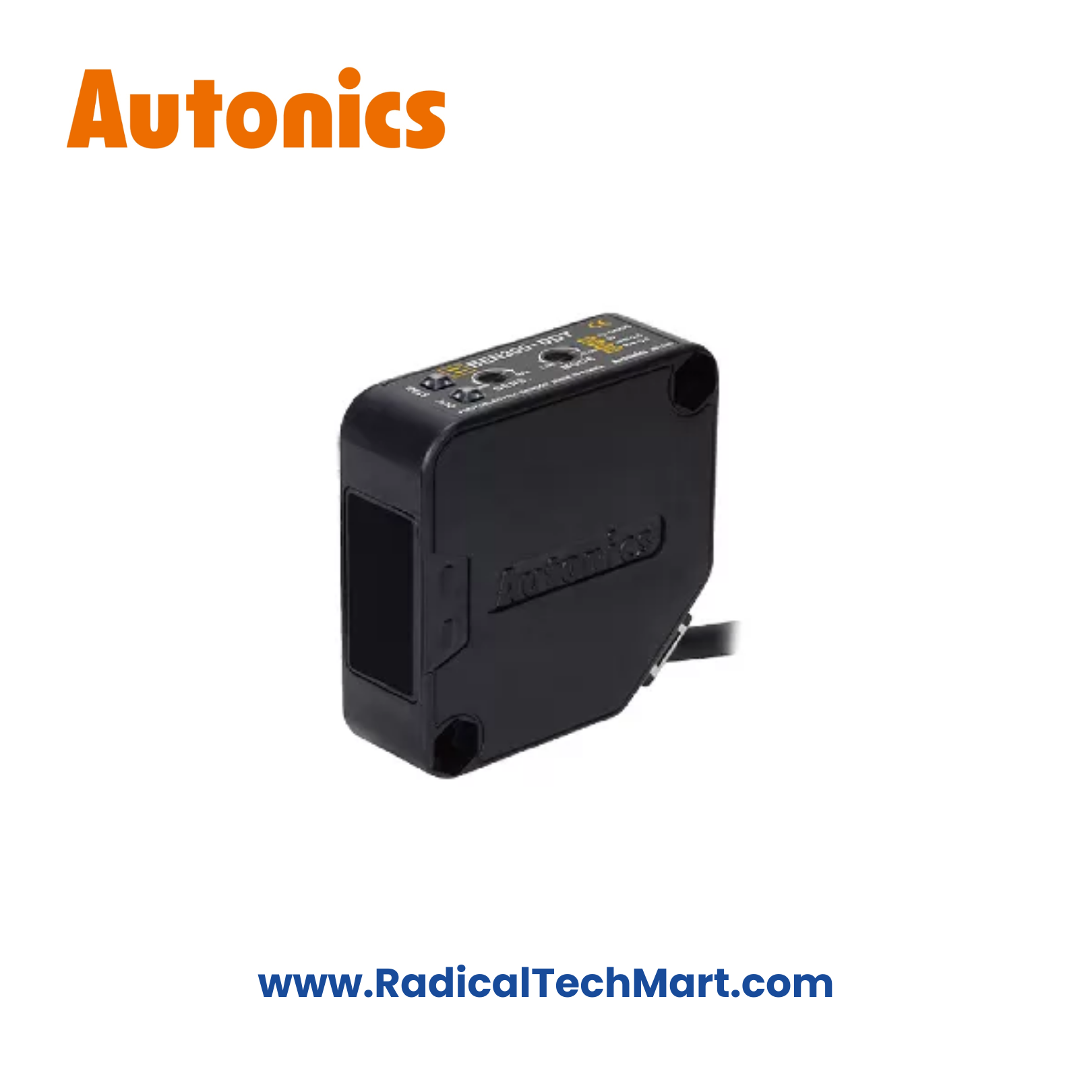
The Autonics BEN300-DFR is a retro-reflective photoelectric sensor designed for short-range, stable object detection using a reflector. With a 300 mm sensing distance, fast response time, and NPN/PNP transistor output, it is well suited for compact automation machines, conveyors, and packaging equipment where through-beam installation is not feasible.
Key Features
Retro-reflective sensing type (sensor + reflector)
Sensing distance up to 300 mm
DC power, solid-state transistor output
NPN & PNP open-collector outputs
Light-ON / Dark-ON selectable
Fast response time (≤ 1 ms)
High immunity to ambient light interference
Robust housing for industrial use
Technical Specifications
| Parameter | Specification |
|---|
| Model | BEN300-DFR |
| Sensing Type | Retro-reflective |
| Sensing Distance | Up to 300 mm |
| Light Source | Infrared LED |
| Output Type | NPN & PNP open-collector |
| Output Mode | Light-ON / Dark-ON |
| Response Time | ≤ 1 ms |
| Supply Voltage | 12–24 VDC ±10% |
| Load Current | ≤ 200 mA |
| Protection Rating | IP50 |
| Operating Temperature | −20 to +65 °C |
Applications
Packaging machines
Conveyor object detection
Counting & positioning systems
Material handling equipment
OEM automation machines
Short-distance sensing applications
What’s in the Box?
FAQ
Q1. What type of sensor is BEN300-DFR?
It is a retro-reflective photoelectric sensor that works with a reflector.
Q2. What is the maximum sensing distance?
Up to 300 mm, depending on reflector size and alignment.
Q3. Does it support both NPN and PNP outputs?
Yes, it provides NPN & PNP open-collector outputs.
Q4. Is this suitable for high-speed detection?
Yes, with a ≤ 1 ms response time, it works well in fast automation lines.
Q5. When should I choose retro-reflective over diffuse?
Retro-reflective sensors offer more stable detection and are preferred when reflectors can be installed.