

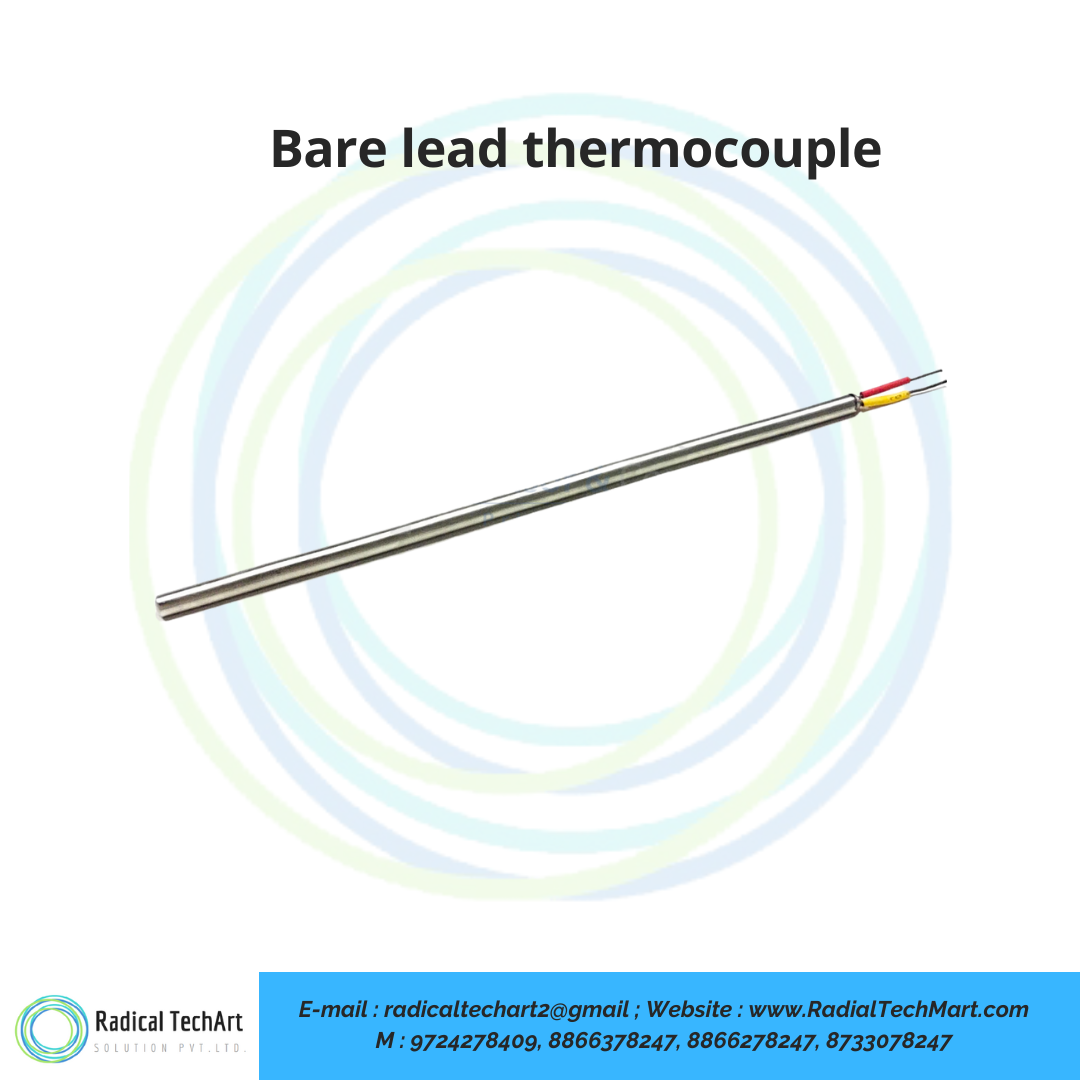
Bare Lead Type K Thermocouple Sensor
Bare Lead Thermocouple is a high-temperature temperature sensor designed for fast and accurate temperature measurement in industrial heating, furnace, boiler, oven, kiln, and process applications. Its exposed measuring end provides quick response, making it suitable for applications where insulation may melt or degrade.
Customize
Share :
A. Product Overview
A Bare Lead Thermocouple is a temperature sensing device used to measure high temperatures in industrial processes. It is generally used where normal insulated thermocouples may fail due to heat, wear, or insulation damage.
In this type of thermocouple, the sensing tip is exposed, which helps it detect temperature changes quickly. Because of this fast response, bare lead thermocouples are widely used in high-temperature machines, heating systems, furnaces, ovens, boilers, and process equipment.
This thermocouple is available in different probe diameters such as 4 mm, 6 mm, and 8 mm. It can be supplied with different thread connections such as 1/8 inch, 1/4 inch, 3/8 inch, 1/2 inch, and 3/4 inch BSP or NPT. Common sheath material options include SS316, SS310, and Inconel, depending on the temperature and process condition.
B. Working Principle
A Bare Lead Thermocouple works on the thermoelectric principle. It consists of two different metal wires joined at one end to form a measuring junction.
When this junction is exposed to heat, it generates a small voltage. This voltage changes according to the temperature. The thermocouple wires are connected to a temperature indicator, controller, transmitter, or data logger. The instrument reads the voltage and converts it into a temperature value based on the thermocouple type.
For example, a Type K bare lead thermocouple can measure high temperatures and is commonly used in industrial applications. The exposed junction helps in fast temperature sensing because the measuring point comes directly in contact with the process temperature.
C. Why It Is Used
Bare Lead Thermocouples are used because they provide fast response and reliable temperature measurement in high-temperature environments.
They are useful when insulation on normal thermocouple wires may melt, burn, or degrade due to extreme heat. The exposed measuring tip allows direct temperature sensing, which improves response time and accuracy in many industrial heating applications.
These thermocouples are commonly used in:
Furnaces
Boilers
Industrial ovens
Kilns
Heat treatment plants
Plastic machinery
Metal processing
Foundry applications
Dryers
High-temperature process equipment
However, bare lead thermocouples should not be used in applications where there is a risk of electrical shock, moisture exposure, short circuit, or direct contact with conductive surfaces.
D. Suitable Buyers
Bare Lead Thermocouple is suitable for buyers who need high-temperature and fast-response temperature measurement.
Suitable buyers include:
Furnace manufacturers
Boiler manufacturers
Industrial oven manufacturers
Heat treatment plants
Plastic machinery manufacturers
Foundry industries
Metal processing plants
Maintenance engineers
Instrumentation engineers
Panel builders
OEM machine manufacturers
Process automation companies
Temperature control system suppliers
Industrial heater manufacturers
This product is especially useful for industries where temperature monitoring and control are important for safety, process quality, and equipment performance.
FAQ
1. What is a Bare Lead Thermocouple?
A Bare Lead Thermocouple is a temperature sensor with an exposed measuring end. It is used for measuring temperature in high-temperature industrial applications where insulated sensors may not be suitable.
2. Where is a Bare Lead Thermocouple used?
It is used in furnaces, boilers, ovens, kilns, heat treatment plants, plastic machinery, foundries, dryers, and industrial heating systems.
3. Why does a Bare Lead Thermocouple give fast response?
The measuring junction is exposed, so it directly senses the process temperature. This helps the thermocouple respond quickly to temperature changes.
4. Which thermocouple type is commonly used in bare lead thermocouples?
Type K is commonly used because it offers a wide temperature range and is suitable for many industrial high-temperature applications.
5. What is the temperature range of a Bare Lead Thermocouple?
The temperature range depends on the thermocouple type and sheath material. Type K bare lead thermocouples can be used up to around 1200°C in suitable conditions.
6. What sheath materials are available?
Common sheath materials include SS316, SS310, and Inconel. The selection depends on the temperature, atmosphere, corrosion level, and process condition.
7. What junction types are available?
Bare lead thermocouples can be supplied with exposed, grounded, and ungrounded junctions. Exposed junctions offer the fastest response, while grounded and ungrounded junctions are selected based on electrical isolation and process needs.
8. Is a Bare Lead Thermocouple suitable for moisture areas?
No. Bare lead thermocouples are generally not recommended where there is moisture, water exposure, electrical shock risk, or short circuit possibility.
9. Can it be connected to a temperature controller?
Yes. A bare lead thermocouple can be connected to a temperature controller, indicator, transmitter, scanner, or data logger that supports the same thermocouple type.
10. How do I select the right Bare Lead Thermocouple?
Select the thermocouple based on temperature range, thermocouple type, probe diameter, thread connection, sheath material, junction type, process environment, and required response time.