

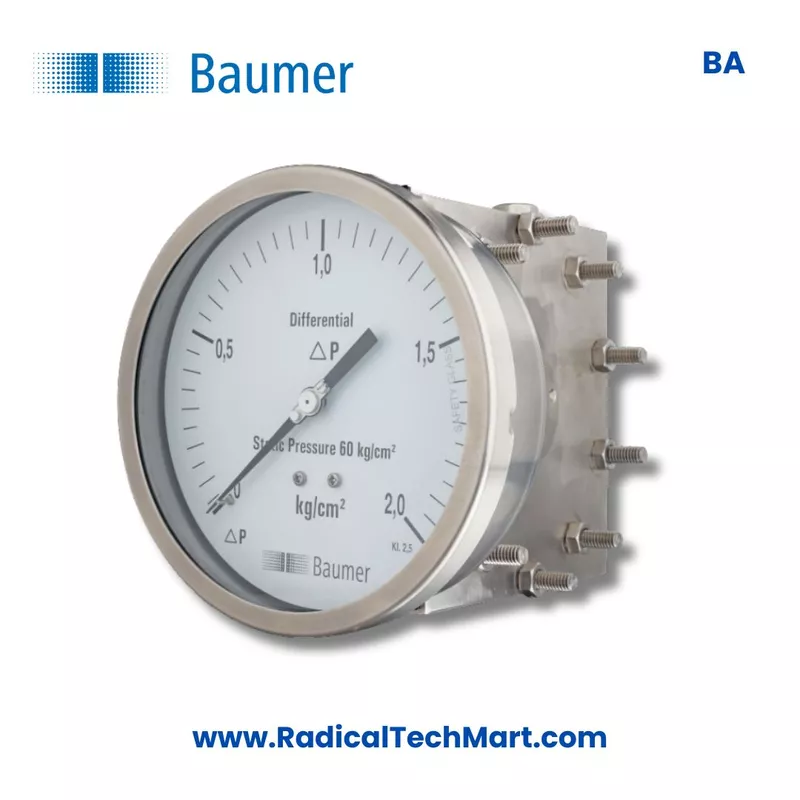


Baumer BA Differential Pressure Gauge with Electrical Contacts
Baumer BA differential pressure gauge with electrical contacts is a stainless steel industrial gauge designed for measuring differential pressure in process applications. It is available in DN 100 and 150 mm dial sizes, with IP65 protection, EN 837-3 compliance, and optional CE approved electrical contacts for alarm and switching applications.
Customize
Share :
A. Product Overview
The Baumer BA differential pressure gauge is designed for accurate differential pressure measurement in industrial systems where two pressure points need to be compared. It is suitable for monitoring pressure difference across filters, pumps, pipelines, tanks, process equipment, and flow systems.
This gauge is available with DN 100 and DN 150 mm dial sizes and supports pressure ranges from 600 mmWC to 4000 mmWC and above. The static pressure capacity depends on the selected range, with 10 kg/cm2, 40 kg/cm2, and 60 kg/cm2 options. It comes with accuracy class 2.5 ascending and is built with an AISI 304 stainless steel bayonet case.
The sensing element is available in AISI 304 SS, AISI 316L SS, and AISI 316 SS, with optional Monel for demanding media. The process connection material is AISI 316L SS, also available with optional Monel. Standard process connection is 1/4 inch NPT female in two numbers. Mounting types 1, 2, 6, and 12 are available. The gauge has IP65 protection and follows EN 837-3 standards. CE approved electrical contacts are available as an option for signal, alarm, and control functions.
B. Working Principle
The Baumer BA differential pressure gauge works by sensing the pressure difference between two separate pressure ports. One port is connected to the high pressure side and the other port is connected to the low pressure side of the process.
When there is a pressure difference between the two points, the internal sensing element deflects according to the differential pressure. This movement is mechanically transferred to the pointer mechanism, which displays the differential pressure value on the dial.
In models with electrical contacts, the contact mechanism can be set at a desired pressure point. When the pointer reaches the set value, the electrical contact operates and can trigger an alarm, signal, shutdown, or control action. This makes the gauge useful not only for visual indication but also for process monitoring and safety interlocking.
C. Why It Is Used
The Baumer BA differential pressure gauge is used to monitor and control pressure difference in industrial processes. It helps operators understand whether equipment is working within the required pressure limits.
Common reasons for using this gauge include filter clogging detection, flow monitoring, pump performance checking, level indication in pressurized vessels, and process pressure comparison. The electrical contact option makes it useful where a warning or switching signal is required when differential pressure crosses a set limit.
Its stainless steel construction, IP65 protection, and optional Monel wetted parts make it suitable for demanding industrial environments. The EN 837-3 standard ensures reliable design and performance for differential pressure measurement applications.
D. Suitable Buyers
The Baumer BA differential pressure gauge is suitable for purchase managers, maintenance engineers, instrumentation engineers, utility engineers, project engineers, and plant operators who require reliable differential pressure measurement with optional electrical contact output.
It is suitable for industries such as chemical, pharmaceutical, petrochemical, power, water treatment, food processing, cement, sugar, HVAC, filtration systems, boiler systems, process plants, and general industrial automation.
This product is also suitable for OEMs, system integrators, panel builders, EPC contractors, MRO teams, and resellers dealing in pressure instruments and process control products.
FAQ
1. What is the Baumer BA differential pressure gauge used for?
The Baumer BA differential pressure gauge is used to measure the pressure difference between two points in a process system. It is commonly used for filter monitoring, pump monitoring, flow indication, tank level applications, and process equipment protection.
2. What dial sizes are available in Baumer BA differential pressure gauge?
The Baumer BA differential pressure gauge is available in DN 100 mm and DN 150 mm dial sizes.
3. What is the pressure range of the Baumer BA differential pressure gauge?
The pressure ranges include 600 mmWC with static pressure 10 kg/cm2, 1000 to 2500 mmWC with static pressure 40 kg/cm2, and 4000 mmWC and above with static pressure 60 kg/cm2.
4. What is the accuracy class of this gauge?
The Baumer BA differential pressure gauge has accuracy class 2.5 ascending.
5. What material is used in the case of the gauge?
The case is made from AISI 304 stainless steel with a bayonet type design.
6. What sensing element materials are available?
The sensing element is available in AISI 304 SS, AISI 316L SS, and AISI 316 SS. Monel is also available as an optional material for special applications.
7. What is the process connection of Baumer BA differential pressure gauge?
The standard process connection is 1/4 inch NPT female in two numbers. The process connection material is AISI 316L SS, with optional Monel.
8. Does this gauge come with electrical contacts?
Yes, CE approved electrical contacts are available as an option. These contacts can be used for alarm, switching, and control applications.
9. What is the protection class of this gauge?
The Baumer BA differential pressure gauge has IP65 protection, making it suitable for industrial environments with dust and water spray exposure.
10. Which standard does this gauge follow?
The gauge follows EN 837-3, which is the standard for diaphragm and capsule pressure gauges.
11. What mounting options are available?
The gauge is available with mounting types 1, 2, 6, and 12, depending on the installation requirement.
12. Which industries can use the Baumer BA differential pressure gauge?
It can be used in chemical plants, pharmaceutical plants, petrochemical plants, power plants, water treatment plants, HVAC systems, food processing plants, filtration systems, and general process industries.