

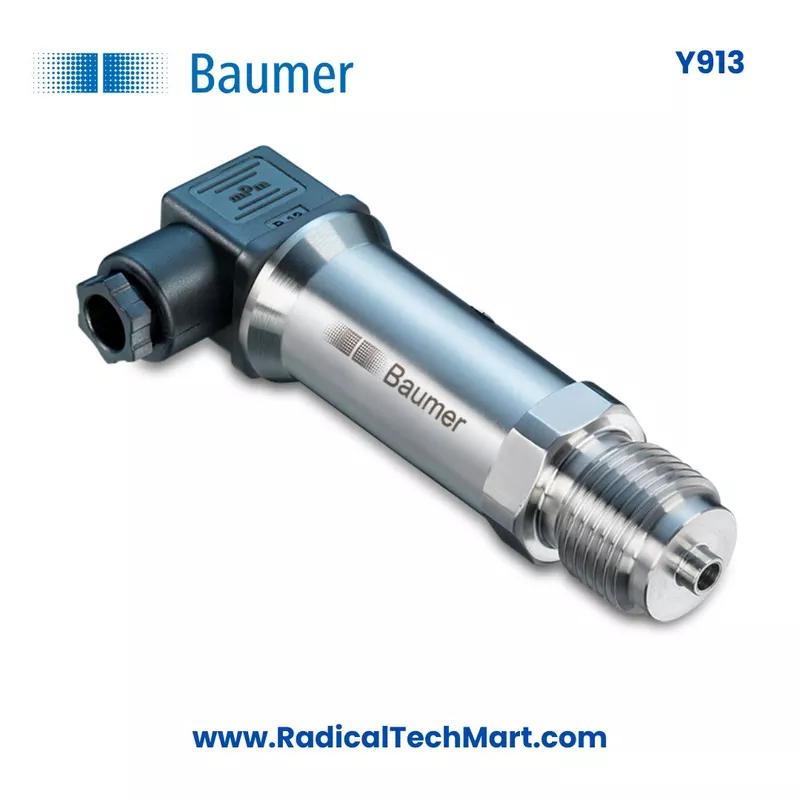


Baumer Y913 Process Pressure Transmitter
Baumer Y913 Process Pressure Transmitter is a robust industrial pressure sensor designed for accurate pressure measurement in chemical, pneumatic, energy and industrial gas applications. It is available with stainless steel housing, ceramic membrane, multiple pressure ranges, 4 to 20 mA or voltage output options and an intrinsically safe ATEX version for hazardous area applications.
Download the Datasheet here!!
Customize
Share :
A. Product Overview
The Baumer Y913 Process Pressure Transmitter is a compact and reliable pressure measurement device used for monitoring absolute and relative gauge pressure in industrial process applications. It is part of the Baumer Y91 pressure sensor configurator range and is suitable for applications where stable, accurate and durable pressure measurement is required.
The transmitter comes with a robust stainless steel housing and AISI 316L wetted process connection for better resistance in demanding industrial environments. It uses a ceramic 96 percent aluminium oxide membrane for pressure sensing and supports measuring ranges from vacuum and low pressure up to high pressure applications.
The Baumer Y913 is available with output signals such as 4 to 20 mA, 0 to 10 V and 1 to 5 V, making it suitable for connection with PLCs, controllers, indicators, data loggers and automation systems. It also supports multiple process connections including BSP and NPT options, helping users select the correct model based on site requirement.
Key features include:
Robust stainless steel housing
Intrinsically safe ATEX version available
Suitable for chemical, pneumatic, energy and industrial gas applications
Absolute and relative gauge pressure measurement
Measuring range from -1 to 600 bar depending on configuration
4 to 20 mA, 0 to 10 V and 1 to 5 V output options
Ceramic membrane for reliable sensing
AISI 316L process connection
IP65 and IP67 protection options
Fast response time for process monitoring
Compact transmitter design for easy installation
B. Working Principle
The Baumer Y913 Process Pressure Transmitter works by converting applied process pressure into a proportional electrical output signal. The process pressure acts on the ceramic sensing membrane. When pressure is applied, the membrane experiences a small mechanical deflection.
This deflection is detected by the internal sensing element and converted into an electrical signal. The transmitter electronics then process and condition this signal to provide a standard industrial output such as 4 to 20 mA, 0 to 10 V or 1 to 5 V.
For automation systems, the output signal represents the actual process pressure. For example, in a 4 to 20 mA configuration, the lower pressure value is represented by 4 mA and the maximum pressure value is represented by 20 mA. This signal can be used by PLCs, indicators, controllers, recorders and monitoring systems for pressure display, control and alarm functions.
Because the Y913 is available in absolute and relative gauge pressure versions, it can be selected according to the measurement requirement. Relative gauge pressure is commonly used for process lines and industrial systems, while absolute pressure is used where pressure must be measured against absolute vacuum reference.
C. Why It Is Used
The Baumer Y913 Process Pressure Transmitter is used to monitor, control and protect industrial processes where pressure measurement is critical. In many plants, pressure directly affects safety, machine performance, product quality and process efficiency. A reliable pressure transmitter helps operators and automation systems take timely action based on real-time pressure values.
It is used because it provides accurate pressure measurement, fast response and strong mechanical construction. The stainless steel housing and AISI 316L wetted parts make it suitable for demanding industrial environments. The ceramic membrane offers stable sensing performance across multiple pressure ranges.
The intrinsically safe ATEX version makes it suitable for hazardous areas where explosive gas or dust atmospheres may be present. This makes the Y913 useful in chemical plants, gas systems, energy applications and industrial process installations.
Main reasons for using Baumer Y913 include:
To measure process pressure accurately
To send pressure signal to PLC, controller or indicator
To improve process monitoring and control
To protect machines and pipelines from overpressure or vacuum conditions
To support safe operation in hazardous area applications with ATEX version
To monitor gas, air, hydraulic and process pressure lines
To reduce manual inspection and improve automation reliability
To maintain stable operation in chemical, pneumatic and energy systems
D. Suitable Buyers
The Baumer Y913 Process Pressure Transmitter is suitable for buyers who need reliable pressure measurement for industrial automation, process control and safety monitoring.
Suitable buyers include:
Chemical plant operators
Pneumatic system manufacturers
Industrial gas system users
Energy and power plant maintenance teams
OEM machine manufacturers
Panel builders and automation system integrators
Instrumentation engineers
Maintenance engineers
Process industry purchase teams
Gas line and compressed air system users
PLC and SCADA automation users
Industrial equipment manufacturers
Distributors and resellers of pressure instruments
Hazardous area equipment buyers
Industrial project contractors
This product is especially suitable for users looking for a Baumer pressure transmitter with configurable pressure range, electrical output, process connection and intrinsically safe option.
FAQ
1. What is the Baumer Y913 Process Pressure Transmitter used for?
The Baumer Y913 Process Pressure Transmitter is used for measuring and transmitting pressure values in industrial applications such as chemical processes, pneumatic systems, energy plants and industrial gas systems.
2. What pressure range is available in Baumer Y913?
The Baumer Y913 is available in multiple pressure ranges depending on configuration. The range covers vacuum, low pressure and high pressure options up to 600 bar.
3. Does Baumer Y913 support 4 to 20 mA output?
Yes, the Baumer Y913 is available with 4 to 20 mA current output. Voltage output options such as 0 to 10 V and 1 to 5 V are also available depending on configuration.
4. Is Baumer Y913 suitable for hazardous areas?
Yes, an intrinsically safe ATEX version is available for hazardous area applications. The correct version must be selected according to the required zone and safety approval.
5. What is the housing material of Baumer Y913?
The Baumer Y913 comes with a robust stainless steel housing, making it suitable for industrial environments.
6. What is the wetted part material of the process connection?
The wetted process connection material is AISI 316L stainless steel, which provides good compatibility for many industrial process media.
7. Which sensing membrane is used in the Baumer Y913?
The Baumer Y913 uses a ceramic membrane made from 96 percent aluminium oxide for reliable pressure sensing.
8. Can Baumer Y913 be connected to PLC systems?
Yes, the transmitter can be connected to PLCs, controllers, indicators, recorders and SCADA systems using standard analog output signals such as 4 to 20 mA or voltage output.
9. What process connections are available?
The Baumer Y913 supports multiple process connection options including G 1/4, G 1/2, 1/4 inch NPT and 1/2 inch NPT, depending on the selected configuration.
10. What is the protection rating of Baumer Y913?
The Baumer Y913 is available with IP65 and IP67 protection options, depending on electrical connection and configuration.
11. Is Baumer Y913 suitable for gas pressure measurement?
Yes, the Baumer Y913 is suitable for industrial gas applications as well as pneumatic and process pressure applications.
12. Why should I choose Baumer Y913 for process pressure measurement?
You should choose Baumer Y913 when you need a reliable, configurable and industrial-grade pressure transmitter with stainless steel housing, ceramic sensing membrane, standard output signals and ATEX option for hazardous areas.