

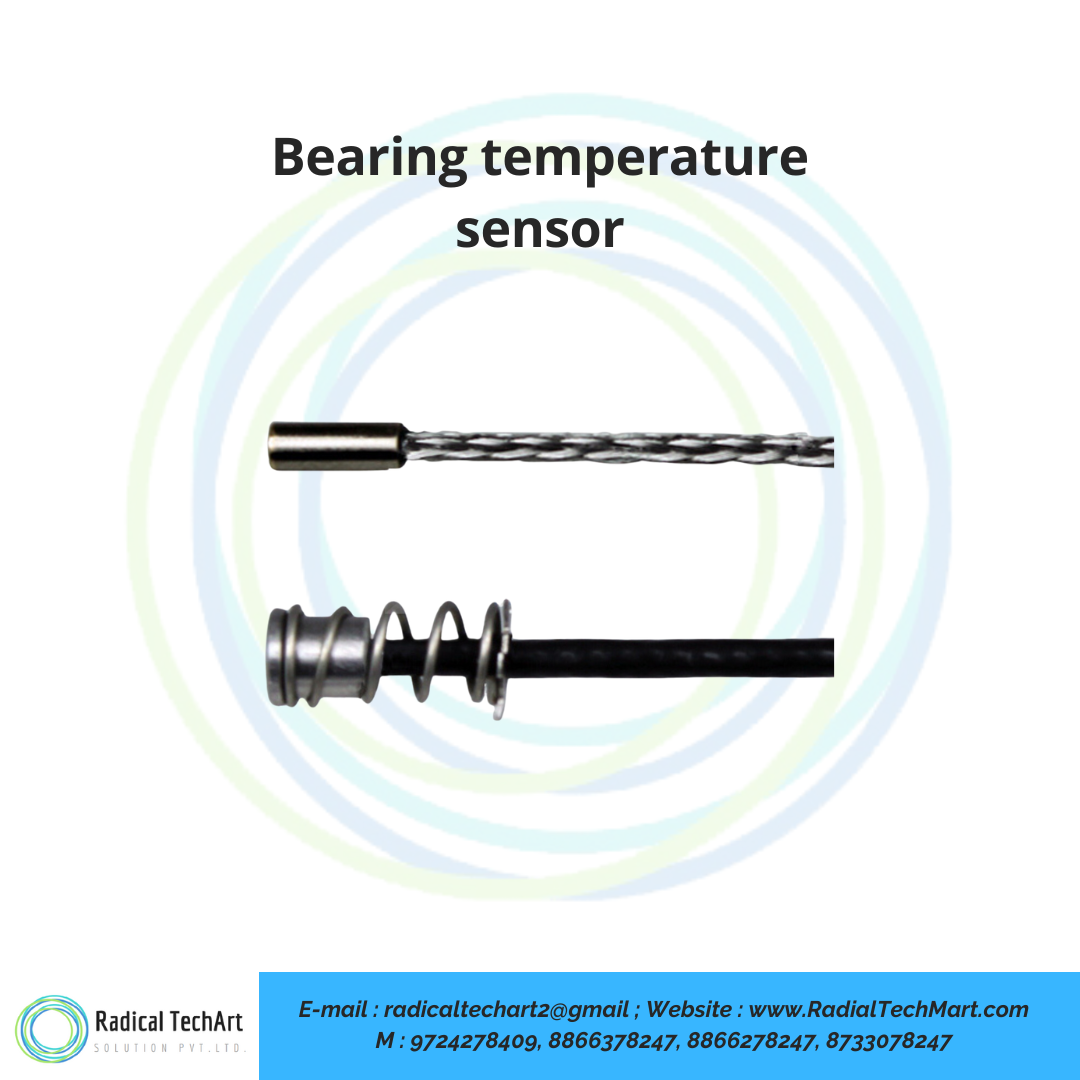


Bearing Temperature Sensor
Bearing Temperature Sensor is used to monitor bearing temperature in rotating machinery and industrial equipment. It helps detect excess heat caused by lubrication issues, bearing wear, overload or mechanical faults, reducing the risk of machine breakdown.
Customize
Share :
A. Product Overview
Bearing Temperature Sensor is a temperature monitoring sensor specially designed for bearings used in rotating machines and heavy-duty industrial equipment. Bearings are critical parts of motors, pumps, gearboxes, compressors, blowers, fans, turbines and conveyors. If bearing temperature increases beyond the safe limit, it can indicate lubrication failure, bearing wear, friction, misalignment or mechanical overload.
This sensor is generally installed near the bearing housing or close to the bearing surface to monitor temperature continuously. It can measure the temperature of the bearing race, rolling elements or lubricant area, depending on the design and installation method.
The Bearing Temperature Sensor is available in K type and J type thermocouple options with a typical temperature range of 35 to 260°C. It can be supplied with 3 mm, 4 mm, 5 mm and 6 mm tip diameter, 5 mm to 15 mm tip length, 0.5 meter to 10 meter wire length and grounded or ungrounded junction options.
B. Working Principle
Bearing Temperature Sensor works by detecting heat generated near the bearing surface or bearing housing. In thermocouple-based bearing temperature sensors, two dissimilar metal wires are joined together at one end to form a measuring junction.
When this junction is exposed to heat from the bearing area, it generates a small electrical voltage. This voltage changes according to the temperature. The signal is then sent to a temperature controller, indicator, PLC, data logger or monitoring system, where it is converted into a readable temperature value.
In RTD-based bearing temperature sensors, resistance changes with temperature. The monitoring device reads this resistance change and converts it into temperature. The selection between thermocouple and RTD depends on temperature range, accuracy requirement, response time and operating environment.
C. Why It Is Used
Bearing Temperature Sensor is used to protect rotating machinery from overheating and premature failure. Bearings can fail due to poor lubrication, high load, misalignment, excessive vibration, contamination or mechanical wear. In many cases, abnormal temperature rise is one of the first warning signs of bearing problems.
By monitoring bearing temperature, maintenance teams can identify problems early and take action before equipment damage occurs. This helps reduce downtime, improve machine safety, increase bearing life and support preventive maintenance and predictive maintenance planning.
It is especially useful in continuous process industries where sudden machine stoppage can lead to production loss, safety risk and high maintenance cost.
D. Suitable Buyers
Bearing Temperature Sensor is suitable for:
Industrial machinery manufacturers
Motor manufacturers
Pump manufacturers
Gearbox manufacturers
Compressor manufacturers
Fan and blower manufacturers
Conveyor system manufacturers
Turbine maintenance teams
Cement plants
Steel plants
Power plants
Chemical plants
Textile machinery users
Plastic machinery users
Process plant maintenance teams
OEM machine builders
Panel builders and automation system integrators
Predictive maintenance service providers
Industrial automation suppliers
FAQ
1. What is a Bearing Temperature Sensor?
A Bearing Temperature Sensor is a temperature sensor used to monitor the temperature of bearings in rotating machines and industrial equipment.
2. Why is bearing temperature monitoring important?
Bearing temperature monitoring helps detect overheating caused by lubrication failure, friction, bearing wear, misalignment or mechanical faults. It helps prevent sudden machine breakdown.
3. Where is a Bearing Temperature Sensor installed?
It is usually installed near the bearing housing, bearing surface or bearing lubrication area, depending on the machine design and measurement requirement.
4. Which sensor types are used for bearing temperature monitoring?
Bearing temperature sensors can be made using thermocouple, RTD or infrared sensing technology. Thermocouple and RTD types are commonly used in industrial machinery.
5. Which thermocouple types are available in this sensor?
This sensor is generally available in K type and J type thermocouple options.
6. What is the temperature range of this sensor?
The typical temperature range is 35 to 260°C, depending on the sensor type, wire insulation and application conditions.
7. What tip diameter options are available?
Common tip diameter options include 3 mm, 4 mm, 5 mm and 6 mm.
8. What wire length options are available?
Wire length is generally available from 0.5 meter to 10 meter, depending on installation requirements.
9. What is the difference between grounded and ungrounded junction?
A grounded junction gives faster response because the measuring junction is connected to the sheath. An ungrounded junction provides better electrical isolation and is useful where electrical noise may affect temperature readings.
10. Which machines use Bearing Temperature Sensors?
Bearing Temperature Sensors are used in motors, pumps, gearboxes, compressors, fans, blowers, turbines, conveyors and other rotating machinery.
11. Can this sensor help in predictive maintenance?
Yes. Continuous bearing temperature monitoring helps identify abnormal heating trends early, making it useful for preventive and predictive maintenance.
12. What are the main benefits of using a Bearing Temperature Sensor?
The main benefits are early fault detection, reduced downtime, improved machine safety, longer bearing life and better equipment reliability.