

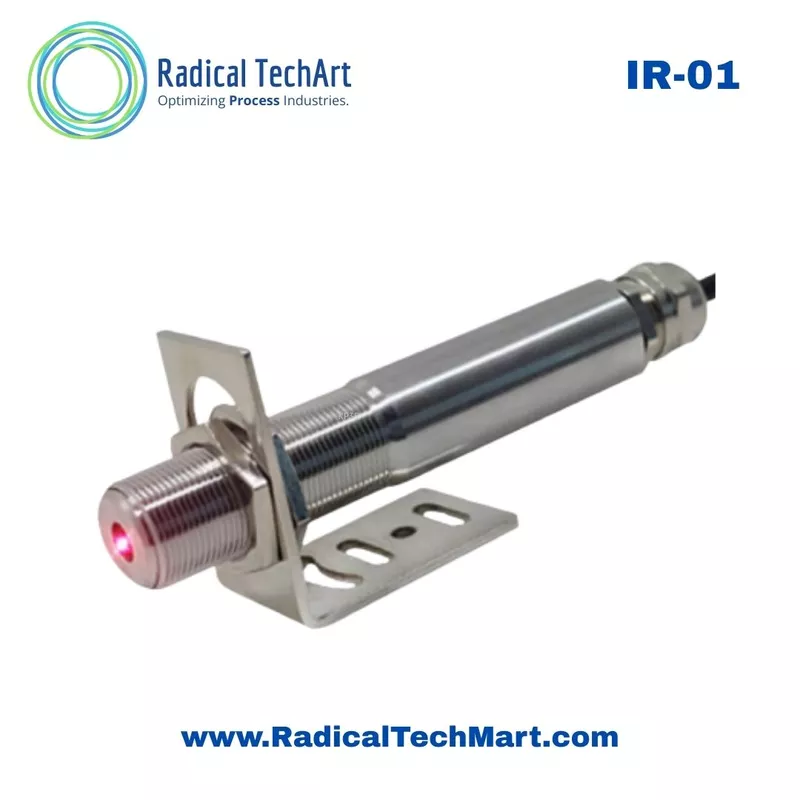


Brook IR-01E Non-Contact Infrared Temperature Sensor for 0–500°C Monitoring
Customize
Share :
A. Product Overview
Brook IR-01E is a compact, threaded, stainless-steel infrared temperature sensor used to measure surface temperature by sensing infrared radiation emitted from the target. It is typically selected where conventional RTD/thermocouple installation is impractical—such as moving products, rotating parts, hot surfaces, or enclosed zones. In industrial automation, stable temperature feedback helps prevent overheating, product defects, and unplanned shutdowns. The IR-01 platform is commonly supplied with industrial outputs (analogue or serial), rugged IP-rated housing, and panel/bracket mounting to suit OEM machinery and plant retrofits.
B. Working Principle
The sensor optics collect infrared energy from the target and convert it into an electrical signal proportional to surface temperature. A fixed industrial spectral band is used for surface sensing, and the device provides a fast response suited for automation. Optical resolution (distance-to-spot) is important: as distance increases, the measured spot size increases, so the sensor must be mounted to “see” only the intended surface area to avoid mixed readings from background hot objects.
C. Key Applications (Typical Industrial Use)
Furnace and heater surface monitoring in Oil & Gas, Chemical, and Power utilities
Extruder, die, and mould surface monitoring in **Plastic ing, shrink tunnel, and hot bar monitoring in Packaging lines
Conveyor product temperature verification in Food processing (surface checks)
Non-contact checks near clean areas in Pharma utilities and packaging zones
Hot bearing, dryer drum, and kiln area monitoring in cement/minerals and general manufacturing
Utility temperature monitoring in HVAC and plant services (hot pipes, insulation surface checks)
D. Why Industries Use This Product
Non-contact sensing reduces mechanical failures and measurement drift caused by probe wear, vibration, scale build-up, or poor thermal contact. In high-temperature equipment, protection is provided by detecting abnormal heating early (heater runaway, blocked cooling, friction heating, product jam). If temperature feedback is missing or incorrect, common outcomes include burnt product, seal failures, heater damage, belt/roller overheating, and safety trips—leading to downtime and rework. Standard industrial housings and common output options support integration with PLC/SCADA and help maintain a standardised spare strategy across multiple lines.
E. Suitable Buyers
OEMs and machine builders needing non-contact temperature feedback for automated equipment
EPC contractors and system integrators for plant modernization and
Maintenance and utility teams for condition monitoring and hot-spot prevention
Plant engineering and procurement teams for standardized installations and spares
Commonly used for replacement of failed contact probes in harsh zones, preferred in standardised installations where uptime is critical, and widely accepted in retrofit projects where mounting access is limited.
Quick Answers
What is Brook IR-01 E?
Brook IR-01E is a non-contact infrared temperature sensor used to measure surface temperature by detecting infrared radiation without touching the object.
Where is Brook IR-01E used?
Used in industrial automation, furnaces/heaters, plastic processing, packaging, and process plants where targets are hot, moving, or difficult to reach.
Why is Brook IR-01E required in industry?
It provides reliable temperature feedback without probe contact issues, helping prevent overheating, product defects, and shutdowns caused by temperature measurement.
Who typically uses Brook IR-01 E?
OEMs, system integrators, plant maintenance teams, utilities managers, and procurement teams in manufacturing, process industries, and packaging lines.
FAQ Section
1) What does “0–500°C” mean for IR-01E selection?
IR-01E is typically selected when the expected surface temperature stays within the 0–50 range for hot plates, packaging seal zones, and moderate furnace surfaces. Keeping the range aligned to the process improves control stability and reduces scaling errors that occur when a sensor is used far below its intended span.
2) How do I ensure stable readings with an infrared temperature sensor?
Stable readings depend on correct mounting distance, ensuring the sensor spot covers only the target surface, and heat sources in the field of view. Surface condition matters: shiny metals can reflect nearby heat, so consistent aiming and shielding/positioning are important for repeatability in industrial installations.
3) Can IR-01E be integrated with PLC/SCADA systems?
Yes. IR-01 series sensors are commonly supplied with industrial output options (analogue and/or serial). The integration approach depends on your control hardware: analogue outputs go to standard AI cards, while serial interfaces require compatible communication modules or gateways. Confirm the required output variant during procurement to match the existing panel architecture.
4) Is IR-01E suitable for moving targets on conveyors?
Non-contact infrared sensing is well suited for moving targets because there is no physical contact and the response is fast. Ensure the sensor is aimed consistently at the product surface, and keep the spot size smaller to prevent reading the background conveyor or fixtures, especially near hot sealing stations.
5) What are common reasons for incorrect temperature readings?
Typical causes include incorrect aiming (the spot includes the background), reflective surfaces, sudden emissivity changes (oxidation/finish), steam/dust blocking the optical path, and mounting too far from the target. In high-heat zones, mechanical vibration over time, bracket locking, and periodic verification help maintain accuracy.
6) What should I check when replacing an existing infrared sensor with IR-01 E?
Match the temperature range (0–500°C for IR-01E), mechanical mounting (threaded body and available space), power supply, and output interface required by your panel. Also verify cable routing, IP protection needs, and the target distance/spot requirement so the replacement fits the existing mounting point without measurement compromise.