

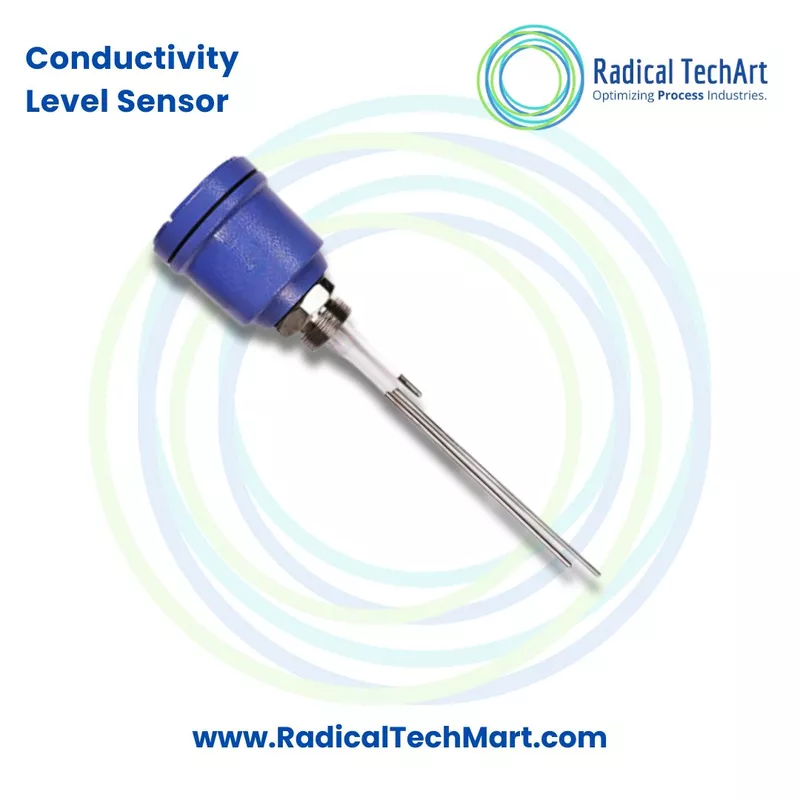
Conductivity Level Sensor for Liquid Level Control
The Conductivity Level Sensor is used for reliable level detection and pump control in conductive liquids. It is suitable for tanks, process vessels, water treatment plants, effluent treatment plants, chemical processing, food processing, power plants and other industrial applications where high level, low level, multi-point level switching and automatic pump control are required.
Download datasheet here!!
Customize
Share :
A. Product Overview
The Conductivity Level Sensor, Aqua 4000 Series, is an industrial level switching device designed for conductive liquid applications. It detects the presence or absence of liquid by using stainless steel probe electrodes installed inside the tank or vessel.
This level sensor is suitable for single point, two point, three point and four point level switching. It can be used for high level alarm, low level alarm, automatic pump control, independent switching and multi-point liquid level monitoring.
The sensor is available with rod type and rope type probes, making it suitable for different tank heights and process conditions. It supports SS304 and SS316 wetted parts, PTFE insulation and weatherproof enclosure options.
B. Working Principle
The Conductivity Level Sensor works on the principle of electrical conductivity.
A low AC voltage is applied between the probe electrode and the tank wall. In insulated tanks, a separate reference electrode is used. When the conductive liquid touches the electrode tip, it creates a conductive path between the sensing probe and the tank wall or reference electrode.
This small current is sensed and amplified by the control unit. The control unit then operates a relay output, which can be connected to alarms, pumps, valves, control panels or automation systems.
In simple terms, when liquid touches the probe, the sensor detects the level and gives a switching signal.
C. Why It Is Used
Conductivity Level Sensors are used because they provide simple, reliable and cost-effective level control for conductive liquids. They have no moving parts, which reduces mechanical failure and maintenance.
They are useful for:
High level detection in tanks
Low level detection in tanks
Dry run protection for pumps
Automatic pump start and stop
Overflow prevention
Empty tank protection
Multi-point level monitoring
Alarm and annunciation systems
Fill and drain control
Process vessel level control
This type of sensor is especially useful where float switches may not be suitable due to turbulence, foam, limited space or mechanical wear.
D. Suitable Buyers
The Conductivity Level Sensor is suitable for buyers and users such as:
Water treatment plant operators
Effluent treatment plant operators
Chemical processing companies
Food processing plants
Power plants
Sugar plants
Detergent manufacturing units
Steel plants
Mineral processing industries
Textile processing units
OEM machine manufacturers
Panel builders
System integrators
Plant maintenance teams
Instrumentation engineers
Purchase managers looking for industrial level sensors
FAQ
1. What is a Conductivity Level Sensor?
A Conductivity Level Sensor is a liquid level detection device used for conductive liquids. It uses probe electrodes to detect whether the liquid has reached a specific level inside a tank or vessel.
2. How does a Conductivity Level Sensor work?
It works by applying a low AC voltage between a probe electrode and the tank wall or reference electrode. When conductive liquid touches the probe, a conductive path is formed and the sensor activates a relay output for control or alarm.
3. Which liquids are suitable for this sensor?
This sensor is suitable for conductive liquids with conductivity not less than 25 micro siemens. Common applications include water, wastewater, process liquids, chemicals, food liquids and effluent treatment liquids.
4. Can this sensor be used for pump control?
Yes. The Conductivity Level Sensor supports two point action for automatic pump control. It can be used to start and stop pumps based on low level and high level conditions.
5. Can it detect multiple liquid levels?
Yes. The Aqua 4000 Series supports two point, three point and four point switching. It can also provide independent multi-channel level switching depending on the application requirement.
6. What probe types are available?
The sensor is available with rod type and rope type probes. Rod type probes are suitable for standard and extended lengths, while rope type probes are suitable for deeper tanks and longer level detection requirements.
7. What materials are used for the sensing probe?
The sensing probe is available in Stainless Steel 304 and Stainless Steel 316. PTFE insulation is available as standard, and other insulation materials can be provided based on the application.
8. What is the maximum operating temperature?
The sensing probe can be used up to 200°C maximum inside the vessel, depending on the selected model and application condition.
9. Where is this sensor commonly used?
It is commonly used in food, power, chemical, sugar, detergent, steel, mineral, textile, water treatment and effluent treatment industries.
10. Why should I choose a Conductivity Level Sensor instead of a float switch?
A Conductivity Level Sensor has no moving parts, so it offers better reliability in applications where mechanical float movement may be affected by turbulence, space restriction, deposits or wear. It is also suitable for multi-point level detection and automatic pump control.