

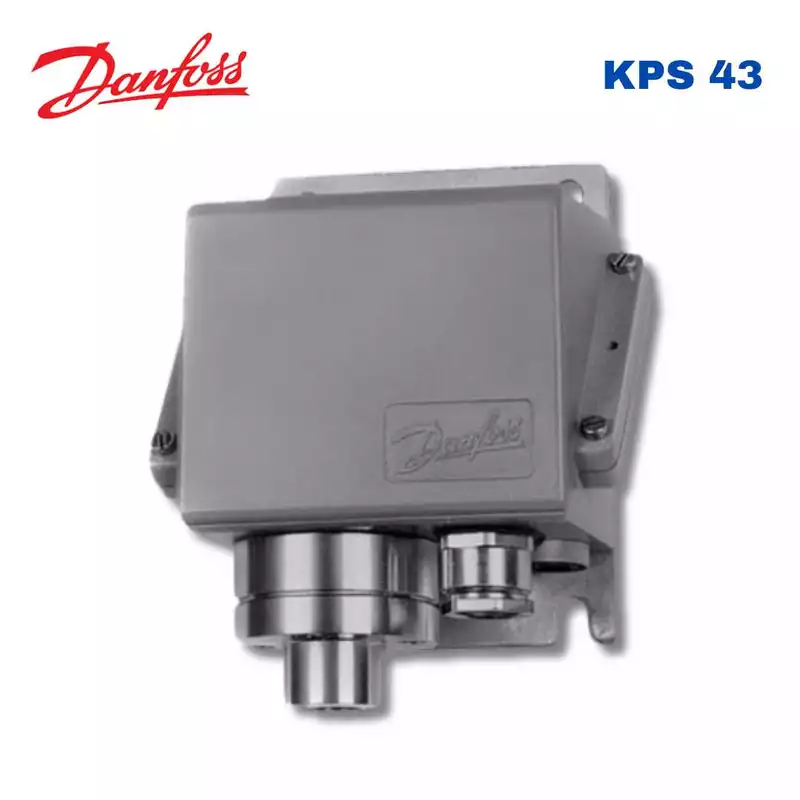


Danfoss KPS 43 High Pressure Switch for Industrial Systems
It is commonly used in compressors, hydraulic systems, power plants, and marine installations requiring robust and reliable pressure protection.
Customize
Share :
A. Product Overview
The Danfoss KPS 43 is a heavy-duty mechanical pressure switch from the KPS series, engineered for high-pressure applications and systems exposed to pressure pulsations. It is used for alarm, control, and safety shutdown functions in demanding industrial and marine environments.
The switch features a rugged metal enclosure with high ingress protection, making it suitable for outdoor installations and harsh operating conditions. Its design ensures stable switching performance even under vibration, shock, and fluctuating pressure loads.
B. Working Principle
The KPS 43 operates using a diaphragm-based mechanical sensing mechanism. Process pressure acts on the diaphragm capsule, which transfers force to a snap-action SPDT contact system. When the pressure reaches the set value, the contacts change state to trigger alarms, stop equipment, or initiate control logic.
An adjustable differential allows the switch to operate reliably in systems with pressure variations, reducing contact chatter and preventing frequent switching that can lead to premature failure.
C. Key Applications
Industrial air and gas compressors
Hydraulic systems with pressure pulsations
Power generation auxiliary systems
Diesel engine protection circuits
Marine engines and onboard systems
Industrial alarm and safety monitoring
D. Why Industries Use This Product
Industries use the KPS 43 for its reliability, safety contribution, and ability to handle demanding pressure conditions. It helps prevent equipment damage caused by overpressure, enables early fault detection, and supports safe system operation.
In high-pressure or pulsating systems, standard pressure switches may fail due to unstable switching or mechanical fatigue. The KPS 43 is specifically designed to withstand such conditions, reducing false alarms, minimizing downtime, and extending the service life of critical equipment.
E. Suitable Buyers
Compressor and hydraulic OEMs
Power plant and utility engineering teams
Marine system integrators and shipyards
Maintenance and reliability engineers
Procurement teams sourcing standardized pressure switches
It is commonly used for replacement in existing KPS installations and preferred in retrofit projects requiring proven high-pressure performance.
Quick Answers
What is Danfoss KPS 43?
Danfoss KPS 43 is a high-pressure mechanical pressure switch designed for industrial and marine systems with pulsating pressure conditions.
Where is Danfoss KPS 43 used?
It is used in compressors, hydraulic systems, power plants, diesel engines, and marine onboard installations.
Why is Danfoss KPS 43 required in industry?
It protects equipment from overpressure, ensures stable alarm and control functions, and reduces the risk of system failure.
Who typically uses Danfoss KPS 43?
OEMs, system integrators, maintenance teams, power utilities, and industrial procurement professionals.
FAQ Section
Is Danfoss KPS 43 suitable for high-pressure industrial applications?
Yes. The KPS 43 is designed specifically for high-pressure systems and is suitable for applications involving pressure pulsations and demanding operating conditions.
Can KPS 43 be used in hydraulic and compressor systems?
The KPS 43 is widely used in hydraulic circuits and compressor installations where stable pressure monitoring and protection are required.
What is the benefit of adjustable differential in KPS 43?
The adjustable differential helps prevent frequent switching in fluctuating pressure conditions, reducing wear on contacts and improving system stability.
Is KPS 43 commonly used as a replacement pressure switch?
Yes. It is commonly used as a direct replacement in existing KPS series installations, subject to matching application requirements.
Does KPS 43 support system safety and downtime prevention?
By enabling timely alarms or shutdowns during abnormal pressure conditions, the KPS 43 helps protect equipment and reduce unplanned downtime.