

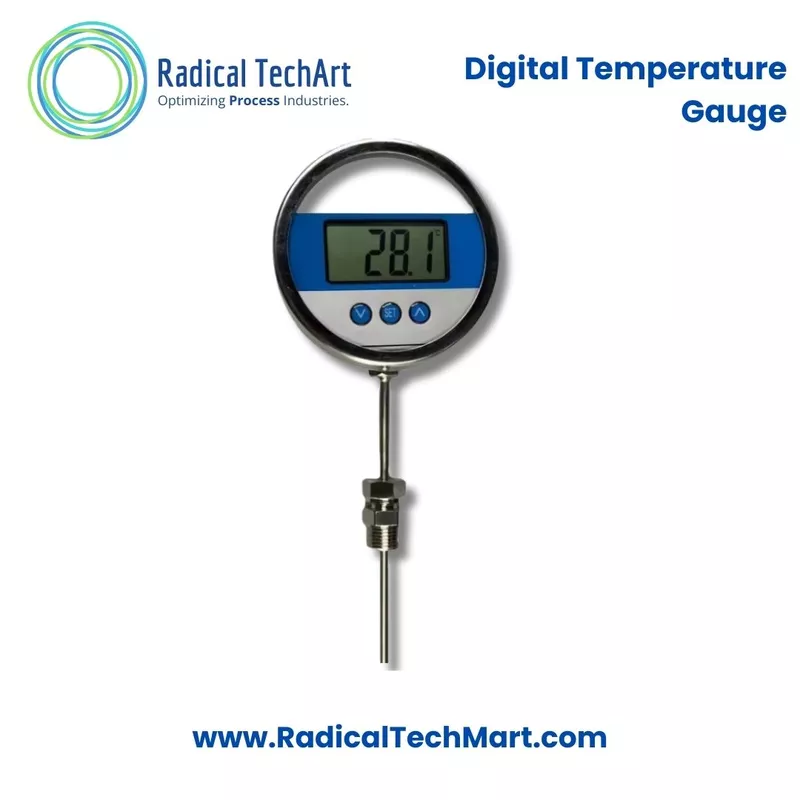


Digital Temperature Gauge for Process Temperature Monitoring
Used in oil & gas, chemical, power, pharma, food, water treatment, HVAC and utilities for field verification and maintenance checks.
Customize
Share :
A. Product Overview
This Digital Temperature Gauge is a local (in situ) temperature indicator designed to provide on-site temperature reading directly at the process point. It combines a stainless-steel probe with a digital display head so operators and maintenance teams can verify temperature in the field without relying only on panel instruments.
This product category is commonly used on pipelines, vessels, heat exchangers, utility skids, HVAC loops, and water systems where quick confirmation of actual temperature improves troubleshooting speed and maintenance accuracy. Some variants are offered as battery-operated gauges with a 4" dial form factor and a multi-digit LCD display, and optional output is offered by some sellers on request.
B. Working Principle
The probe contains a temperature sensing element—commonly RTD (Pt100), and in some offerings K-type thermocouple for higher ranges. The sensor’s electrical characteristic changes with temperature, and internal electronics convert that signal into a stable digital value shown on the LCD.
Certain local display instruments support configuration of sensor input type through settings on the display head (used when the same indicator design is built to accept RTD/thermocouple inputs depending on the ordered variant). This makes the gauge practical for standardized plant maintenance because technicians can verify temperature at the equipment location and cross-check transmitter/controller readings during troubleshooting.
C. Key Applications (Bulleted)
Oil & Gas: utility lines, skid packages, lube systems, fuel and process headers
Chemical: pipelines, vessels, reactor utility circuits, mixing/skid temperature checks
Power: auxiliary cooling loops, utility skids, plant water circuits
Pharma: process utilities, HVAC/cleanroom support, water loops for maintenance verification
Food: CIP/SIP utilities, hot water lines, process and packaging utilities
Water: filtration skids, pump discharge lines, distribution networks
HVAC: chilled/hot water circuits, plant room monitoring, AHU utility verification
Utilities: general plant piping, compressor/dryer support, service lines
D. Why Industries Use This Product
Industries use local digital temperature gauges to improve operational safety and preventive maintenance. Local indication helps teams detect abnormal temperature conditions early, reducing the risk of overheating, inefficient heat transfer, or unstable process conditions. It also reduces downtime by enabling fast “at-point” confirmation—useful when diagnosing whether a deviation is a real process issue or a signal/loop issue.
Many plants prefer standardized installations with common thread sizes and probe formats for easier replacement. For example, suppliers commonly offer 1/2" BSP adjustable process connection and stainless-steel enclosure designs, with ingress protection such as IP65 mentioned for some models.
If local temperature indication is not available at key points, maintenance teams may lose time validating temperature, potentially leading to delayed fault isolation and higher risk of equipment stress. Note that at least one published datasheet explicitly positions the gauge as “used for testing” rather than continuous monitoring, so selection should match the duty and plant requirement.
E. Suitable Buyers
OEMs: commonly integrated in packaged skids and utility modules where on-site verification is required
EPC Contractors: preferred for standardized installations using common process connections like 1/2" BSP adjustable
Maintenance & Utilities Teams: commonly used for replacement of existing local temperature points during shutdowns and preventive maintenance
Plant Engineering & Procurement: widely accepted in retrofit projects when plants want local visibility without adding control-panel complexity; also useful where optional output is requested for integration needs (variant-dependent).
FAQ SECTION
Which sensor type should I choose—Pt100 RTD or K-type thermocouple?
Pt100 RTD is commonly selected for stable industrial ranges and routine utility/process monitoring, while K-type thermocouple is often offered for higher temperature services. Some suppliers explicitly list Pt100 (Class A) and K-type options with different upper-range capabilities. Choose based on process range, standardization, and maintenance spares policy.Is this digital temperature gauge suitable for continuous monitoring?
Not always. One published datasheet states the gauge is intended for testing and not for continuous monitoring, so duty selection is important. If your application requires continuous monitoring or control integration, confirm the specific model’s intended use and any optional output requirement before standardizing.What are the common process connection and mounting options?
Suppliers commonly specify 1/2" BSP adjustable connection, allowing positioning along the sensor length. This is useful for replacements and standardized installations because it helps match insertion depth and existing mounting points without redesigning piping layouts.What enclosure and protection levels are typically offered?
Some product pages specify AISI 304 SS enclosure with IP65 rating and bayonet-style enclosure construction. Always verify the IP rating and enclosure type on the exact model being procured, especially for outdoor, washdown, or high-moisture installations.What stem length and diameter options are available?
Standard industrial offerings commonly mention up to ~300 mm stem length for typical installations, while some suppliers also claim custom long lengths (even up to meters) for special applications. Stem diameter options vary by seller and may include multiple sizes, so selection should match thermowell/insertion requirements and mechanical strength needs.Does this product support output signals like 4–20 mA or HART?
Some sellers list 4–20 mA / HART as “on request”, implying it is variant-dependent rather than standard on every gauge. If you need integration to PLC/SCADA, specify the required output at procurement to avoid mismatch with a local-only testing gauge.