

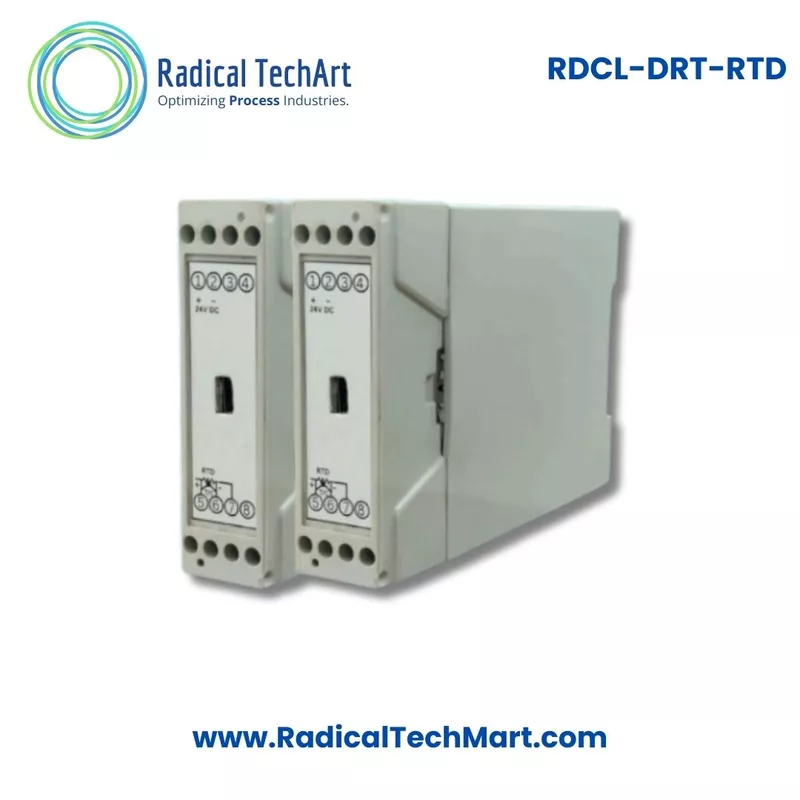


DIN-Rail Universal Temperature Transmitter (Economy / Non-Isolated)
Customize
Share :
A. Product Overview
This DIN-Rail Universal Low-Cost Temperature Transmitter converts multiple sensor and low-level signal inputs into a stable 2-wire 4–20 mA analog output for industrial monitoring and control. It supports RTD inputs (Pt100, Cu50), thermocouple inputs (B, E, J, K, N, R, S, T), and resistance and mV voltage signals, allowing different field signals to be standardized into one common current loop format.
The transmitter is PC configurable, enabling selection of input type and measurement range as required. For thermocouple measurement, it includes built-in cold junction compensation (CJC) to improve measurement reliability. It is designed for DIN-rail installation in control panels and skids where consistent 4–20 mA transmission is needed to connect field points to PLC, DCS, SCADA, panel meters, and data acquisition systems.
B. Working Principle
The transmitter accepts an input signal from an RTD, thermocouple, resistance source, or mV signal, linearizes the input based on the selected sensor type, and converts it into a 4–20 mA output proportional to the configured measurement range.
For thermocouples, cold junction compensation is applied to correct the reference junction effect and support accurate temperature conversion. The device operates in a 2-wire loop, where the same two conductors provide power and carry the 4–20 mA signal to the receiving instrument.
Output behavior includes defined loop limits and diagnostic currents to support stable operation and fault recognition:
Saturation current (low): 3.9 mA
Saturation current (high): 20.5 mA
Alarm current (sensor fault / sensor off): 3.9 mA or 22 mA (except thermocouple inputs as specified)
Circuit limit: ≤ 22 mA
Configuration is performed by PC to select the input type and measurement range.
C. Key Applications
DIN-rail conversion of RTD and thermocouple temperature signals to 4–20 mA
Standardizing resistance and mV signals into a 2-wire current loop
Control panels and skids requiring PC-configured universal input transmitters
Temperature measurement points using Pt100 / Cu50 and thermocouples B, E, J, K, N, R, S, T
Industrial loops transmitting temperature signals to PLC/DCS/SCADA and panel indicators
D. Why Industries Use This Product
Universal DIN-rail temperature transmitters are used to standardize different sensor signals into a widely accepted 4–20 mA output, simplifying integration with automation systems and reducing the need to stock different transmitter models for different sensor types.
This transmitter specifies accuracy of 0.1% FS and response time ≤ 1 second, supporting stable signal conversion for industrial applications. It also defines current loop saturation and alarm behavior for easier loop troubleshooting and sensor fault detection. Protection is listed as IP00 for the device and IP66 when mounted, supporting use in panel installations and protected field mounting.
E. Suitable Buyers
OEMs building control panels, skids, and machines using DIN-rail signal conditioning
EPC contractors standardizing multiple temperature input types into 4–20 mA loops
Maintenance and utilities teams replacing existing DIN-rail 4–20 mA transmitter points
Plant engineering and procurement teams managing standardization and retrofit projects with PC-configured universal input transmitters
FAQ SECTION
1. What input types are supported by this DIN-rail temperature transmitter?
It supports RTD (Pt100, Cu50), thermocouple (B, E, J, K, N, R, S, T), resistance input, and mV voltage signal input.
2. What is the output signal and wiring type?
Output is 4–20 mA in a 2-wire loop (loop-powered).
3. What RTD ranges are listed?
Pt100 is listed as -200 to 850°C and Cu50 as -50 to 150°C.
4. What thermocouple types and ranges are listed?
B, E, J, K, N, R, S, and T are listed. Example ranges include B: 400 to 1820°C, K: -180 to 1372°C, and T: -200 to 400°C.
5. How is the transmitter configured?
Input type and range are selected by PC configuration.
6. Does it include cold junction compensation for thermocouples?
Yes, built-in cold junction compensation is included.
7. What are the response time and accuracy?
Response time is ≤ 1 second and accuracy is 0.1% FS.
8. What is the power supply range and output limits?
Power supply is 12–40 V. Circuit limit is ≤ 22 mA. Saturation currents are 3.9 mA (low) and 20.5 mA (high).
9. What happens during sensor fault conditions?
Alarm current is 3.9 mA or 22 mA for sensor damage or sensor off (except thermocouple inputs as specified).
10. What protection rating is listed?
IP00 for the device and IP66 when mounted.