

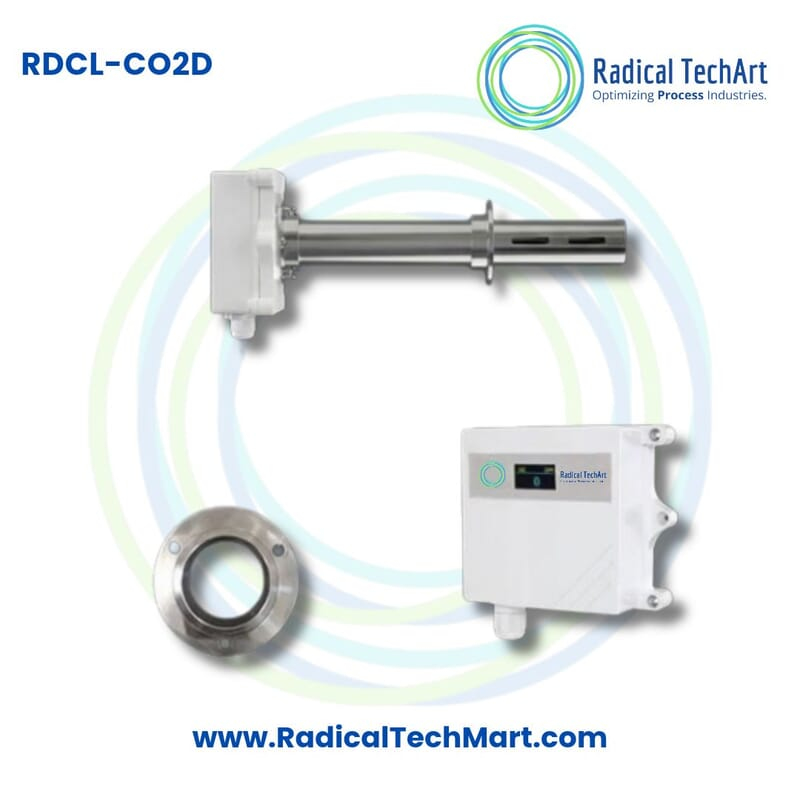


Duct Mount Carbon Dioxide (CO2) Sensor and Transmitter | RDCL-CO2D
The RDCL-CO2D Duct Mount Carbon Dioxide (CO2) Sensor and Transmitter is designed for accurate and continuous carbon dioxide monitoring in HVAC ducts, air handling units (AHU) and ventilation systems. Featuring advanced Non Dispersive Infrared (NDIR) technology, a measurement range of 0 to 5000 PPM and multiple output options including RS485, 4 to 20mA, 0 to 5V and 0 to 10V, it enables reliable CO2 measurement for building automation and indoor air quality management. Its stainless steel sensing probe, temperature compensation, automatic calibration functionality and optional display make it suitable for commercial and industrial ventilation applications.
Customize
Share :
A. Product Overview
The RDCL-CO2D Duct Mount CO2 Sensor and Transmitter is an industrial carbon dioxide monitoring instrument specifically developed to measure CO2 concentrations inside air ducts and ventilation systems.
It uses advanced NDIR (Non Dispersive Infrared) sensing technology with a measurement channel and reference channel to provide accurate and stable CO2 measurements. This technology enables continuous monitoring of carbon dioxide concentration in return air ducts, helping HVAC systems maintain indoor air quality and optimize ventilation performance.
The RDCL-CO2D offers multiple industrial communication and analog output options, allowing integration with Building Management Systems (BMS), Programmable Logic Controllers (PLC), HVAC controllers and other automation equipment.
The sensor features a stainless steel probe for corrosion resistance and a durable, water resistant enclosure. Its internal anti interference circuit helps maintain stable measurements in industrial environments where electromagnetic interference may occur.
Key Features
Measurement Range: 0 to 5000 PPM CO2
Sensing Technology: NDIR infrared CO2 measurement with reference channel
Output Options: RS485, 4 to 20mA, 0 to 5V and 0 to 10V
Power Supply: 10 to 30V DC
Measurement Accuracy: ±(50 PPM and 3% of full scale) at 25°C within 400 to 5000 PPM
Data Update Interval: 2 seconds
Operating Temperature: Minus 10°C to 50°C
Operating Humidity: 0 to 95% RH, non condensing
Probe Material: Stainless steel
Temperature Compensation: Built in
Calibration: Automatic calibration functionality for RS485 versions
Display: Optional display for local CO2 readings
Installation: Duct mounted configuration
Applications: HVAC, AHU, BMS, industrial ventilation and building automation
These features make the RDCL-CO2D an effective solution for continuous duct air quality monitoring in commercial buildings and industrial facilities.
B. Working Principle
The RDCL-CO2D Duct Mounted Carbon Dioxide Sensor operates using Non Dispersive Infrared (NDIR) technology, which measures carbon dioxide concentration based on the absorption of infrared radiation by CO2 molecules.
How Does the RDCL-CO2D CO2 Sensor Work?
Step 1: Air Sampling Inside the Duct
The stainless steel sensing probe is installed inside the HVAC duct or ventilation channel. Air circulating through the duct reaches the sensor's measurement chamber.
Step 2: Infrared CO2 Detection
The internal NDIR sensing element emits infrared radiation through the measurement chamber. Carbon dioxide molecules absorb infrared energy at specific wavelengths.
Step 3: CO2 Concentration Measurement
The sensor measures the infrared absorption and calculates the carbon dioxide concentration in parts per million (PPM). A reference channel helps improve measurement stability and accuracy.
Step 4: Temperature Compensation
The built in temperature compensation function reduces measurement variations caused by changes in operating temperature.
Step 5: Signal Transmission
The measured CO2 concentration is transmitted through the selected output interface, such as RS485, 4 to 20mA, 0 to 5V or 0 to 10V, to compatible controllers and monitoring equipment.
Step 6: Ventilation Control
The connected HVAC controller or BMS can use the measured CO2 concentration to regulate fresh air intake and ventilation operation according to the control strategy.
This process supports continuous carbon dioxide monitoring and demand controlled ventilation in commercial and industrial buildings.
C. Why Is the RDCL-CO2D Duct CO2 Sensor Used?
The RDCL-CO2D is used to monitor carbon dioxide concentrations within HVAC ducts and ventilation systems, supporting indoor air quality management and efficient building operation.
1. Indoor Air Quality Monitoring
Elevated CO2 concentrations can indicate inadequate ventilation in occupied spaces. Monitoring CO2 levels in ventilation ducts helps facility operators assess ventilation performance and identify when additional fresh air may be required.
2. HVAC Ventilation Control
The duct mounted CO2 transmitter provides continuous measurement data to HVAC control systems. This information can be used to adjust ventilation equipment and improve airflow management.
3. Demand Controlled Ventilation
The RDCL-CO2D can support demand controlled ventilation systems that adjust fresh air intake according to measured carbon dioxide levels.
This approach helps optimize ventilation operation based on occupancy related CO2 changes rather than relying entirely on fixed ventilation settings.
4. Energy Efficiency
Continuous CO2 monitoring enables HVAC controllers to manage ventilation more efficiently. Where appropriate, reducing unnecessary outside air intake can help lower the energy consumed for heating, cooling and air handling.
5. Building Automation Integration
With RS485 and analog output options, the RDCL-CO2D can be connected to compatible building automation systems, HVAC controllers and PLC based monitoring equipment.
6. Commercial and Industrial Ventilation Monitoring
The sensor is suitable for applications requiring continuous carbon dioxide measurement in ducted air systems, including commercial buildings, offices, educational facilities and industrial ventilation installations.
Common Applications
HVAC duct CO2 monitoring
AHU return air monitoring
Commercial building ventilation control
Indoor air quality monitoring systems
Building Management Systems
Demand controlled ventilation
Office and commercial complexes
Schools and educational institutions
Shopping malls and public buildings
Industrial ventilation and air handling systems
D. Suitable Buyers
The RDCL-CO2D Duct Mount Carbon Dioxide Sensor and Transmitter is suitable for businesses, engineering professionals and organizations involved in HVAC installation, building automation and industrial air quality monitoring.
Suitable Buyer | Typical Requirement |
HVAC Contractors | CO2 sensors for air ducts and ventilation control |
AHU Manufacturers | Duct mounted CO2 monitoring equipment for air handling units |
BMS System Integrators | CO2 transmitters for building automation systems |
HVAC Consultants | CO2 measurement solutions for ventilation system designs |
Facility Management Companies | Continuous monitoring of indoor ventilation performance |
Industrial Automation Companies | CO2 sensors with analog or RS485 communication outputs |
Commercial Building Developers | CO2 monitoring for HVAC and building ventilation |
Educational Institutions | Ventilation monitoring in classrooms and common areas |
OEM Equipment Manufacturers | Integration of CO2 sensing into ventilation equipment |
MEP Contractors | CO2 transmitters for mechanical ventilation projects |
The RDCL-CO2D is particularly suitable for buyers seeking an industrial duct CO2 sensor with NDIR measurement technology, multiple output options and compatibility with automated ventilation control systems.
Frequently Asked Questions (FAQ)
1. What is the RDCL-CO2D Duct Mount CO2 Sensor?
The RDCL-CO2D is a duct mounted carbon dioxide sensor and transmitter designed to measure CO2 concentration in HVAC ducts, air handling units and ventilation systems. It uses NDIR sensing technology for continuous carbon dioxide monitoring.
2. What is the measurement range of the RDCL-CO2D?
The standard CO2 measurement range is 0 to 5000 PPM. Other measurement ranges may be available depending on configuration and customization requirements.
3. What sensing technology does the RDCL-CO2D use?
The RDCL-CO2D uses Non Dispersive Infrared (NDIR) sensing technology. This technology measures carbon dioxide concentration by detecting infrared radiation absorbed by CO2 molecules.
4. What output signals are available?
The sensor family offers RS485, 4 to 20mA, 0 to 5V and 0 to 10V output options. The required output configuration should be selected according to the connected monitoring or control system.
5. Can the RDCL-CO2D be connected to a BMS?
Yes. The RDCL-CO2D can be integrated with compatible Building Management Systems using an appropriate analog or RS485 communication interface.
6. Is the RDCL-CO2D suitable for AHU applications?
Yes. The sensor is designed for duct installation and can be used in air handling unit systems to measure carbon dioxide concentration in return air or other suitable ventilation ducts.
7. Does the RDCL-CO2D support automatic calibration?
Automatic calibration functionality is available for RS485 versions. Calibration should be performed according to the applicable product instructions and environmental conditions.
8. What is the power supply requirement?
The RDCL-CO2D operates with a DC power supply ranging from 10 to 30V DC.
9. Can the sensor be used for industrial applications?
Yes. Its stainless steel sensing probe, anti interference circuitry and multiple output options make it suitable for compatible industrial ventilation and building automation applications within the specified operating conditions.
10. Does the RDCL-CO2D have a display?
Display and non display configurations are available. The optional display allows users to view measured CO2 concentration locally.