

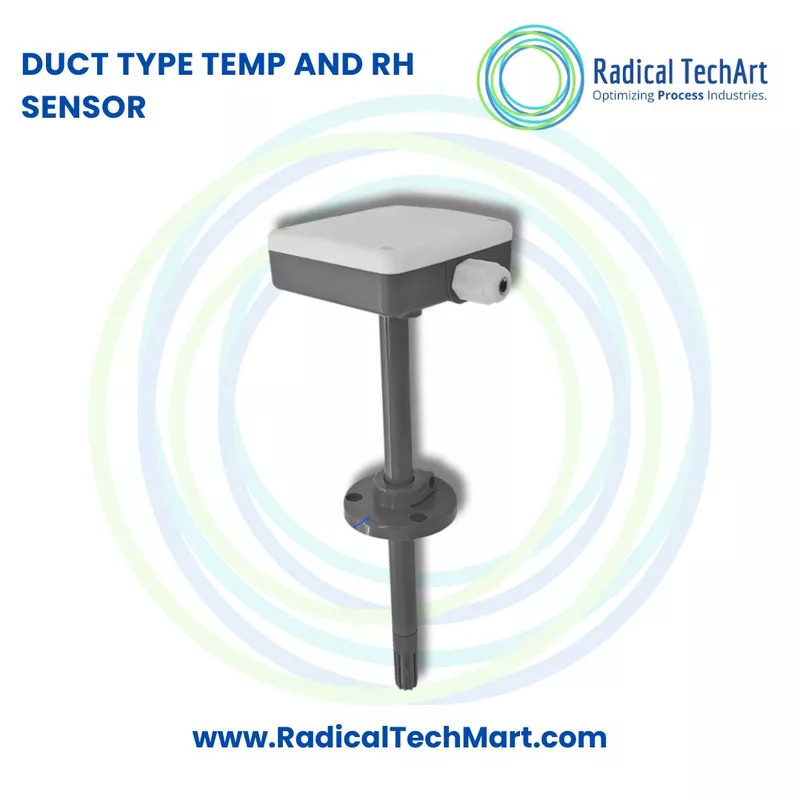


Duct Mount Temperature and Humidity Transmitter | 4-20mA / RS485 Modbus
Industrial Duct Mount Temperature and Humidity Transmitter designed for continuous measurement of air temperature and relative humidity in HVAC ducts, air handling units (AHU) and building automation systems.
Available with 4-20mA analog output or RS485 Modbus RTU communication for integration with PLC, BMS, SCADA and industrial monitoring systems.
Customize
Share :
A. Product Overview
The Duct Mount Temperature and Humidity Transmitter is designed to measure air temperature and relative humidity directly inside ventilation ducts and industrial air handling systems.
The transmitter uses a duct-mounted sensing probe to monitor air conditions and convert the measured values into signals that can be processed by compatible monitoring and automation equipment.
The instrument is suitable for applications where continuous temperature and humidity monitoring is required to maintain controlled environmental conditions.
Radical TechMart offers two output variants:
1. Duct Mount Temperature and Humidity Transmitter with 4-20mA Output
This variant provides an industrial analog signal for integration with compatible PLCs, digital indicators, process controllers and building management systems.
2. Duct Mount Temperature and Humidity Transmitter with RS485 Modbus RTU Output
This variant provides digital communication for integration with compatible PLCs, BMS, SCADA and centralized monitoring systems.
The transmitter is suitable for HVAC installations, pharmaceutical manufacturing facilities, cleanrooms, laboratories, hospitals, commercial buildings and industrial ventilation systems.
B. Working Principle
The Duct Mount Temperature and Humidity Transmitter works by measuring the temperature and relative humidity of air passing through a duct.
The instrument contains temperature and humidity sensing elements positioned within a probe installed inside the air duct.
Step 1: Air Temperature Measurement
The temperature sensing element detects the temperature of the surrounding air. The transmitter electronics process this measurement and prepare it for transmission to the connected system.
Step 2: Relative Humidity Measurement
The humidity sensing element responds to moisture present in the air and measures relative humidity, expressed as a percentage of RH.
Step 3: Signal Conversion
The transmitter processes the measured temperature and humidity values and provides the selected electrical output.
In the 4-20mA variant, measured values are represented by analog current signals according to the configured measuring ranges.
In the RS485 Modbus RTU variant, the measured values are communicated digitally to compatible devices through an RS485 communication network.
Step 4: Monitoring and Automation
The connected PLC, BMS, SCADA or monitoring system receives the measurement data. Depending on the system configuration, the data can be used for displaying environmental conditions, recording trends, generating alarms or controlling external HVAC equipment.
The transmitter itself is primarily a measurement device. Automatic temperature or humidity control requires a compatible controller and suitable control equipment.
C. Why Is a Duct Mount Temperature and Humidity Transmitter Used?
Maintaining suitable temperature and humidity conditions is important for HVAC performance, environmental monitoring and many industrial processes.
A duct-mounted transmitter provides continuous measurements directly from the air distribution system.
1. Continuous Temperature and Humidity Monitoring
The device enables regular monitoring of air temperature and relative humidity without requiring manual measurements inside the duct.
2. HVAC System Monitoring
It helps HVAC operators monitor air conditions within air handling units, supply air ducts and return air ducts.
3. Building Automation Integration
The transmitter can supply measurement signals to compatible building management systems for centralized monitoring of temperature and humidity.
4. Pharmaceutical and Cleanroom Applications
Temperature and humidity monitoring is important in pharmaceutical facilities, cleanrooms and controlled manufacturing environments. The transmitter can serve as part of an environmental monitoring or HVAC control system.
5. Improved Environmental Control
When connected to suitable controllers, the measured values can be used to manage external heating, cooling, humidification and dehumidification equipment.
6. Remote Monitoring and Data Collection
The RS485 Modbus RTU variant enables digital communication with compatible automation systems, supporting centralized monitoring and data acquisition.
D. Suitable Buyers
The Duct Mount Temperature and Humidity Transmitter is suitable for companies and professionals involved in HVAC installation, industrial automation, facility management and environmental monitoring.
| Buyer Category | Typical Requirement |
|---|---|
| HVAC Contractors | Temperature and humidity measurement inside ventilation ducts |
| AHU Manufacturers | Integration of duct sensors into air handling units |
| BMS System Integrators | Monitoring air conditions through building automation systems |
| PLC and SCADA Integrators | Transferring temperature and humidity measurements to automation systems |
| Pharmaceutical Manufacturers | HVAC environmental monitoring in controlled production areas |
| Cleanroom Contractors | Duct air condition monitoring in cleanroom ventilation systems |
| Hospitals and Laboratories | Monitoring environmental conditions in ventilation networks |
| Commercial Building Operators | Centralized HVAC temperature and humidity monitoring |
| Food Processing Industries | Monitoring air conditions in controlled processing areas |
| Industrial OEMs | Integration of duct-mounted transmitters into equipment and automation projects |
Frequently Asked Questions
1. What is a Duct Mount Temperature and Humidity Transmitter?
A Duct Mount Temperature and Humidity Transmitter is an industrial instrument used to measure air temperature and relative humidity inside HVAC ducts, air handling units and ventilation systems. It converts measured values into analog or digital signals for monitoring and automation equipment.
2. What is the difference between a 4-20mA and an RS485 duct temperature and humidity transmitter?
A 4-20mA transmitter provides analog current signals for compatible controllers and analog input modules. An RS485 Modbus RTU transmitter communicates measurement data digitally with compatible PLC, SCADA and BMS systems. The correct selection depends on the available input interfaces and communication requirements.
3. Where is a duct temperature and humidity sensor installed?
The sensing probe is installed through the wall of an air duct so that it is exposed to the air flowing inside. The transmitter enclosure and mounting arrangement are positioned according to the manufacturer's installation instructions.
4. Can this transmitter be connected to a PLC?
Yes. The 4-20mA variant can be connected to a compatible PLC analog input module. The RS485 Modbus RTU variant can communicate with a PLC that supports the appropriate serial interface and Modbus RTU protocol.
5. Is this humidity transmitter suitable for HVAC systems?
Yes. Duct-mounted temperature and humidity transmitters are commonly used for HVAC monitoring, including air handling units, supply air ducts, return air ducts and commercial ventilation systems.
6. Can the transmitter be used in a Building Management System?
Yes. The transmitter can be integrated with compatible BMS systems using the selected analog or RS485 communication interface. Compatibility must be checked against the BMS input and communication specifications.
7. Can this transmitter measure temperature and humidity simultaneously?
Yes. The product is intended to measure both air temperature and relative humidity. The exact output arrangement, analog channel configuration and Modbus register details should be verified for the selected variant.
8. Is this sensor suitable for pharmaceutical and cleanroom HVAC applications?
It can be used for temperature and humidity monitoring in pharmaceutical and cleanroom HVAC installations, subject to the required measurement accuracy, calibration, environmental suitability and applicable project specifications.
9. What power supply is required for a duct temperature and humidity transmitter?
The referenced product is advertised as a DC24V transmitter. The exact permitted supply voltage range and wiring requirements should be confirmed from the manufacturer's datasheet before installation.
10. Does the transmitter control temperature and humidity automatically?
No. The transmitter measures temperature and humidity and sends the readings to a connected system. Automatic control requires a compatible controller, PLC or BMS with suitable external control equipment.
11. Can the RS485 transmitter be connected to SCADA software?
Yes. An RS485 Modbus RTU transmitter can communicate with a compatible SCADA system through an appropriate communication interface or gateway, provided the serial settings and Modbus register mapping are configured correctly.
12. Which output should I select for my application?
Choose the 4-20mA variant when the receiving equipment has compatible analog current inputs. Choose the RS485 Modbus RTU variant when digital communication and integration into a compatible Modbus network are required.
13. Can this device be used for supply air and return air monitoring?
Yes. Duct temperature and humidity transmitters can be installed at suitable measurement locations in supply air and return air ducts to monitor the operating conditions of HVAC systems.
14. Where can I buy a Duct Mount Temperature and Humidity Transmitter in India?
You can inquire about Duct Mount Temperature and Humidity Transmitters through Radical TechMart. Both 4-20mA analog and RS485 Modbus RTU output variants are offered for selection based on application and automation requirements.