

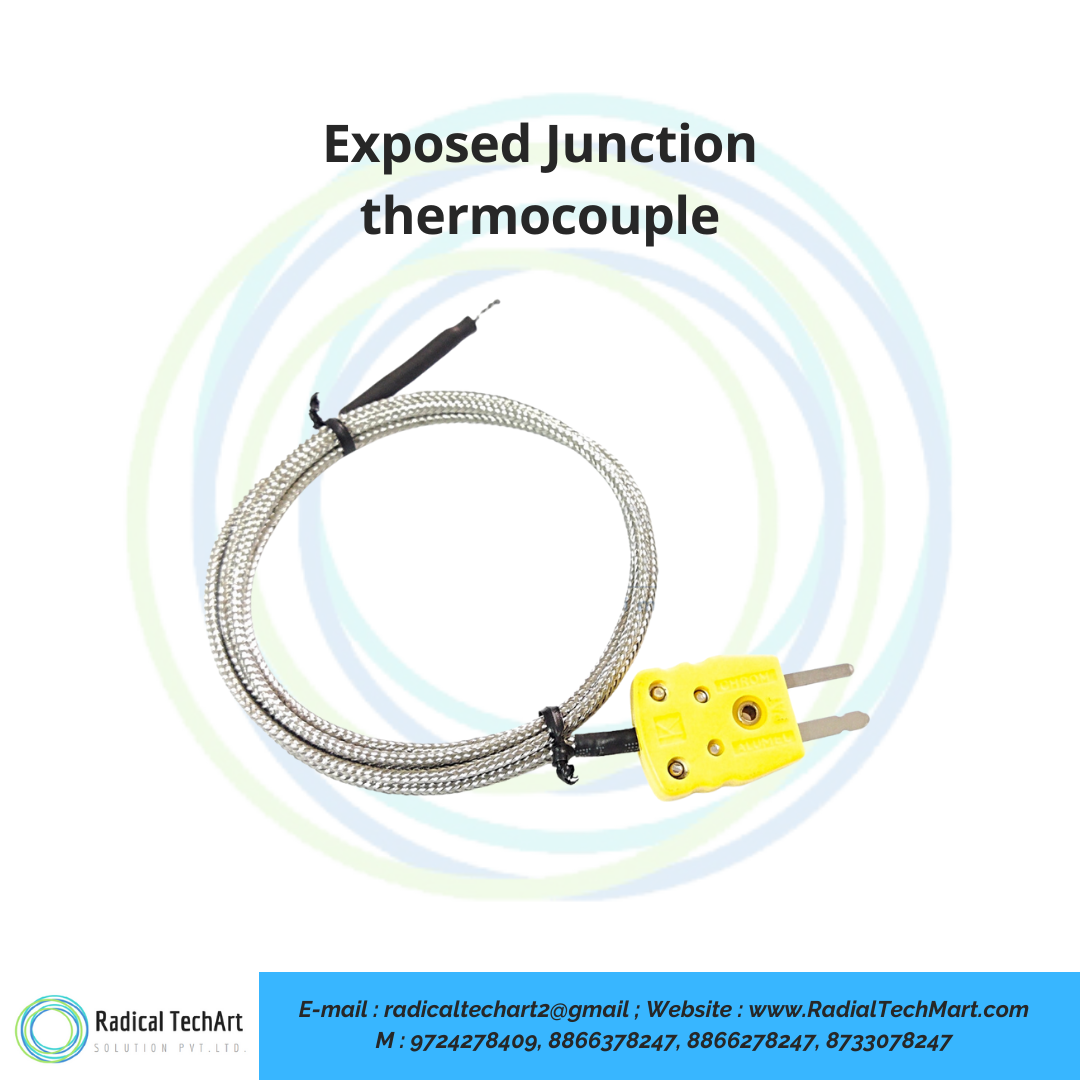


Exposed Junction Thermocouple Wire with Connector
Exposed Junction Thermocouple is a fast response temperature sensor used for direct temperature measurement in testing, development, research, industrial monitoring, and semiconductor applications. It is available in Type E, Type K, Type J, and Type T options with stainless steel braided, Teflon, or fiberglass wire insulation. The exposed junction design provides quick and accurate temperature readings from minus 50°C to 400°C, depending on the selected type and insulation.
Customize
Share :
A. Product Overview
Exposed Junction Thermocouple is designed for applications where fast temperature response and accurate measurement are required. In this type of thermocouple, the sensing junction is directly exposed, allowing it to make direct contact with the surface, air, gas, or material being measured.
It is commonly available in different thermocouple types such as Type K, Type J, Type T, and Type E. The selection depends on the required temperature range, accuracy, response time, and application environment.
This thermocouple is suitable for test and development work, laboratory use, scientific research, industrial trials, semiconductor manufacturing, process checking, and machinery temperature monitoring.
Key Specifications
Type: E, K, J, T
Temperature Range: minus 50°C to 400°C
Connector: Flat pin
Wire Insulation: Stainless steel braided, Teflon, or Fiberglass
Wire Length: 0.5 meter to 2 meter
Junction: Grounded exposed junctionB. Working Principle
An exposed junction thermocouple works on the thermoelectric principle. It is made by joining two different metal wires at one end to form a sensing junction. When this junction experiences a change in temperature, it generates a small voltage signal.
This voltage changes according to the temperature at the sensing point. The signal is then read by a temperature indicator, controller, data logger, or measuring instrument and converted into a temperature value.
In an exposed junction thermocouple, the sensing tip is not covered by a protective sheath. Because of this, the junction directly touches the measuring medium. This gives a much faster response compared to insulated or enclosed junction thermocouples.
C. Why It Is Used
Exposed junction thermocouples are used when quick temperature measurement is more important than heavy mechanical protection. Since the junction is directly exposed, it can detect temperature changes very quickly.
They are used for:
Fast temperature response
Direct contact temperature measurement
Test and development applications
Research and laboratory experiments
Semiconductor manufacturing
Air, gas, and surface temperature checking
Industrial process testing
Machine and equipment temperature monitoring
Temporary temperature measurement during trialsThe exposed junction design helps in getting faster and more accurate readings in controlled environments. However, because the junction is open, it can be affected by physical damage, corrosion, chemical exposure, and rough handling. For this reason, it may require more frequent inspection, calibration, or replacement compared to protected thermocouples.
D. Suitable Buyers
This exposed junction thermocouple is suitable for buyers who need fast response temperature sensing for testing, research, and industrial applications.
Suitable Buyers Include
Research laboratories
Testing and development teams
Semiconductor manufacturing companies
Industrial maintenance teams
Machine manufacturers
Automation engineers
Process industries
Quality control departments
Educational and technical institutes
Temperature instrument dealers
OEM machine builders
Calibration laboratories
Product development companiesThis product is ideal for users who need quick and direct temperature measurement in controlled applications where the sensor is not exposed to heavy mechanical damage or harsh chemical conditions.
FAQ
1. What is an exposed junction thermocouple?
An exposed junction thermocouple is a temperature sensor where the sensing junction is directly exposed. This allows the junction to touch the measuring surface, air, gas, or material directly for faster temperature response.
2. What is the temperature range of this exposed junction thermocouple?
The temperature range is minus 50°C to 400°C, depending on the selected thermocouple type, wire insulation, and application conditions.
3. Which thermocouple types are available?
This thermocouple is available in Type E, Type K, Type J, and Type T options.
4. Why is an exposed junction thermocouple faster than other thermocouples?
Because the sensing junction is directly exposed and not covered by a protective sheath. This allows it to detect temperature changes quickly.
5. Where is an exposed junction thermocouple used?
It is used in test and development, research laboratories, semiconductor manufacturing, industrial testing, machine monitoring, process checking, and direct temperature measurement applications.
6. Is an exposed junction thermocouple suitable for harsh environments?
It is suitable for fast response applications, but it is not ideal for very harsh environments where the sensor may face physical damage, chemical exposure, or heavy corrosion.
7. What wire insulation options are available?
The wire insulation options include stainless steel braided, Teflon, and fiberglass.
8. What connector is used with this thermocouple?
This thermocouple comes with a flat pin connector.
9. What wire length is available?
The available wire length is from 0.5 meter to 2 meter.
10. What is the junction type?
The junction type is grounded exposed junction.
11. Why does this thermocouple require more care?
Since the sensing junction is open and directly exposed, it can be damaged by rough handling, physical contact, or chemical exposure. Regular inspection and calibration are recommended.
12. Is this thermocouple good for accurate temperature measurement?
Yes, it is suitable for accurate and fast temperature measurement, especially where direct contact and quick response are required.