

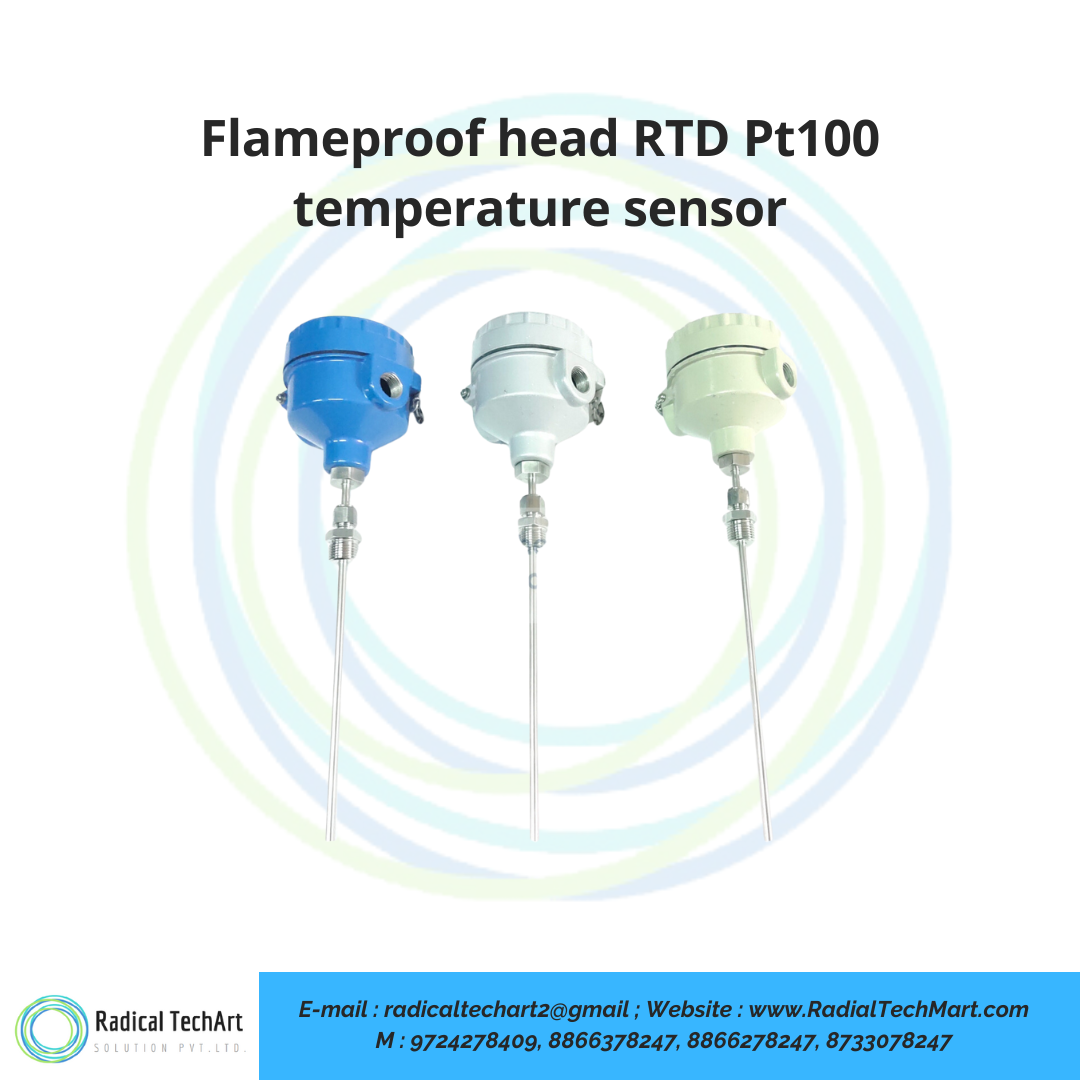
Flameproof Head Pt100 RTD Temperature Sensor with Adjustable Connection
Flameproof Head Pt100 RTD Temperature Sensor is designed for safe and accurate temperature measurement in hazardous and explosive industrial areas. It comes with a flameproof head, platinum Pt100 sensing element, adjustable threaded connection, and suitable sheath materials such as SS304, SS316, S310, and Inconel for reliable performance in demanding process environments.
Customize
Share :
A. Product Overview
The Flameproof Head Pt100 RTD Temperature Sensor is an industrial temperature sensor used to measure temperature safely in hazardous areas where flammable gases, vapours, dust, or explosive atmospheres may be present.
This sensor uses a Pt100 platinum RTD element, which provides accurate and stable temperature measurement. The flameproof head is designed to contain any internal spark or explosion inside the enclosure, preventing ignition of the surrounding atmosphere.
It is commonly used in oil and gas plants, chemical industries, refineries, mining areas, pharmaceutical plants, and other process industries where safety and accuracy are both important.
The sensor is available with simplex or duplex construction, different probe diameters, custom probe lengths, BSP and NPT thread connections, and sheath materials such as SS304, SS316, S310, and Inconel.
B. Working Principle
A Pt100 RTD sensor works on the principle of resistance change with temperature. The sensing element is made from platinum and has a resistance of 100 ohms at 0 degrees Celsius.
When the process temperature changes, the resistance of the platinum element also changes. This resistance change is measured by a temperature indicator, controller, transmitter, or PLC system and converted into a temperature reading.
The flameproof head protects the electrical termination and sensing assembly in hazardous environments. If any spark or small explosion occurs inside the head, the flameproof enclosure contains it and prevents it from spreading outside.
C. Why It Is Used
The Flameproof Head Pt100 RTD Temperature Sensor is used where normal temperature sensors may not be safe due to the presence of explosive gases, vapours, or dust.
It is preferred because it provides accurate temperature measurement, stable long-term performance, safe operation in hazardous areas, strong mechanical protection, and compatibility with industrial control systems.
Its adjustable connection makes installation easier in tanks, pipelines, vessels, reactors, process equipment, and machinery. The flameproof design makes it suitable for critical industries where temperature monitoring and safety compliance are essential.
D. Suitable Buyers
This product is suitable for process industries, plant maintenance teams, automation engineers, electrical contractors, panel builders, OEM machine manufacturers, instrumentation engineers, safety engineers, and purchase teams working in hazardous or explosive area applications.
It is especially useful for oil and gas companies, chemical plants, refineries, pharmaceutical units, mining industries, paint industries, solvent handling areas, food processing plants, and industrial utilities where flameproof temperature measurement is required.
FAQ
1. What is a Flameproof Head Pt100 RTD Temperature Sensor?
A Flameproof Head Pt100 RTD Temperature Sensor is a temperature sensor designed for hazardous areas. It uses a platinum Pt100 RTD element for accurate measurement and a flameproof head for safe operation in explosive environments.
2. Where is this flameproof RTD sensor used?
It is used in oil and gas plants, chemical industries, refineries, mining areas, pharmaceutical plants, process tanks, pipelines, reactors, and other hazardous industrial locations.
3. Why is a flameproof head required in this sensor?
A flameproof head is required to prevent internal sparks or explosions from igniting the surrounding flammable gases, vapours, or dust. It improves safety in hazardous area temperature measurement.
4. What is the benefit of Pt100 in this RTD sensor?
Pt100 offers high accuracy, good stability, and reliable temperature measurement. It is widely used in industrial applications because its resistance changes predictably with temperature.
5. What sheath materials are available for this sensor?
Common sheath materials include SS304, SS316, S310, and Inconel. The material is selected based on temperature range, corrosion resistance, process media, and application requirement.
6. What probe diameter and length options are available?
The probe diameter is commonly available in 5 mm, 6 mm, 8 mm, 10 mm, and 12 mm. Probe length can be customized from 50 mm to 5000 mm as per application requirement.
7. Which thread connections are available?
This sensor can be supplied with BSP and NPT thread connections such as 1/4 inch, 3/8 inch, 1/2 inch, and 3/4 inch, depending on installation requirements.
8. Can this sensor be used in explosive areas?
Yes, this sensor is designed for potentially explosive or hazardous environments where flameproof temperature measurement is required.
9. What is the difference between simplex and duplex RTD sensor?
A simplex RTD sensor has one sensing element, while a duplex RTD sensor has two sensing elements inside the same probe. Duplex sensors are useful when two separate temperature signals are required from one installation point.
10. Is this sensor suitable for industrial automation systems?
Yes, it can be connected with temperature indicators, controllers, transmitters, PLC systems, and other industrial automation equipment for process temperature monitoring and control.