

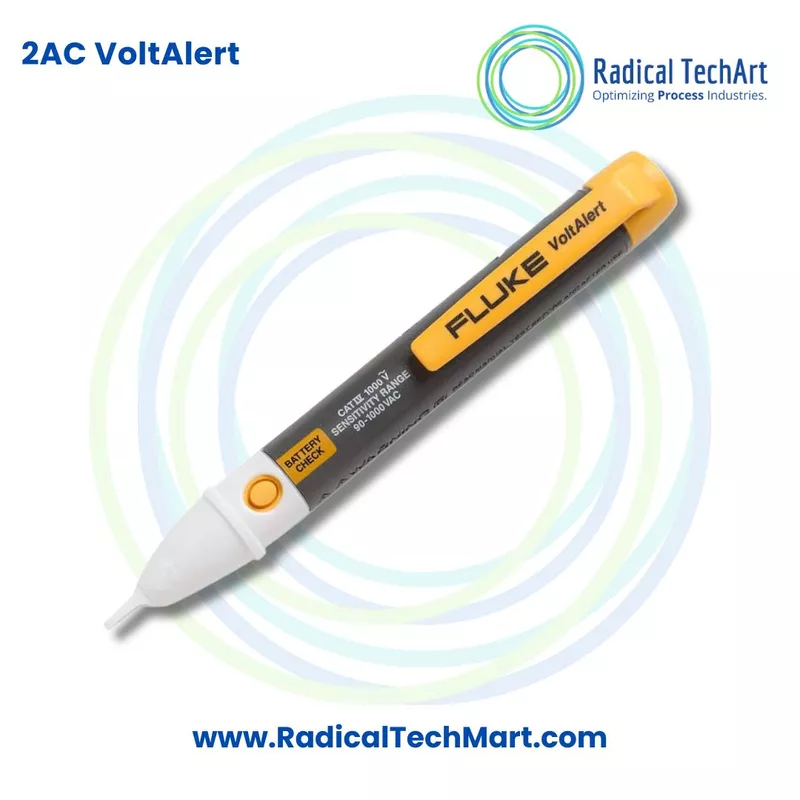


Fluke 2AC VoltAlert Non-Contact Voltage Detector
The Fluke 2AC VoltAlert Non-Contact Voltage Detector is a pocket-sized electrical tester designed to detect AC voltage from 90 V to 1000 V without touching a bare conductor. Its tip glows red when voltage is detected near outlets, terminal strips, cables, power cords, switches, and energized wiring. The always-on design, battery-check function, integrated pocket clip, and CAT IV 1000 V safety rating make it suitable for residential, commercial, and industrial voltage testing.
Customize
Share :
A. Product Overview
The Fluke 2AC VoltAlert is a compact non-contact voltage detector used for quick go or no-go testing of energized AC circuits. It allows users to check whether AC voltage is present without making direct electrical contact with the conductor.
The tester operates across a voltage range of 90 V AC to 1000 V AC. When the tip is brought close to an energized outlet, terminal strip, insulated cable, or power cord, the tip illuminates red to indicate voltage presence.
The Fluke 2AC is designed to remain always on, which reduces setup time during routine electrical checks. It also includes a battery-check function that helps confirm the battery condition before testing. However, the manufacturer specifies that the battery-check function should not replace verification on a known live source before and after use.
Its integrated pocket clip makes the tester easy to carry, while the CAT IV 1000 V rating supports use in demanding electrical environments. According to the technical data, the tester is intended for residential, commercial, and industrial applications and carries a two-year warranty.
Key Features
- Non-contact AC voltage detection
- Detection range from 90 V AC to 1000 V AC
- Red illuminated tip when voltage is detected
- Always-on operation
- Built-in battery-check function
- Integrated pocket clip
- Pocket-sized construction
- CAT IV 1000 V safety rating
- Typical battery life of more than one year
- Suitable for residential, commercial, and industrial use
- Two-year warranty
B. Working Principle
The Fluke 2AC works by sensing the electrostatic field produced by an energized AC conductor.
When AC voltage is present in a wire, outlet, terminal, switch, or power cord, an alternating electric field develops around the conductor. The sensing tip of the Fluke 2AC detects this field through the conductor insulation.
Direct contact with the bare conductor is not required. When the tester detects an electric field within its operating range, the tip glows red to indicate the presence of AC voltage.
Step-by-Step Working Process
- The tester remains active through its always-on design.
- The user checks the tester on a known live source.
- The sensing tip is moved near the outlet, wire, terminal, power cord, or electrical component.
- The tester senses the electrostatic field surrounding an energized AC conductor.
- The tip glows red when voltage is present.
- The tester should again be checked on a known live source after completing the test.
The technical data states that the tester detects AC voltage through insulation and does not require contact with the bare conductor.
C. Why the Fluke 2AC Is Used
The Fluke 2AC is used for quick preliminary detection of AC voltage before electrical maintenance, installation, or troubleshooting work.
Fast Voltage Presence Checks
The tester provides a quick visual indication of whether voltage may be present in an electrical circuit. This helps technicians carry out initial checks before using a contact voltage tester or digital multimeter.
Non-Contact Testing
The user does not need to touch exposed metal or connect test leads. This makes routine voltage checks faster and more convenient.
Identifying Energized Circuits
The Fluke 2AC can help identify energized:
- Electrical outlets
- Terminal strips
- Switches
- Power cords
- Insulated cables
- Junction boxes
- Electrical panels
- Extension cords
- Lighting circuits
- Appliance supply cables
Checking Defective Grounds
The tester can be used as a preliminary tool when checking energized circuits and possible defective ground conditions.
Electrical Troubleshooting
It can help locate voltage presence during diagnosis of:
- Non-working outlets
- Faulty switches
- Broken power cords
- Disconnected wiring
- Tripped circuits
- Interrupted electrical supply
- Energized wires inside panels
- Faulty lighting circuits
Improved Work Efficiency
Because the tester is always on, users can perform repeated checks without selecting a measurement function or connecting test leads.
Portable Everyday Testing Tool
The compact shape and pocket clip make it suitable for carrying during field service, facility maintenance, inspection, and installation work.
D. Suitable Buyers
The Fluke 2AC VoltAlert Non-Contact Voltage Detector is suitable for:
Electricians
Electricians can use it for preliminary voltage checks during wiring, repair, inspection, and maintenance work.
Electrical Maintenance Technicians
Maintenance teams can use it to check circuits, outlets, terminal strips, equipment cables, and electrical panels.
HVAC Technicians
HVAC service professionals can use it to check whether power is present at air conditioners, compressors, thermostats, contactors, and control wiring.
Industrial Maintenance Teams
Factories and production plants can use it for quick voltage-presence checks around machinery, control cabinets, motors, and electrical distribution systems.
Facility Management Companies
Facility technicians can use it in offices, hotels, hospitals, malls, warehouses, schools, and commercial buildings.
Electrical Contractors
Contractors can use it during installation, testing, commissioning, and fault-finding activities.
Appliance Service Technicians
Repair professionals can use it to check appliance power cords, sockets, switches, and incoming electrical supply.
Homeowners and Do-It-Yourself Users
It can be used for basic household checks around outlets, extension cords, switches, lamps, and power cables, provided all safety instructions are followed.
Technical Training Institutes
Training centres can use it to demonstrate non-contact voltage detection and basic electrical safety procedures.
Frequently Asked Questions
1. What is the Fluke 2AC VoltAlert?
The Fluke 2AC VoltAlert is a non-contact voltage detector used to identify the presence of AC voltage without touching a bare conductor.
2. What is the voltage detection range of the Fluke 2AC?
It detects AC voltage from 90 V to 1000 V.
3. How does the Fluke 2AC indicate voltage?
The sensing tip glows red when the tester detects AC voltage.
4. Does the Fluke 2AC need to touch a bare wire?
No. It detects the electrostatic field around an energized AC conductor through insulation.
5. Is the Fluke 2AC always on?
Yes. It is designed to remain always on for faster voltage checks.
6. Does the Fluke 2AC have a battery-check function?
Yes. It includes a battery-check function to help confirm that the battery is in usable condition.
7. Is the battery-check function enough to confirm safe operation?
No. The tester should be checked on a known live source before and after use. The battery-check function is only an additional convenience feature.
8. Can the Fluke 2AC measure the exact voltage value?
No. It is a voltage-presence detector, not a measuring instrument. It indicates whether AC voltage is present but does not display the exact voltage.
9. Can the Fluke 2AC detect DC voltage?
No. It is designed for AC voltage detection.
10. Can the Fluke 2AC detect voltage through insulation?
Yes. It can sense the electric field around energized insulated conductors.
11. Can it be used on electrical outlets?
Yes. It can be used near outlets to check for AC voltage presence.
12. Can the Fluke 2AC test power cords?
Yes. It can help identify voltage presence in power cords and extension leads.
13. Is the Fluke 2AC suitable for industrial use?
Yes. It is suitable for residential, commercial, and industrial voltage checks.
14. What is the safety rating of the Fluke 2AC?
The tester is rated CAT IV 1000 V.
15. What is the operating temperature range?
The listed operating and storage temperature range is minus 10 degrees Celsius to 50 degrees Celsius.
16. What is the maximum operating altitude?
The tester is specified for operation up to 2000 metres under its CAT IV 1000 V rating.
17. How long does the battery normally last?
The technical data lists typical battery life as more than one year.
18. Does the Fluke 2AC have a pocket clip?
Yes. It has an integrated clip designed for pocket storage.
19. What is the warranty period?
The Fluke 2AC carries a two-year warranty according to the technical data.
20. Can the Fluke 2AC replace a multimeter?
No. It is intended for preliminary voltage-presence checks. A properly rated contact tester or digital multimeter should be used when an exact voltage measurement is required.
21. Can the tester confirm that a circuit is safe to touch?
No. A non-contact voltage detector should not be the only method used to establish electrical safety. Proper isolation, lockout procedures, and verification using correctly rated test equipment are required.
22. What are the main applications of the Fluke 2AC?
Common applications include outlet testing, live-wire detection, terminal checks, power-cord inspection, preliminary fault finding, electrical maintenance, HVAC servicing, facility management, and household electrical checks.