

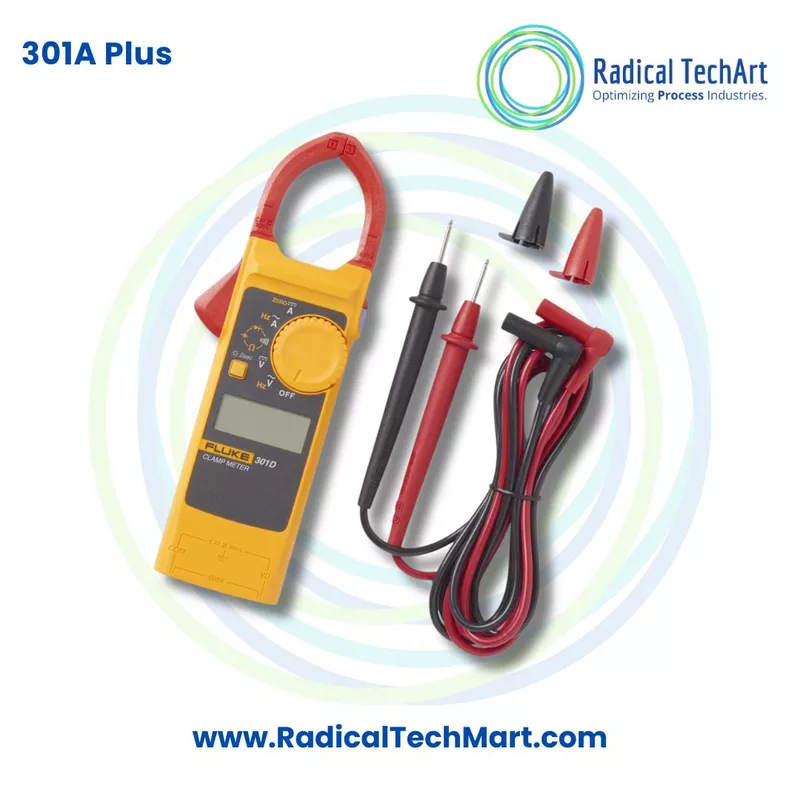


Fluke 301A Plus 400A AC Clamp Meter with Test Leads
Download the manual here!!
Customize
Share :
A. Product Overview
The Fluke 301A Plus 400A AC Clamp Meter with Test Leads is designed for electricians, maintenance technicians and field-service professionals who require a compact instrument for measuring current and testing electrical circuits.
The clamp jaw allows AC current to be measured without disconnecting the conductor. The supplied test leads can be used for voltage, resistance, continuity, capacitance, diode and frequency measurements.
Main Measurement Functions
- AC current up to 400A
- AC voltage up to 600V
- DC voltage up to 600V
- Resistance up to 60 kΩ
- Capacitance up to 999.9 µF
- Voltage frequency from 1 Hz to 99.99 kHz
- AC current frequency from 45 Hz to 400 Hz
- Audible continuity testing
- Diode testing up to 3.000V
The 301A provides 40A and 400A AC current ranges. The 40A range offers 0.01A resolution, which helps users observe smaller changes in current during electrical diagnostics.
General Features
- 6000-count LCD
- Display updates three times per second
- Data Hold function
- Hazardous-voltage indicator
- Automatic power-off after approximately 20 minutes
- Low-battery indication
- 34 mm jaw opening
- Approximately 132 g weight with batteries
- Two AAA alkaline batteries
- Approximately 500-hour stated battery life
- CAT III 300V measurement-category rating
B. Working Principle
AC Current Measurement
When the clamp jaw is positioned around a single current-carrying conductor, the meter detects the magnetic field generated by the alternating current. Its internal sensing circuit converts this magnetic-field signal into an AC current reading.
This clamp-based method allows current to be measured without cutting, opening or disconnecting the conductor.
For correct measurement, the jaw should surround only one conductor. Clamping around both phase and neutral conductors together can cause the magnetic fields to cancel and produce an incorrect reading.
The test leads must not remain connected to the input terminals while measuring current with the clamp jaw.
AC and DC Voltage Measurement
For voltage measurement, the black test lead is connected to the COM terminal and the red test lead is connected to the voltage and resistance terminal.
The probes are placed across the two circuit points being tested. The meter then measures the electrical potential difference and displays the AC or DC voltage according to the selected function.
Resistance Measurement
During resistance testing, the meter applies a small internal test signal through the component or circuit. It measures the response and calculates the resistance value.
Power must be removed from the circuit before resistance measurement. The display indicates an open circuit when the resistance is above the available measuring range.
Continuity Testing
The continuity function checks whether an uninterrupted electrical path exists between two test points.
When the measured resistance is below approximately 30 Ω, the meter sounds an audible buzzer. This helps technicians identify connected wires, closed switches, intact fuses and complete circuit paths without continuously watching the display.
Capacitance Measurement
The meter measures capacitance by charging the capacitor with a known current, monitoring the resulting voltage and calculating the capacitance value.
The capacitor must be isolated from the circuit and safely discharged before measurement.
Diode Testing
The diode-test function applies a controlled test signal across the diode and displays its forward-bias voltage. Reversing the test-lead polarity helps identify the diode’s anode and cathode and determine whether it is conducting correctly.
Frequency Measurement
The Fluke 301A can measure frequency in two ways:
- Through the test leads while testing AC voltage
- Through the clamp jaw while measuring AC current
This function is useful for checking power-supply frequency and the operating frequency of electrical equipment.
C. Why the Fluke 301A Plus Is Used
Non-Intrusive Current Measurement
The clamp jaw allows AC current to be measured without disconnecting the wire. This reduces testing time and helps avoid unnecessary interruption of operating equipment.
Electrical Fault Diagnosis
The meter can help detect:
- Excessive current consumption
- Overloaded circuits
- Incorrect supply voltage
- Open circuits
- Broken wires
- Loose electrical connections
- Failed fuses
- Faulty capacitors
- Defective diodes
- Abnormal motor current
- Electrical control-panel faults
Multiple Measurements with One Instrument
The Fluke 301A combines clamp-current measurement with common multimeter functions. Technicians can use one portable instrument for current, voltage, resistance, continuity, capacitance, diode and frequency testing.
Compact Design for Field Work
The meter measures approximately 190 mm long and weighs around 132 g with batteries. Its slim body and 34 mm jaw opening make it convenient for carrying in a service bag and accessing conductors inside electrical panels.
Capturing Difficult-to-Read Measurements
The Data Hold function freezes the displayed value. This is useful when the display cannot be viewed easily while the meter is positioned around a conductor or inside a crowded electrical panel.
Hazardous-Voltage Warning
The hazardous-voltage symbol appears when the meter detects voltage above approximately 30V or an overload condition in the voltage functions. This provides a visible warning that a potentially dangerous voltage is present.
D. Suitable Buyers
The Fluke 301A Plus 400A AC Clamp Meter is suitable for:
- Industrial electricians
- Electrical contractors
- Electrical maintenance engineers
- HVAC and refrigeration technicians
- Facility maintenance teams
- Field-service technicians
- Control-panel manufacturers
- Machine maintenance technicians
- Motor and pump service professionals
- Commercial building maintenance departments
- Manufacturing plants
- Technical training institutes
- Electrical inspection professionals
- Solar installation technicians
- Generator and power-system service teams
It is particularly suitable for users who need routine AC current measurement along with basic electrical circuit testing in a compact instrument.
Frequently Asked Questions
1. What is the maximum AC current range of the Fluke 301A Plus?
The Fluke 301A measures AC current up to 400A. It provides 40A and 400A ranges.
2. Can the Fluke 301A measure DC current?
No. The clamp jaw measures AC current only. The meter can measure DC voltage through the test leads, but it does not provide DC current measurement.
3. Can it measure AC and DC voltage?
Yes. The Fluke 301A supports AC voltage and DC voltage measurements up to 600V through the test leads.
4. Is the Fluke 301A a True RMS clamp meter?
No. The uploaded Fluke manual identifies the True RMS function specifically with the 301C model. It does not specify the 301A as a True RMS clamp meter.
5. Does the Fluke 301A have a backlit display?
The uploaded manual specifies the backlight function for the 301B and 301C models, not for the 301A. Therefore, a backlight should not be listed for the 301A unless confirmed by a separate official datasheet for the exact 301A Plus product variant.
6. What is the jaw-opening size?
The maximum jaw opening is approximately 34 mm.
7. Does the product include test leads?
The manual lists the Fluke TL75 test lead with two protective caps as the compatible replacement test-lead set. Package contents should still be confirmed against the exact supplier listing before publishing.
8. Does the meter have a Data Hold function?
Yes. The Data Hold function freezes the displayed reading until the Hold button is pressed again.
9. Can it test continuity?
Yes. The audible continuity buzzer operates when the resistance is below approximately 30 Ω.
10. Can the Fluke 301A measure resistance?
Yes. It measures resistance up to 60 kΩ, with 600 Ω, 6 kΩ and 60 kΩ ranges.
11. Can it measure capacitance?
Yes. The meter measures capacitance up to 999.9 µF. The capacitor must be disconnected and discharged before testing.
12. Can it test diodes?
Yes. It provides a diode-test function with a measurement range up to 3.000V.
13. Does it measure frequency?
Yes. It measures voltage frequency from 1 Hz to 99.99 kHz through the test leads and AC current frequency from 45 Hz to 400 Hz through the clamp jaw.
14. What batteries does the meter use?
It operates using two AAA alkaline batteries. The stated battery life is approximately 500 hours under specified conditions.
15. Does it have automatic power-off?
Yes. The meter automatically switches off after approximately 20 minutes without operation to conserve battery power.
16. What is the safety rating?
The uploaded manual specifies a CAT III 300V measurement-category rating according to IEC 61010-2-032.
17. Where can the Fluke 301A Plus be used?
It can be used for electrical panels, motors, pumps, compressors, HVAC equipment, control systems, commercial buildings, manufacturing equipment and general electrical troubleshooting.