

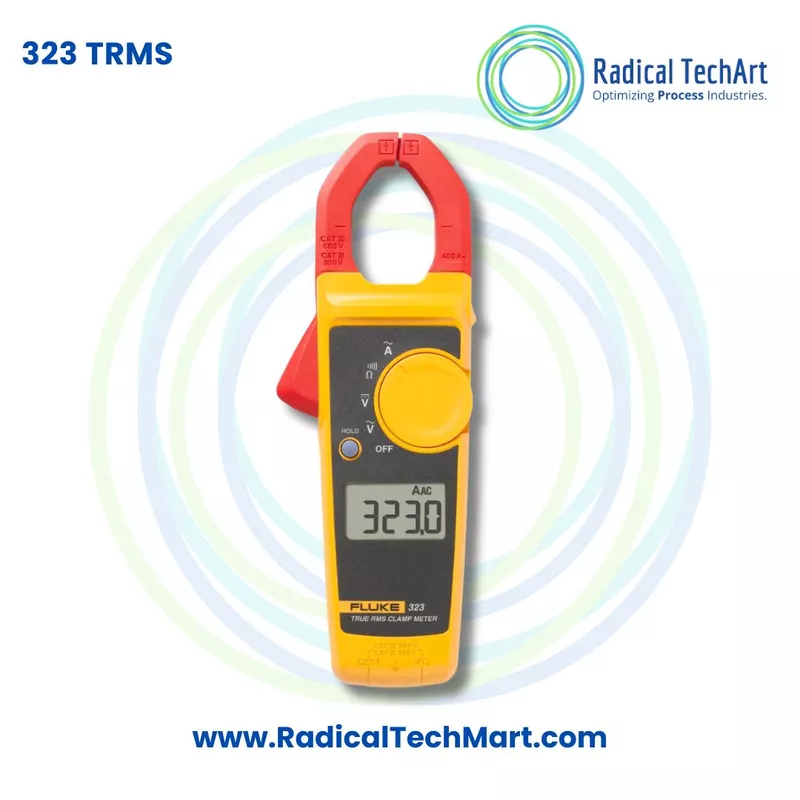
Fluke 323 400A AC TRMS Clamp Meter
The Fluke 323 400A AC True RMS Clamp Meter is a compact electrical testing instrument designed for accurate AC current, AC and DC voltage, resistance, and continuity measurements. Its True RMS capability improves measurement reliability on non-linear electrical loads, while the clamp design allows current testing without disconnecting the conductor. It is suitable for electrical installation, maintenance, troubleshooting, HVAC service, and industrial applications.
Download the manual here!!
Customize
Share :
A. Product Overview
The Fluke 323 is a professional True RMS digital clamp meter designed for electricians, service technicians, HVAC professionals, and industrial maintenance teams. It can measure AC current up to 400 A through its clamp jaw without requiring the conductor to be disconnected.
The meter also measures AC voltage and DC voltage up to 600 V, resistance up to 4000 ohms, and electrical continuity. It provides a continuity buzzer for quick identification of complete circuits and low-resistance connections.
The Fluke 323 is designed with a compact body that supports operation in restricted electrical panels, distribution boards, cable compartments, and control cabinets. Its True RMS measurement system provides more dependable readings when testing loads with distorted or non-sinusoidal waveforms.
According to the product manual, the Fluke 323 has a 400 A AC current range, 600 V maximum voltage rating, CAT III 600 V and CAT IV 300 V safety classifications, and a continuity threshold of 70 ohms or less.
Key Features
- True RMS AC current measurement
- AC current range up to 400 A
- AC voltage measurement up to 600 V
- DC voltage measurement up to 600 V
- Resistance measurement up to 4000 ohms
- Audible continuity testing
- Data hold function
- Compact and ergonomic construction
- Suitable for non-linear electrical loads
- CAT III 600 V safety rating
- CAT IV 300 V safety rating
- Operates using two AAA batteries
- Designed for electrical installation and maintenance work
B. Working Principle
The Fluke 323 measures electrical current by detecting the magnetic field produced around a current-carrying conductor.
When AC current flows through a wire, it creates a magnetic field around the conductor. The clamp jaw is placed around a single conductor, and the meter detects this magnetic field. Internal electronic circuitry converts the detected magnetic field into a current value that appears on the digital display.
The conductor does not need to be cut, disconnected, or inserted directly into the meter. This makes clamp-based current measurement faster and less disruptive than conventional series-current measurement.
For voltage, resistance, and continuity testing, the supplied test leads are connected to the meter terminals.
AC Current Measurement
The clamp jaw is opened and positioned around one live conductor. The meter senses the magnetic field and calculates the AC current flowing through the conductor.
Only one conductor should be placed inside the clamp jaw. Clamping around both phase and neutral conductors may cause the magnetic fields to cancel, resulting in an incorrect or near-zero reading.
True RMS Measurement
True RMS technology calculates the effective value of an AC waveform. This is especially useful when testing non-linear electrical loads such as variable frequency drives, electronic power supplies, LED drivers, computers, motor controls, and HVAC equipment.
Standard averaging meters may produce inaccurate readings on distorted waveforms, while a True RMS meter provides a more representative measurement.
Voltage Measurement
The test leads are connected across the required electrical points. The meter then measures the potential difference between those points and displays the AC or DC voltage.
Resistance Measurement
The meter applies a small internal test signal to the disconnected component or circuit. It calculates resistance based on the response and displays the result in ohms.
Continuity Testing
The continuity function checks whether an electrical path is complete. The Fluke 323 activates its buzzer when the measured resistance is approximately 70 ohms or lower.
C. Why the Fluke 323 Clamp Meter Is Used
The Fluke 323 is used to measure current and troubleshoot electrical systems without disconnecting conductors. It helps technicians identify overloaded circuits, faulty wiring, abnormal current consumption, voltage problems, open circuits, and poor electrical connections.
Non-Intrusive Current Testing
Current can be measured by clamping around a conductor instead of opening the circuit. This reduces testing time and avoids unnecessary interruption of equipment operation.
Accurate Testing of Modern Electrical Loads
Many modern devices produce non-sinusoidal current waveforms. True RMS measurement helps provide reliable readings on equipment such as:
- Variable frequency drives
- Switch-mode power supplies
- Electronic lighting systems
- Air-conditioning units
- Motor control panels
- Industrial automation equipment
- Computers and server power systems
Electrical Troubleshooting
The meter can be used to identify:
- Excessive current draw
- Current imbalance
- Low or high supply voltage
- Open electrical circuits
- Damaged wires
- Loose connections
- Faulty switches
- Blown fuses
- Defective heaters
- Motor operating problems
Preventive Maintenance
Regular current, voltage, resistance, and continuity checks can help identify electrical problems before they cause breakdowns, production stoppages, overheating, or equipment damage.
Improved Working Convenience
The compact clamp design supports measurements inside crowded electrical panels and narrow cable compartments. The data hold function allows the displayed reading to be retained when the screen cannot be viewed during measurement.
Electrical Safety Classification
The CAT III 600 V and CAT IV 300 V ratings make the meter suitable for specified measurements in building distribution systems and at the source of low-voltage installations, subject to correct operating procedures and appropriately rated accessories.
D. Suitable Buyers
The Fluke 323 400A AC True RMS Clamp Meter is suitable for:
Electricians
Electricians can use it for installation checks, current measurement, voltage testing, circuit continuity, and fault diagnosis in residential and commercial electrical systems.
Electrical Maintenance Engineers
Maintenance personnel can use it to inspect motors, control panels, distribution boards, electrical feeders, heating systems, and production machinery.
HVAC Technicians
HVAC professionals can use the meter to check compressor current, fan motor current, supply voltage, wiring continuity, and electrical resistance.
Industrial Maintenance Teams
Factories and process plants can use the Fluke 323 for routine maintenance of motors, pumps, conveyors, control cabinets, heaters, and other electrically powered equipment.
Facility Management Companies
Facility teams can use it for electrical maintenance in offices, hospitals, hotels, malls, warehouses, schools, and commercial buildings.
Panel Builders
Electrical panel manufacturers can use the meter for wiring verification, continuity testing, voltage checking, and operational inspection.
Electrical Contractors
Contractors can use it during installation, commissioning, maintenance, and troubleshooting work.
Service and Repair Technicians
Technicians repairing machines, appliances, and electrical equipment can use it to diagnose current, voltage, resistance, and continuity-related faults.
Technical Training Institutes
Training centres and educational laboratories can use the meter to demonstrate practical electrical measurement and troubleshooting techniques.
Frequently Asked Questions
1. What is the Fluke 323 Clamp Meter?
The Fluke 323 is a True RMS digital clamp meter used for measuring AC current, AC voltage, DC voltage, resistance, and continuity in electrical circuits.
2. What is the maximum AC current range of the Fluke 323?
The Fluke 323 can measure AC current up to 400 A.
3. Can the Fluke 323 measure DC current?
No. The Fluke 323 measures AC current through the clamp jaw. It can measure DC voltage through the test leads, but it does not measure DC current.
4. What voltage can the Fluke 323 measure?
It can measure AC voltage and DC voltage up to 600 V.
5. What does True RMS mean?
True RMS means the meter calculates the effective value of an AC waveform. It provides more reliable measurements on distorted and non-linear electrical signals.
6. Why is True RMS important in a clamp meter?
True RMS is important when measuring equipment such as variable frequency drives, electronic power supplies, motor controllers, LED lighting, HVAC systems, and other loads that do not produce a clean sine wave.
7. Can the Fluke 323 measure resistance?
Yes. It can measure resistance up to 4000 ohms.
8. Does the Fluke 323 have continuity testing?
Yes. It includes an audible continuity function. The buzzer operates when the measured resistance is approximately 70 ohms or below.
9. Can current be measured without disconnecting the wire?
Yes. The clamp jaw measures AC current without cutting or disconnecting the conductor.
10. Should the clamp be placed around both phase and neutral wires?
No. The clamp should normally be placed around one conductor only. Clamping around phase and neutral together may cancel the magnetic fields and produce an incorrect reading.
11. Is the Fluke 323 suitable for electricians?
Yes. It is designed for electricians, HVAC technicians, maintenance engineers, panel builders, contractors, and industrial service professionals.
12. Is the Fluke 323 suitable for industrial use?
Yes. It can be used for industrial electrical maintenance, motor testing, panel inspection, current monitoring, and equipment troubleshooting.
13. What are the safety ratings of the Fluke 323?
The meter is rated CAT III 600 V and CAT IV 300 V.
14. Does the Fluke 323 have a data hold function?
Yes. The data hold function freezes the displayed reading for easier recording and viewing.
15. What type of batteries does the Fluke 323 use?
It operates using two AAA batteries.
16. Can the Fluke 323 measure capacitance or temperature?
No. Capacitance and contact temperature measurement are available on other models in the Fluke 323, 324, and 325 series, but not on the Fluke 323.
17. What is the operating temperature range of the meter?
The specified operating temperature range is from minus 10 degrees Celsius to 50 degrees Celsius.
18. Is the Fluke 323 suitable for tight electrical panels?
Yes. Its compact body and clamp design make it suitable for testing inside crowded distribution boards, control panels, and cable compartments.
19. Can the Fluke 323 be used to confirm that a circuit is safe to touch?
No. A current reading alone should not be used to determine whether a circuit is safe. Voltage must also be measured using the correct procedure and properly rated test equipment.
20. What are the main applications of the Fluke 323?
Typical applications include electrical installation, preventive maintenance, HVAC servicing, motor testing, panel inspection, voltage verification, continuity testing, resistance measurement, and electrical fault diagnosis.