

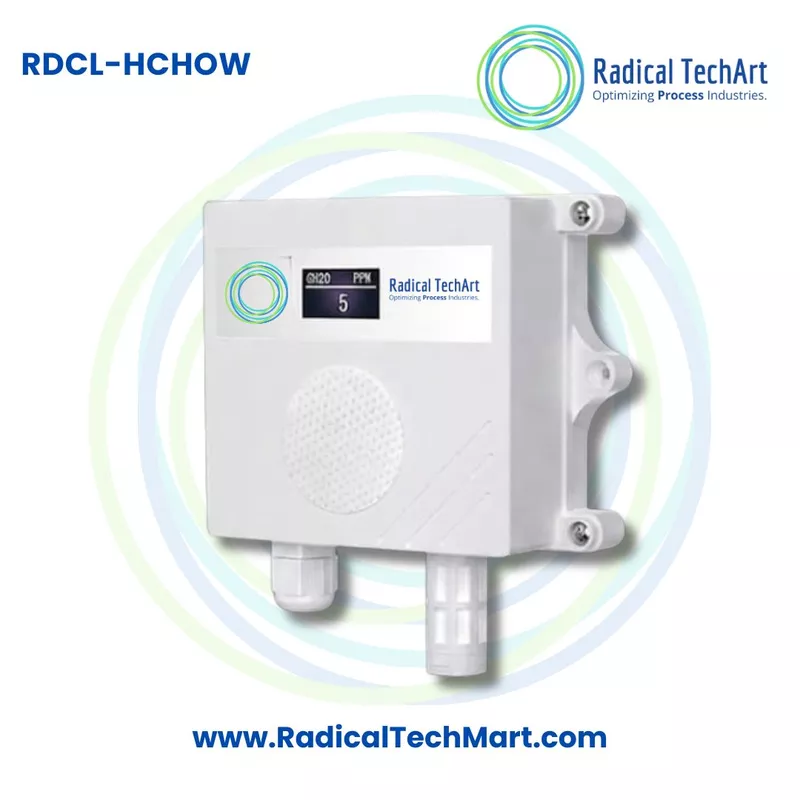


Formaldehyde (HCHO) Gas Sensor and Transmitter | RDCL-HCHOW
The RDCL-HCHOW Formaldehyde (HCHO) Gas Sensor and Transmitter is a high accuracy electrochemical gas detection instrument designed for continuous formaldehyde concentration monitoring in industrial and indoor environments. Featuring a measurement range of 0 to 5 ppm, 0.01 ppm resolution, RS485, 4 to 20mA, 0 to 5V and 0 to 10V output options, it provides reliable gas concentration measurements. Its wall mounted design, optional OLED display and optional temperature and humidity sensing make it suitable for HVAC systems, laboratories, chemical plants, smart buildings and indoor air quality monitoring applications.
Customize
Share :
A. Product Overview
The RDCL-HCHOW Wall Mount Formaldehyde (HCHO) Gas Sensor and Transmitter continuously measures formaldehyde concentration in indoor and industrial air. Formaldehyde (HCHO or CH2O) may be released from furniture, plywood, adhesives, paints, coatings and chemical processes. Elevated exposure can affect respiratory health.
Using electrochemical sensing technology, the RDCL-HCHOW measures 0 to 5 ppm with 0.01 ppm resolution. Available RS485 and analog outputs enable integration with compatible PLC, SCADA, BMS and ventilation systems. The device has a wall mounted enclosure, optional OLED display and optional temperature and humidity sensing.
Key Features
Electrochemical formaldehyde sensing for continuous monitoring
Measurement range: 0 to 5 ppm; resolution: 0.01 ppm
Accuracy: ±5% full scale under reference conditions
Response time: 35 seconds or less; repeatability: 2% or better
Outputs: RS485, 4 to 20 mA, 0 to 5V or 0 to 10V
Supply: 10 to 30V DC
Optional OLED display and temperature and humidity measurement
Wall mounted installation for industrial and indoor applications
Technical Specifications
Parameter | Specification |
|---|---|
Model | RDCL-HCHOW |
Gas Detected | Formaldehyde (HCHO or CH2O) |
Sensing Technology | Electrochemical |
Measurement Range | 0 to 5 ppm |
Resolution | 0.01 ppm |
Accuracy | ±5% FS at 1 ppm, 25°C and 50% RH |
Repeatability | ≤2% |
Response Time | ≤35 seconds |
Stability | ≤7% of signal value per year |
Zero Drift | ≤±0.5 ppm from −20°C to 40°C |
Outputs | RS485, 4 to 20 mA, 0 to 5V, 0 to 10V |
Power Supply | 10 to 30V DC |
Power Consumption | 0.12W |
Operating Temperature | −20°C to 50°C |
Operating Humidity | 15% to 90% RH, non-condensing |
Operating Pressure | 91 to 110 kPa |
Warm Up Time | At least 5 minutes |
Installation | Wall Mount |
Display | Optional OLED |
Additional Measurement | Optional temperature and humidity |
B. Working Principle
The RDCL-HCHOW uses an electrochemical sensing element to turn formaldehyde concentration into a measurable electrical signal.
Gas Diffusion: Formaldehyde in the air enters the sensor through a gas permeable interface.
Electrochemical Reaction: HCHO reacts at the sensing electrode and generates a small electrical current related to concentration.
Signal Processing: Internal electronics convert the signal into a formaldehyde reading in parts per million (ppm).
Output Transmission: The transmitter sends measurements via the selected RS485 or analog output to compatible controllers and monitoring systems.
Continuous Monitoring: Connected equipment can log HCHO levels and support ventilation or alarm functions when appropriately configured.
C. Why Is the RDCL-HCHOW Used?
The sensor helps identify elevated formaldehyde concentration and supports indoor air quality and industrial environmental monitoring.
Indoor Air Quality: Monitor emissions from furniture, plywood, flooring, adhesives and paints in offices or commercial buildings.
Workplace Monitoring: Assess HCHO concentration where formaldehyde containing materials are handled.
Chemical Manufacturing: Monitor selected production, processing and storage areas.
HVAC and Ventilation: Supply gas concentration data to compatible building automation and ventilation controllers.
Paint and Wood Industries: Monitor areas using coatings, resins and adhesives.
Laboratories: Measure ambient HCHO in facilities handling formaldehyde solutions.
Industrial Automation: Integrate readings with compatible PLC, SCADA and data acquisition systems.
Typical applications include indoor air quality systems, smart buildings, commercial facilities, chemical plants, furniture factories, laboratories and environmental monitoring installations.
D. Suitable Buyers
Suitable Buyers | Typical Applications |
|---|---|
HVAC Contractors | Indoor air and ventilation monitoring |
BMS Integrators | Centralized HCHO measurement |
Chemical Manufacturers | Process and storage area monitoring |
Environmental Monitoring Companies | Indoor and industrial air assessment |
Furniture and Wood Processors | Adhesive and resin emission monitoring |
Paint and Coating Manufacturers | Manufacturing area monitoring |
Laboratory Managers | Formaldehyde monitoring in laboratories |
OEM Manufacturers | Integration into gas monitoring equipment |
EHS Teams | Workplace exposure assessment |
Instrumentation Engineers | Fixed monitoring and automation |
E. Frequently Asked Questions
1. What is the RDCL-HCHOW?
The RDCL-HCHOW is a wall mounted electrochemical formaldehyde gas sensor and transmitter for continuous HCHO measurement in ambient air.
2. What are its range and resolution?
The reference range is 0 to 5 ppm with 0.01 ppm resolution.
3. How does the formaldehyde sensor work?
HCHO reacts at an electrochemical sensing electrode, generating a signal that is processed into a ppm reading.
4. Which output signals are available?
RS485, 4 to 20 mA, 0 to 5V and 0 to 10V are available output options.
5. Can it connect to PLC or SCADA?
Yes, using a compatible analog or RS485 interface. Confirm communication protocol compatibility before installation.
6. What power supply does it require?
A 10 to 30V DC supply.
7. Is it suitable for indoor air quality monitoring?
Yes. It can measure formaldehyde in applicable offices, commercial buildings, laboratories and other indoor environments.
8. Can it measure temperature and humidity?
Optional temperature and humidity measurement is available in selected configurations.
9. Does it have a display?
An optional OLED display provides local formaldehyde readings.
10. What are its response time and accuracy?
Response time is 35 seconds or less. Reference accuracy is ±5% FS at 1 ppm, 25°C and 50% RH.
11. Where can it be installed?
In suitable chemical facilities, laboratories, buildings, paint and wood processing areas and HVAC monitoring installations.
12. Can it detect formaldehyde leakage?
It can identify elevated ambient HCHO levels. Safety critical alarming requires an appropriately designed and verified detection system.
13. What is the difference between an HCHO sensor and transmitter?
A sensor detects HCHO; a transmitter processes its signal and provides an output such as RS485 or 4 to 20 mA.