

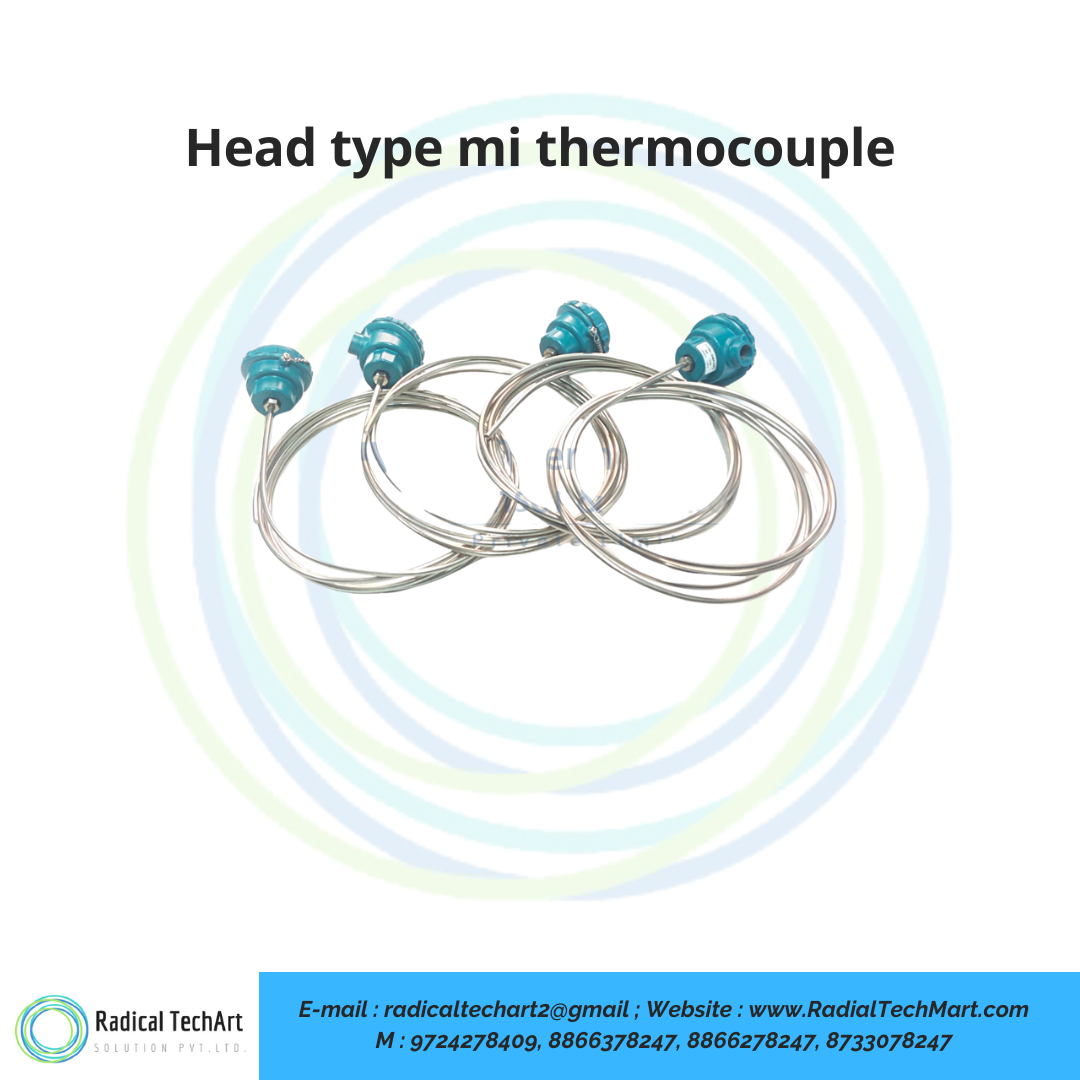
Head Type MI Thermocouple
Head Type MI Thermocouple is a rugged industrial temperature sensor designed for accurate and reliable temperature measurement in high-temperature and harsh process environments. It uses mineral insulated cable with a durable metal sheath and a protective terminal head for easy wiring, strong mechanical protection, and long service life.
Customize
Share :
A. Product Overview
Head Type MI Thermocouple is a mineral insulated temperature sensor used for measuring temperature in industrial processes, machinery, furnaces, reactors, pipelines, boilers, and high-temperature equipment.
The sensor is constructed using a metal sheath filled with highly compacted mineral insulation, usually magnesium oxide. This construction provides excellent thermal conductivity, electrical insulation, mechanical strength, and resistance against vibration and harsh working conditions.
The head section is generally made from aluminum, stainless steel, or cast iron. It protects the terminal connection and allows easy connection between the thermocouple and the measuring instrument, temperature controller, data logger, indicator, or PLC system.
Head Type MI Thermocouples are available in different thermocouple types such as K Type, J Type, N Type, and T Type, depending on the temperature range and application requirement. They can also be customized in different probe diameters, lengths, sheath materials, head types, and process connections.
B. Working Principle
A thermocouple works on the Seebeck effect. It consists of two different metal wires joined together at one sensing junction. When this junction is exposed to heat, it generates a small voltage signal. This voltage changes according to the temperature at the sensing point.
In a Head Type MI Thermocouple, the sensing element is protected inside a mineral insulated metal sheath. The compacted mineral insulation helps transfer heat quickly from the process area to the sensing junction while also keeping the wires electrically insulated.
The generated millivolt signal is carried to the terminal head, where it is connected to a temperature indicator, controller, transmitter, data logger, or PLC. The instrument then converts the thermocouple signal into a temperature reading.
C. Why It Is Used
Head Type MI Thermocouple is used when accurate, stable, and durable temperature measurement is required in demanding industrial environments.
It is preferred because it offers:
Reliable temperature measurement in high-temperature applications
Strong protection against vibration, pressure, and mechanical damage
Fast response due to mineral insulated construction
Easy wiring and maintenance through the protective terminal head
Good performance in furnaces, reactors, boilers, pipelines, and process equipment
Customizable probe length, diameter, sheath material, and head type
Suitable design for continuous industrial temperature monitoring
Long service life compared to ordinary thermocouple probes
This type of thermocouple is especially useful where the sensor must withstand heat, vibration, chemical exposure, and rough plant conditions.
D. Suitable Buyers
Head Type MI Thermocouple is suitable for:
Process industries requiring temperature measurement
Chemical plants
Pharmaceutical manufacturing units
Food processing plants
Power plants
Boiler manufacturers
Furnace manufacturers
Petrochemical industries
Oil and gas plants
Plastic machinery manufacturers
Heat treatment plants
Cement plants
Steel plants
OEM machine manufacturers
Panel builders
Automation system integrators
Maintenance departments
Instrumentation engineers
Purchase teams looking for customized temperature sensors
FAQ
1. What is a Head Type MI Thermocouple?
A Head Type MI Thermocouple is a mineral insulated thermocouple sensor with a protective terminal head. It is used for industrial temperature measurement in furnaces, boilers, reactors, pipelines, machinery, and process equipment.
2. What does MI mean in MI Thermocouple?
MI means Mineral Insulated. In this design, the thermocouple wires are insulated with compacted mineral insulation inside a metal sheath. This improves heat transfer, electrical insulation, mechanical strength, and durability.
3. Why is a head provided in this thermocouple?
The head protects the terminal connection from dust, moisture, vibration, and mechanical damage. It also makes wiring easier and allows the thermocouple to be connected safely to a controller, indicator, transmitter, data logger, or PLC.
4. Which thermocouple types are available in Head Type MI Thermocouple?
Head Type MI Thermocouples are commonly available in K Type, J Type, N Type, and T Type. The correct type depends on the temperature range, process condition, and application requirement.
5. Where is Head Type MI Thermocouple used?
It is used in furnaces, boilers, reactors, pipelines, chemical plants, pharmaceutical plants, food industries, power plants, plastic machinery, heat treatment equipment, and general process control applications.
6. What sheath material is used in Head Type MI Thermocouple?
Common sheath materials include stainless steel 304, stainless steel 316, stainless steel 310, Inconel, and other high-temperature alloys. The sheath material is selected based on temperature, corrosion, and process environment.
7. Can Head Type MI Thermocouple be customized?
Yes, it can be customized as per application requirements. Probe diameter, probe length, thermocouple type, sheath material, head type, process connection, and cable termination can be selected according to the customer’s need.
8. Is Head Type MI Thermocouple suitable for high-temperature applications?
Yes, Head Type MI Thermocouple is suitable for high-temperature industrial applications. The actual temperature range depends on the thermocouple type and sheath material selected.
9. What instruments can be connected with this thermocouple?
It can be connected with temperature indicators, PID controllers, temperature transmitters, data loggers, PLC systems, recorders, and automation control panels.
10. How should I select the right Head Type MI Thermocouple?
To select the right sensor, confirm the temperature range, thermocouple type, probe diameter, probe length, sheath material, process connection, head type, and working environment. For corrosive, high-temperature, or vibrating applications, proper sheath material and construction are very important.