

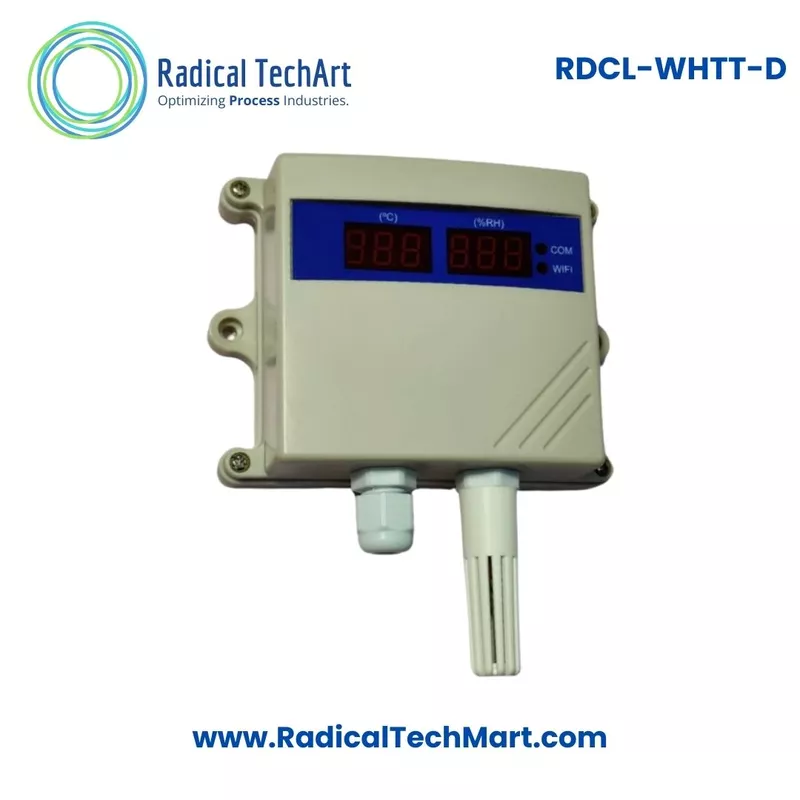


Wall-Mount Humidity and Temperature Transmitter with Display
Customize
Share :
A. Product overview
The Temperature & Humidity Transmitter is a compact, wall-mount monitoring device designed to measure ambient relative humidity (0–100% RH) and temperature (0–100°C) in industrial and commercial indoor environments. It provides a stable 4–20 mA output signal for easy integration with PLCs, BMS/building automation systems, DCS/SCADA, data loggers, and panel indicators. With complete isolation between input power, temperature unit, and signal output, it is built for reliable operation in automation applications such as communication rooms and warehouses where stable monitoring is required.B. Working principle
Sensing: The internal sensing elements continuously detect humidity and temperature in the surrounding air.
Signal conditioning: The transmitter processes the raw sensor signals, applies scaling and linearization, and ensures measurement stability.
Electrical isolation: The power input and output signal circuits are isolated to reduce interference, improve safety, and protect connected control systems.
Output conversion: The measured values are converted into a standard 4–20 mA signal that can be transmitted over longer cable runs with good noise immunity and read by industrial controllers.
C. Why it is used
Continuous monitoring of temperature and humidity to maintain stable environmental conditions
Improved process control by feeding live data to automation systems (PLC/BMS/DCS/SCADA)
Safety and reliability in industrial installations due to isolated power and signal circuits
Better equipment protection and asset reliability in areas like communication rooms, server spaces, and control panels
Monitoring in warehouses and storage areas to help reduce moisture-related damage, corrosion, and quality issues
D. Suitable buyers
HVAC and building automation (BMS) system integrators
Industrial automation panel builders and PLC integrators
Facility management teams for warehouses, plants, and commercial buildings
Data center, server room, telecom, and communication room operators
OEMs needing ambient monitoring for machines, panels, or enclosures
Maintenance (MRO) teams responsible for environmental monitoring and compliance
FAQ
1. What is a temperature and humidity transmitter used for?
It measures ambient temperature and relative humidity and sends the readings as a standard signal to a controller or monitoring system for automation, alarms, and reporting.
2. What is the output signal of this transmitter?
It provides a 4–20 mA output signal, which is widely used in industrial automation and building management systems due to its noise immunity and long-distance transmission capability.
3. What are the measurement ranges?
Humidity: 0–100% RH
Temperature: 0–100°C
4. What is the accuracy of the transmitter?
Humidity accuracy is ±3% RH (default). Temperature accuracy is ±0.5°C (default).
5. What power supply is required?
It operates on 10–30V DC, making it suitable for typical 24V DC control panels.
6. Where can this transmitter be installed?
It is commonly installed in communication rooms, warehouses, and automation environments where continuous temperature and humidity monitoring is required.
7. Can it be connected to PLC, BMS, or SCADA systems?
Yes. The 4–20 mA output is compatible with PLC analog inputs, BMS controllers, DCS/SCADA systems, and data loggers.
8. What does “complete isolation” mean and why is it important?
Isolation means the input power and output signal circuits are electrically separated, improving safety, reducing electrical noise issues, and protecting connected automation equipment.