

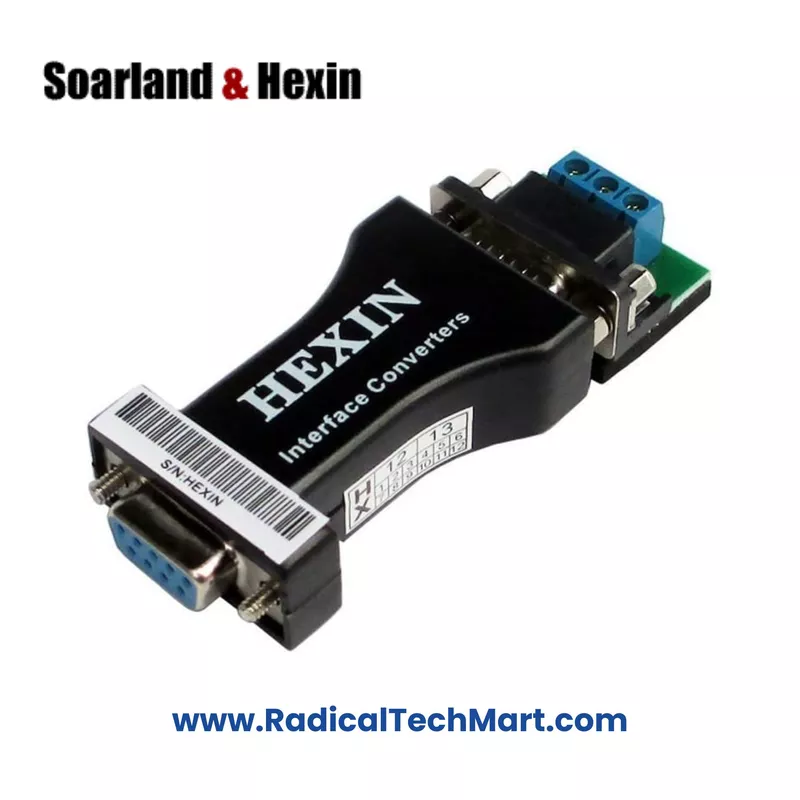


HXSP-485 RS-232 to RS-485 Converter
HXSP-485 RS-232 to RS-485 Converter (2-Wire, Passive Powered)
Bidirectional RS-232 to RS-485 converter for 2-wire half-duplex communication up to 1200 m. Ideal for SCADA, billing, access control and industrial automation networks, powered directly from the RS-232 port.
Customize
Share :
The HXSP-485 RS-232 to RS-485 Converter is a compact, bidirectional serial interface converter that converts RS-232 TXD/RXD signals to 2-wire half-duplex RS-485. Designed for master–slave and multi-drop networks, it is widely used in power systems, industrial automation, IC card billing, one-card solutions, access control, parking systems, and other serial communication applications. The converter is typically powered directly from the RS-232 port, eliminating the need for an external power supply in most installations.
Key Features
Bidirectional RS-232 ↔ RS-485 serial converter
2-wire half-duplex RS-485 communication
Passive powered from RS-232 (TXD, RTS, DTR) – no external supply in most cases
Optional external power via RS-485 side (+5 to +12 V) when required
Communication distance up to 1200 m on RS-485 side, 5 m on RS-232 side
Supports baud rates from 300 to 115,200 bps
Transparent communication – no protocol conversion, upper layer unchanged
DB9 female RS-232 connector and DB9 male + terminal block RS-485 interface
Supports point-to-point and multi-point RS-485 networks (up to 32 devices with proper termination)
Operating temperature from -10°C to 85°C, 5–95% RH
Technical Specifications
| Parameter | Value |
|---|---|
| Model | HXSP-485 |
| Function | Bidirectional RS-232 to RS-485 Converter |
| RS-232 Standard | EIA RS-232 |
| RS-485 Standard | EIA RS-485 (2-wire half-duplex) |
| RS-232 Connector | DB9 female |
| RS-485 Connector | DB9 male with 4/6-pin terminal block |
| Work Mode | Asynchronous, point-to-point or multi-point |
| Transmission Medium | Twisted pair or shielded cable |
| Baud Rate | 300 to 115,200 bps |
| Distance | RS-232: up to 5 m; RS-485: up to 1200 m |
| Communication Protocol | Transparent (no change to data frame) |
| RS-232 Signals | TXD, RXD, GND (plus RTS, DTR for power) |
| RS-485 Signals | Data+, Data-, GND, optional +5~+12 V |
| Power (Normal) | Powered from RS-232 TXD/RTS/DTR (≥ +5 V level) |
| Power (Alternative) | +5~+12 V from RS-485 pin 4 (or 6) and GND |
| Operating Temperature | -10°C to 85°C |
| Humidity | 5% to 95% RH (non-condensing) |
| Housing | Compact DB9-type converter |
| Warranty | 1 Year |
Applications
RS-232 host to RS-485 field devices
Multi-drop RS-485 networks from a PC COM port
SCADA, RTU, and PLC serial communication
IC card billing and “one-card” systems
Access control & parking management systems
General industrial automation and remote monitoring
What’s in the Box
1× HXSP-485 RS-232 to RS-485 Converter
1× Quick user/connection guide
(If you ship any cable or external power adapter, you can add that as a line.)
FAQ (4–6 Q&A)
1) When do I need external power for the HXSP-485?
Normally the converter is powered from the RS-232 TXD, RTS, and DTR pins (voltage ≥ +5 V). If the RS-232 port cannot provide sufficient power, you can supply +5~+12 V from the RS-485 side using the appropriate terminal pins.
2) What is the maximum communication distance?
The RS-232 side supports up to 5 m, while the RS-485 side can reach up to 1200 m using twisted pair or shielded cable and correct termination.
3) How many RS-485 devices can I connect?
In a typical RS-485 multi-drop network, one RS-232 host (through the HXSP-485) can control up to 32 RS-485 devices, provided the line is correctly terminated with 120 Ω resistors at the ends.
4) Is any special protocol required?
No. The converter provides transparent transmission. Existing RS-232 protocols and data frames work unchanged over RS-485.
5) What baud rates are supported?
The converter supports baud rates from 300 bps to 115,200 bps, suitable for most industrial and billing systems.
6) What type of wiring should I use on RS-485?
Use twisted pair or shielded twisted pair cable for Data+ and Data- lines, with proper grounding. Terminating resistors (120 Ω) should be added at both ends of long RS-485 lines.