

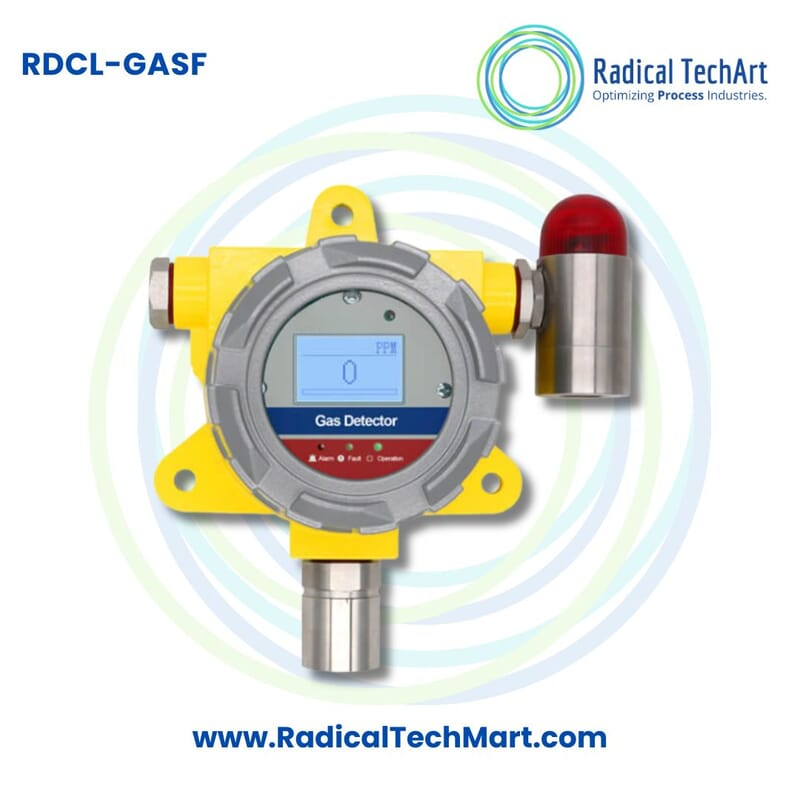


Industrial Fixed Gas Detector with LCD Display and Alarm | RDCL-GASF
The RDCL-GASF Industrial Fixed Gas Detector is a wall-mounted gas monitoring instrument designed for continuous detection of hazardous gases in industrial environments. Featuring a digital LCD display, audible and visual alarms, electrochemical sensing technology and configurable gas measurement ranges, it provides reliable gas concentration monitoring. With 4 to 20 mA, RS485 Modbus RTU and voltage output options, this fixed gas detector is suitable for chemical plants, oil and gas industries, wastewater treatment facilities, refineries, manufacturing plants and industrial safety applications.
Customize
Share :
A. Product Overview
The RDCL-GASF Industrial Fixed Gas Detector with LCD Display and Alarm is a wall-mounted instrument for continuous monitoring of a selected gas in industrial environments. It displays real-time concentrations and activates audible and visual alarms when preset limits are reached.
Gas-specific versions are available for Carbon Monoxide (CO), Hydrogen Sulfide (H2S), Oxygen (O2), Ammonia (NH3), Ozone (O3), Chlorine (Cl2), Hydrogen (H2), Sulfur Dioxide (SO2), Nitrogen Dioxide (NO2), Formaldehyde (CH2O) and other supported gases. Output options enable integration with PLCs, SCADA and gas alarm panels.
Key Features
- Continuous, real-time single-gas monitoring with electrochemical sensing.
- LCD display with built-in audible and visual alarms.
- Configurable high and low gas alarm thresholds.
- Output options: 4 to 20 mA, 0 to 5 V, 0 to 10 V and RS485 Modbus RTU.
- Remote infrared parameter configuration without opening the enclosure.
- 10 to 30 V DC supply and wall-mounted design.
- IP66 enclosure in the referenced configuration.
- Explosion-protection design for applicable hazardous areas, subject to valid certification and site requirements.
- Multiple gas types and measurement ranges to suit industrial applications.
Technical Specifications
| Parameter | Specification |
|---|---|
| Model | RDCL-GASF |
| Product Type | Industrial Fixed Gas Detector |
| Installation | Wall Mounted |
| Sensor Technology | Electrochemical |
| Detectable Gas | One selected gas per detector |
| Display | Digital LCD |
| Alarm | Audible and Visual |
| Supply | 10 to 30 V DC |
| Output Options | 4 to 20 mA, 0 to 5 V, 0 to 10 V, RS485 |
| Protocol | Modbus RTU |
| RS485 Distance | Up to 2000 metres |
| Protection | IP66 |
| Operating Temperature | -20°C to 50°C for listed gas configurations |
| Relay Rating | 250 V AC, 1 A or 30 V DC, 1 A |
| Configuration | Remote Infrared Control |
| Explosion Protection Reference | Ex db IIC T6 Gb; Ex tb IIIC T80°C Db |
Available Gas Detection Options
| Gas | Typical Measurement Range |
|---|---|
| Carbon Monoxide (CO) | 0 to 1000 ppm |
| Hydrogen Sulfide (H2S) | 0 to 100 ppm |
| Oxygen (O2) | 0 to 30% VOL |
| Ammonia (NH3) | 0 to 50 or 0 to 100 ppm |
| Ozone (O3) | 0 to 100 ppm |
| Chlorine (Cl2) | 0 to 20, 0 to 50 or 0 to 100 ppm |
| Hydrogen (H2) | 0 to 1000 ppm |
| Sulfur Dioxide (SO2) | 0 to 20 or 0 to 2000 ppm |
| Nitrogen Dioxide (NO2) | 0 to 20 or 0 to 2000 ppm |
| Formaldehyde (CH2O) | 0 to 5 ppm |
Note: This is a single-gas detector. Gas type, range, accuracy, response time and available outputs depend on the chosen variant. Confirm the selected version and certification before ordering.
B. Working Principle
The RDCL-GASF uses electrochemical gas sensing and continuous ambient-air monitoring:
- Gas Sampling: Surrounding air reaches the installed sensor by natural diffusion.
- Detection: The target gas reacts at the electrochemical sensing element, generating a concentration-related electrical signal.
- Processing: Electronics process and calibrate the signal to calculate gas concentration in ppm or % VOL, as applicable.
- Display: The LCD shows the measured gas concentration in real time.
- Alarm: Audible and visual alerts activate at configured alarm thresholds.
- Transmission: Depending on the variant, readings are sent via analog signals or RS485 Modbus RTU to compatible PLC, SCADA or gas alarm systems.
- Continuous Operation: While correctly powered and maintained, the detector monitors the installed location without repeated handheld checks.
C. Why Is an Industrial Fixed Gas Detector Used?
Industrial processes may release toxic gases or create oxygen-deficient atmospheres. A fixed detector helps identify elevated concentrations at a designated monitoring point, warns personnel and supports continuous plant safety monitoring.
Major Applications
- Chemical Manufacturing: Monitoring gases such as NH3, Cl2, H2S and SO2 near processing and storage equipment.
- Oil and Gas: Fixed detection of selected hazards at processing stations, equipment and maintenance areas.
- Petrochemical Plants and Refineries: Toxic gas monitoring in process and storage locations.
- Sewage and Wastewater Treatment: H2S and other relevant gas monitoring near treatment equipment and pump rooms.
- Pharmaceutical Facilities: Monitoring supported gases in production and chemical-handling areas.
- Industrial Gas Storage: Detection of elevated gas concentrations near cylinder banks and gas-handling systems.
- Manufacturing Plants: Monitoring gases used or produced in industrial processes.
- Mining and Underground Facilities: Fixed monitoring at suitable, assessed locations for supported gas hazards.
- Industrial Laboratories: Monitoring selected toxic gases in testing and research spaces.
- Automation and Safety Systems: Integration with PLC, SCADA and alarm panels for centralized monitoring.
Benefits
- Continuous measurements and local audible/visual warnings.
- Earlier identification of hazardous gas concentrations.
- Less reliance on periodic manual spot checks.
- Integration with centralized safety and automation systems.
- Permanent monitoring at identified risk locations.
- Selection of gas-specific ranges and communication outputs.
D. Suitable Buyers
| Suitable Buyers | Typical Requirements |
|---|---|
| Chemical Manufacturers | Toxic gas and leak monitoring |
| Oil, Gas and Petrochemical Companies | Fixed gas safety monitoring |
| Refineries | Hazardous gas monitoring in processing areas |
| Sewage and Wastewater Plants | H2S and relevant gas detection |
| Pharmaceutical Manufacturers | Gas monitoring in controlled processing areas |
| Industrial Safety, EHS and HSE Teams | Workplace gas hazard alerts |
| Factory and Plant Managers | Permanent gas monitoring equipment |
| Automation Companies and System Integrators | PLC, SCADA and alarm panel connectivity |
| Engineering and EPC Contractors | Gas monitoring systems for industrial projects |
| Industrial Maintenance Contractors | Installation and replacement of detectors |
| Laboratories | Fixed monitoring of selected gases |
| Gas Detection Distributors | Supply of gas-specific detector variants |
Frequently Asked Questions (FAQs)
1. What is the RDCL-GASF Industrial Fixed Gas Detector?
It is a permanently installed, wall-mounted detector that measures one selected gas continuously and provides LCD readings, audible/visual alarms and optional industrial outputs.
2. What is a fixed gas detector used for?
It monitors gas concentration at an installed location and warns when preset concentration thresholds are reached.
3. Which gases can the RDCL-GASF detect?
Available variants cover CO, H2S, O2, NH3, O3, Cl2, H2, SO2, NO2, CH2O and other supported gases. Select the appropriate sensor version.
4. Can the RDCL-GASF detect multiple gases simultaneously?
No. The referenced model monitors one selected gas. Multiple detectors or a dedicated multi-gas system are needed for simultaneous multi-gas coverage.
5. Does the RDCL-GASF have a built-in alarm?
Yes. Its audible and visual alarms activate when the measured gas concentration reaches configured limits.
6. What output signals are available?
Depending on configuration, outputs include 4 to 20 mA, 0 to 5 V, 0 to 10 V and RS485 Modbus RTU. Confirm the required option when ordering.
7. Can it connect to PLC or SCADA systems?
Yes. Compatible versions can connect through 4 to 20 mA or RS485 Modbus RTU for remote monitoring.
8. Does the RDCL-GASF support RS485 Modbus RTU?
Yes, on the relevant communication variant, with configurable device address and baud rate.
9. What power supply is required?
The referenced detector operates on 10 to 30 V DC.
10. Is the RDCL-GASF suitable for hazardous areas?
The referenced design includes explosion-protection markings, but actual suitability depends on the selected unit's valid certification and the site's hazardous-area classification. Verify both before installation.
11. What is its protection rating?
The referenced configuration is IP66 rated for dust and powerful water-jet protection, subject to correct installation and manufacturer limitations.
12. How does a fixed detector differ from a portable detector?
A fixed detector is permanently installed for ongoing monitoring at one location. A portable detector can be carried for personal monitoring or inspections at different locations.