

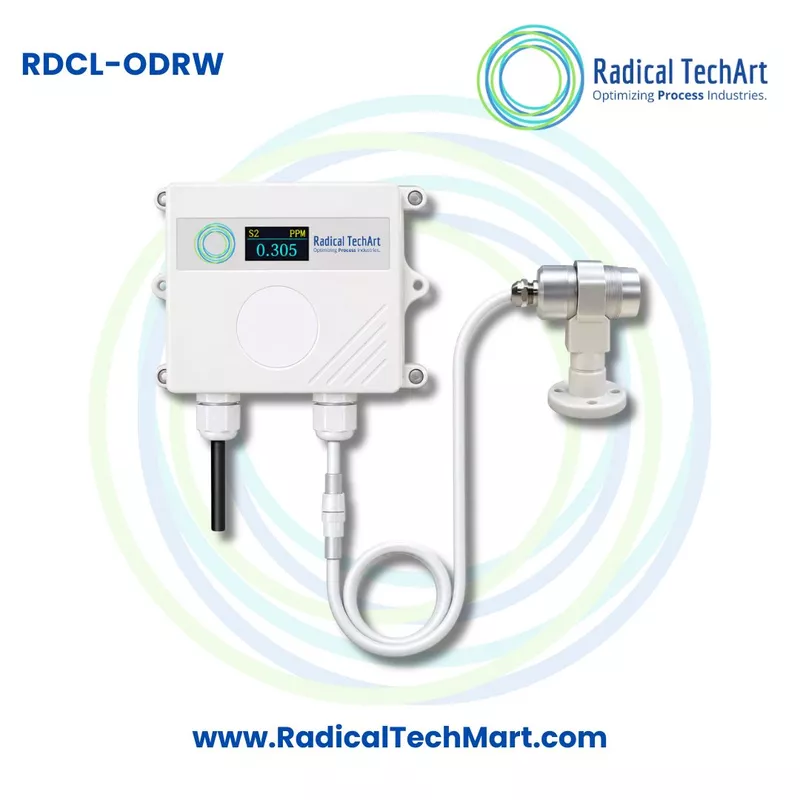


Industrial Odor Sensor for Restrooms and Waste Facilities | RDCL-ODRW
The RDCL-ODRW Industrial Odor Sensor for Restrooms and Waste Facilities is a wall mounted odor monitoring sensor and transmitter designed for continuous detection of unpleasant odors in public toilets, washrooms, garbage dumps, landfills, wastewater treatment facilities and livestock farms. Available with electrochemical and semiconductor sensing technologies, it monitors odor related gases such as hydrogen sulfide, ammonia, trimethylamine and other compounds depending on the selected sensor configuration. With RS485 Modbus RTU, 4 to 20mA, 0 to 5V and 0 to 10V output options, IP65 protection, temperature compensation and optional relay control, it supports automated ventilation and industrial environmental monitoring.
Customize
Share :
A. Product Overview
The RDCL-ODRW Industrial Odor Sensor and Transmitter is a wall mounted device designed to monitor odor related gases in public restrooms, sewage treatment plants, waste facilities, livestock farms and industrial environments.
Odors often contain hydrogen sulfide (H2S), ammonia (NH3), trimethylamine, methanethiol and other volatile compounds. The RDCL-ODRW uses electrochemical or semiconductor sensing technology, depending on configuration, to monitor selected odor related gases.
It supports RS485 Modbus RTU and analog outputs for integration with PLC, SCADA, BMS and automated ventilation systems. Its IP65 enclosure and optional relay outputs make it suitable for fixed environmental monitoring.
Key Features and Technical Specifications
Parameter | Specification |
|---|---|
Model | RDCL-ODRW |
Product Type | Industrial Odor Sensor and Transmitter |
Installation | Wall Mount |
Sensing Technology | Electrochemical or Semiconductor |
Electrochemical Range | 0 to 5 ppm |
Semiconductor Range | 0.3 to 3 ppm |
Electrochemical Accuracy | ±5% FS or ±10% FS |
Semiconductor Accuracy | ±13% FS |
Resolution | 0.001 ppm |
Output Options | RS485, 4 to 20 mA, 0 to 5V, 0 to 10V |
Communication | Modbus RTU for RS485 |
Power Supply | 10 to 30V DC |
Power Consumption | 0.18W |
Response Time | ≤80 seconds |
Preheating Time | At least 5 minutes |
Repeatability | ≤2% |
Zero Drift | ±0.5 ppm |
Operating Temperature | −20°C to 50°C |
Operating Humidity | 15% to 90% RH, non-condensing |
Operating Pressure | 90 to 110 kPa |
Protection Rating | IP65 |
Relay Output | Optional, up to 2 channels |
Accuracy depends on the sensing technology and reference gas. Select the configuration according to the target gases and application.
Main Advantages
Continuous monitoring of selected odor related gases
Electrochemical and semiconductor sensing options
RS485 Modbus RTU and industrial analog outputs
IP65 protection against dust and water jets
Optional relay control for exhaust fans
Calibration and compensation for stable measurement
Suitable for smart sanitation and industrial automation
B. Working Principle
The RDCL-ODRW detects selected odor related compounds through electrochemical or semiconductor sensing.
1. Gas Exposure: Surrounding air enters through a protective gas permeable interface.
2. Gas Detection: The sensor responds to selected compounds such as hydrogen sulfide, ammonia and other odor producing gases, depending on configuration.
3. Signal Generation: Electrochemical versions generate electrical signals through chemical reactions. Semiconductor versions detect changes in sensing element resistance.
4. Signal Processing: Internal electronics process the measurement using calibration and compensation functions.
5. Output Transmission: Readings are transmitted through RS485 Modbus RTU or the selected analog output to compatible monitoring systems.
6. Ventilation Control: Optional relays or external controllers can activate exhaust fans when configured thresholds are exceeded.
Electrochemical vs Semiconductor Sensor
Feature | Electrochemical | Semiconductor |
|---|---|---|
Principle | Chemical reaction | Resistance change |
Range | 0 to 5 ppm | 0.3 to 3 ppm |
Sensitivity | Selected gases | Multiple odor related gases |
Stability | Generally higher | More environment dependent |
Typical Use | Targeted gas monitoring | General odor trend monitoring |
Note: The sensor does not independently measure every odor compound or directly quantify human perceived smell. Readings depend on the selected sensing technology and gas mixture.
C. Why Is the RDCL-ODRW Used?
The RDCL-ODRW supports odor monitoring, sanitation management and automated ventilation.
1. Public Restrooms: Monitors odor trends in public toilets and commercial washrooms.
2. Smart Toilet Automation: Supports automatic exhaust fan operation through compatible controllers.
3. Garbage Facilities: Monitors odor related gases around waste collection centers and landfills.
4. Sewage Treatment Plants: Measures selected gases associated with sewage processing and wastewater treatment.
5. Livestock Farms: Supports monitoring of ammonia, hydrogen sulfide and other odor related compounds from animal waste.
6. Industrial Ventilation: Provides measurement signals for automated exhaust ventilation control.
7. Environmental Monitoring: Tracks changes in odor related gas concentrations around industrial waste processing facilities.
8. Facility Management: Helps identify recurring odor conditions and assess ventilation or cleaning requirements.
Common Applications
Public toilets and commercial washrooms
Smart sanitation systems
Airports, railway stations and shopping malls
Garbage collection centers and landfills
Sewage and wastewater treatment plants
Livestock farms and manure handling facilities
Industrial waste processing
Automated ventilation systems
PLC, SCADA and BMS monitoring
D. Suitable Buyers
Suitable Buyers | Applications |
|---|---|
Smart Toilet Solution Providers | Automated washroom odor monitoring |
Facility Management Companies | Restroom monitoring |
Shopping Mall Operators | Public sanitation monitoring |
Airport and Railway Managers | High traffic washroom monitoring |
Municipal Corporations | Public toilets and waste facilities |
Waste Management Companies | Garbage facility odor monitoring |
Landfill Operators | Odor trend monitoring |
Sewage Treatment Plant Operators | Sewage related gas monitoring |
Wastewater Contractors | Treatment facility monitoring |
Livestock Farm Operators | Animal waste odor monitoring |
Automation Integrators | PLC and SCADA integration |
HVAC Contractors | Automated exhaust ventilation |
Environmental Monitoring Companies | Odor monitoring projects |
OEM Manufacturers | Smart sanitation equipment |
E. Frequently Asked Questions
1. What is the RDCL-ODRW Industrial Odor Sensor?
The RDCL-ODRW is a wall mounted sensor and transmitter designed for monitoring selected odor related gases in sanitation, waste handling and industrial environments.
2. How does the odor sensor work?
It uses electrochemical or semiconductor sensing technology to convert gas interactions into electrical signals for concentration monitoring.
3. What measurement ranges are available?
Electrochemical: 0 to 5 ppm. Semiconductor: 0.3 to 3 ppm.
4. Which gases can it detect?
Depending on configuration, it responds to selected gases including hydrogen sulfide, ammonia, trimethylamine, methanethiol, dimethyl sulfide, dimethyl disulfide, styrene and ethanol.
5. Can it be used in public toilets?
Yes. It supports odor trend monitoring in public toilets, commercial washrooms and smart sanitation systems.
6. Is it suitable for garbage dumps and landfills?
Yes. It can monitor selected odor related gases at suitable garbage collection, waste transfer and landfill locations.
7. What output signals are available?
RS485 Modbus RTU, 4 to 20 mA, 0 to 5V and 0 to 10V, depending on configuration.
8. Can it connect to a PLC?
Yes. Compatible PLC systems can receive measurements through RS485 or analog input interfaces.
9. Can it automatically control exhaust fans?
Yes. Optional relay outputs or compatible external controllers can operate ventilation equipment based on configured thresholds.
10. What power supply is required?
The RDCL-ODRW operates on 10 to 30V DC, with approximately 0.18W average power consumption.