




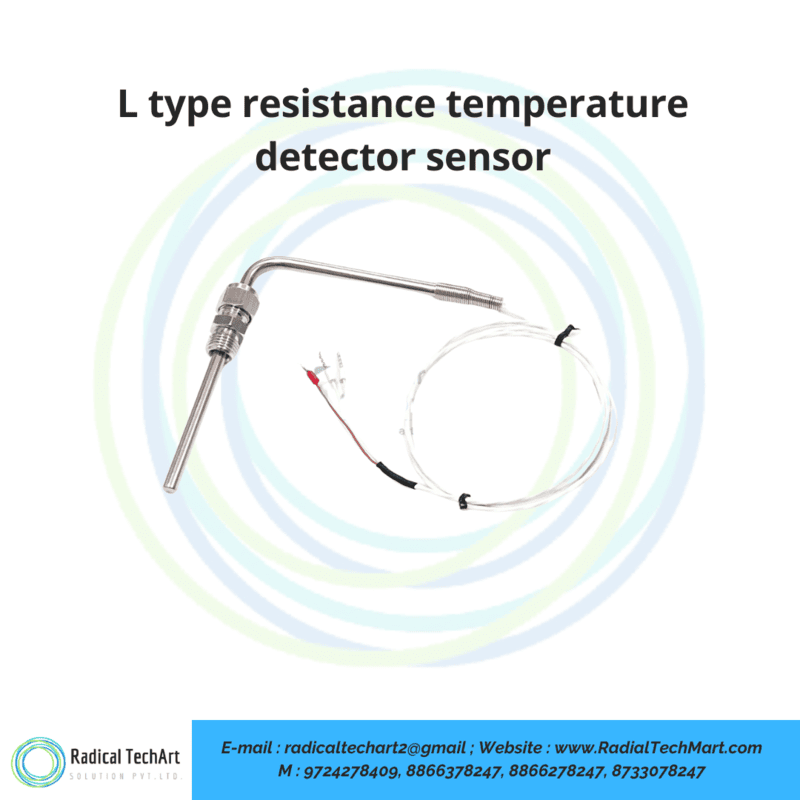
L Type RTD Pt100 Temperature Sensor with Wire
L Type RTD Pt100 sensor is a resistance temperature detector designed for accurate temperature measurement in industrial processes, HVAC systems, laboratory equipment, machinery and scientific applications. Its L-shaped stainless steel probe allows easy insertion into the process area while protecting the Pt100 element from mechanical damage, chemicals and harsh working conditions.
Customize
Share :
A. Product Overview
L Type RTD Pt100 sensor is a temperature sensor used to measure temperature accurately in liquids, gases, machines, tanks, pipelines and industrial process equipment. It is called an L type sensor because the probe is bent in an L shape, making it suitable for applications where straight sensor installation is difficult or where temperature needs to be measured at a specific point.
This sensor uses a Pt100 resistance temperature detector element. Pt100 means the sensor has 100 ohms resistance at 0°C. The resistance changes with temperature, and this change is converted into a temperature reading by a temperature indicator, controller, transmitter or PLC system.
The stainless steel probe provides durability and protection, while different thread sizes, probe diameters, wire lengths and wiring configurations make it suitable for many industrial applications.
Key Specifications
Element: Pt100 Simplex and Duplex
Temperature Range: -70 to 500°C
Probe Diameter: 4 mm, 5 mm and 6 mm
Thread Size: 1/4 inch, 3/8 inch, 1/2 inch and 3/4 inch in BSP and NPT
Wire Length: 0.5 meter to 10 meter
Wire Configuration: 2 wire, 3 wire and 4 wire
B. Working Principle
L Type RTD Pt100 sensor works on the resistance temperature detector principle. Inside the sensor, there is a platinum sensing element. Platinum is used because it gives stable and repeatable resistance change with temperature.
At 0°C, the Pt100 element has 100 ohms resistance. When the temperature increases, the resistance of the platinum element also increases. When the temperature decreases, the resistance decreases.
This resistance value is measured by a temperature controller, digital indicator, transmitter or PLC. The instrument converts the resistance signal into a temperature reading.
The L-shaped stainless steel probe is inserted into the process area, while the wire side is connected to the measuring instrument or control system. This design allows safe and practical installation in machines, tanks, pipelines and industrial setups.
C. Why It Is Used
L Type RTD Pt100 sensor is used where accurate and stable temperature measurement is required. It is especially useful in applications where a straight probe is not suitable because of space limitations, installation angle or process design.
The L shape makes installation easier in compact areas and allows the sensing tip to reach the correct temperature measurement point. The stainless steel sheath protects the sensing element from harsh environments, vibration, chemicals and mechanical impact.
It is commonly used because it offers better accuracy and stability compared to many basic temperature sensors. It helps maintain process temperature, improve product quality, protect machinery and support automation control.
Common uses include industrial process control, HVAC systems, laboratory instruments, scientific equipment, heating systems, machinery temperature monitoring and pipeline temperature measurement.
D. Suitable Buyers
L Type RTD Pt100 sensor is suitable for buyers who need accurate temperature measurement in industrial and technical applications.
Suitable buyers include:
Industrial automation companies
Control panel manufacturers
Machine manufacturers
HVAC contractors
Laboratory equipment manufacturers
Pharmaceutical plants
Chemical processing industries
Food processing industries
Plastic machinery manufacturers
Boiler and furnace equipment manufacturers
Pipeline and tank system manufacturers
Maintenance engineers
Process plant engineers
OEM equipment manufacturers
PLC and SCADA system integrators
FAQ
1. What is an L Type RTD Pt100 sensor?
An L Type RTD Pt100 sensor is a resistance temperature detector with an L-shaped probe. It uses a platinum Pt100 element to measure temperature accurately in industrial and process applications.
2. What does Pt100 mean?
Pt100 means the sensor uses a platinum resistance element with 100 ohms resistance at 0°C. The resistance changes as temperature changes.
3. Why is the sensor designed in L shape?
The L shape helps the sensor fit into compact spaces or applications where a straight sensor cannot be installed easily. It also helps measure temperature at a specific point inside the process.
4. What is the temperature range of this sensor?
The temperature range is generally -70 to 500°C, depending on probe material, cable insulation and application conditions.
5. What probe diameters are available?
Common probe diameter options are 4 mm, 5 mm and 6 mm.
6. What thread sizes are available?
Thread size options include 1/4 inch, 3/8 inch, 1/2 inch and 3/4 inch in BSP and NPT connection types.
7. What wire configurations are available?
This sensor is available in 2 wire, 3 wire and 4 wire configurations. 3 wire and 4 wire configurations are preferred for better accuracy.
8. Where is L Type RTD Pt100 sensor used?
It is used in industrial process control, HVAC systems, laboratory equipment, machinery, tanks, pipelines, scientific instruments and temperature monitoring systems.
9. What is the difference between simplex and duplex RTD sensor?
Simplex RTD sensor has one sensing element. Duplex RTD sensor has two sensing elements inside one probe, allowing two separate readings or backup sensing in the same location.
10. Can this sensor be customized?
Yes, L Type RTD Pt100 sensor can be customized in probe diameter, probe length, thread size, wire length, wire insulation and wire configuration as per application requirement.

