

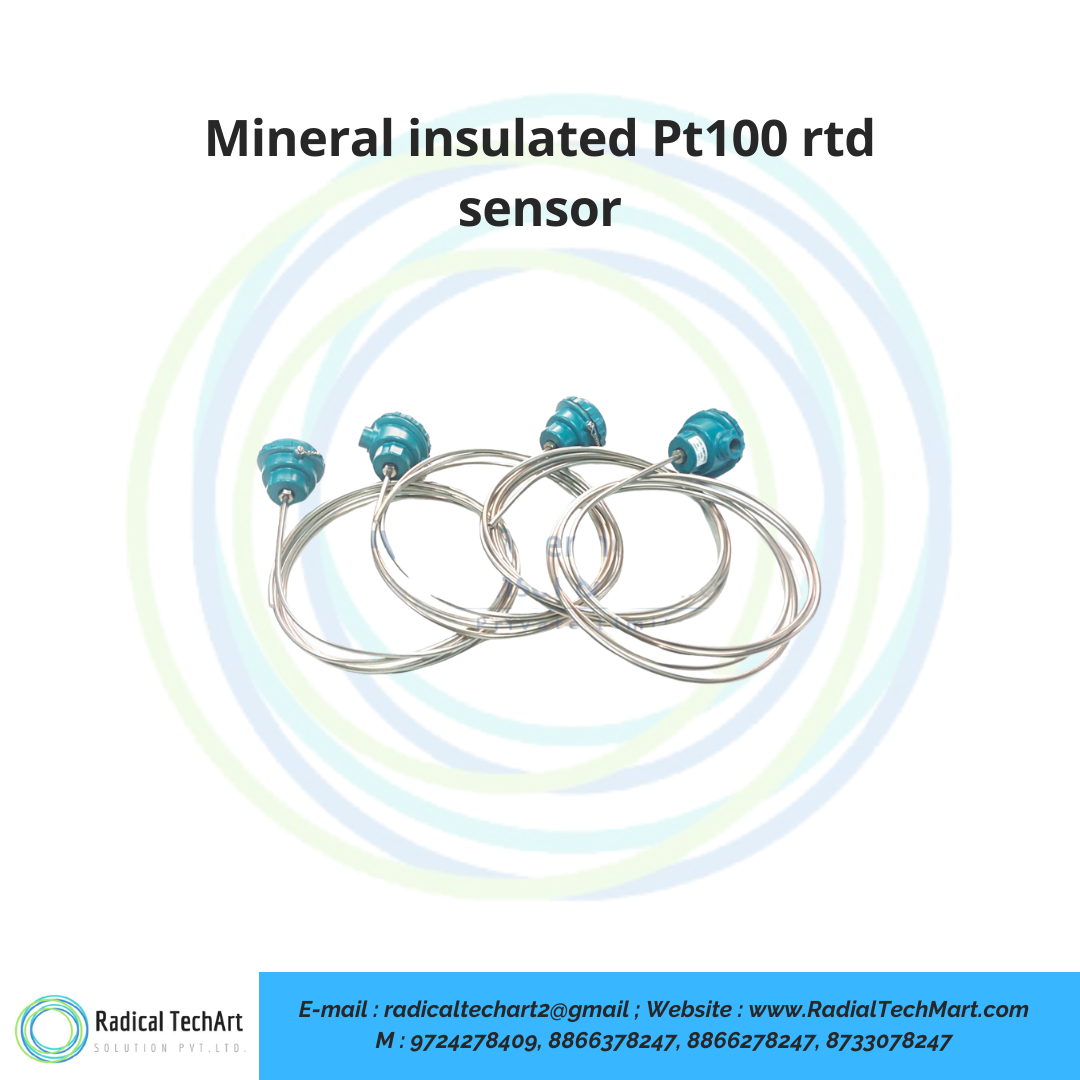
Mineral Insulated Pt100 RTD Sensor for Industrial Temperature Measurement
Mineral Insulated Pt100 RTD Sensor is designed for accurate and reliable temperature measurement in harsh industrial environments. It uses a Pt100 sensing element inside a flexible SS316 mineral insulated sheath, making it suitable for high temperature, vibration, pressure and chemical exposure applications.
Customize
Share :
A. Product Overview
The Mineral Insulated Pt100 RTD Sensor is an industrial temperature sensor used for precise temperature measurement in demanding process conditions. It is made with a Pt100 RTD element protected inside a stainless steel mineral insulated sheath.
The sensor is designed to work in harsh environments where normal temperature sensors may fail due to heat, vibration, moisture, shock or chemical exposure. Its flexible cable design makes it easy to install in machines, pipelines, tanks, furnaces, heating systems and process equipment.
Key Specifications
Type: Pt100 Simplex and Duplex
Temperature Range: Minus 50°C to 600°C
Probe Diameter: 3 mm, 4.5 mm, 6 mm, 8 mm and 10 mm
Probe Length: 50 mm to 5000 mm
Accuracy: Class B as per IEC 60751
Sheath Material: SS316
B. Working Principle
The Mineral Insulated Pt100 RTD Sensor works on the resistance temperature detector principle. A Pt100 element has a resistance of 100 ohms at 0°C. When the temperature changes, the resistance of the Pt100 element also changes in a predictable way.
This resistance signal is sent to a temperature indicator, PID controller, PLC, transmitter or data acquisition system. The connected instrument converts the resistance value into a temperature reading.
The mineral insulation inside the sheath provides good heat transfer, electrical insulation and mechanical protection. This helps the sensor give stable and accurate readings even in high temperature and high vibration areas.
C. Why It Is Used
Mineral Insulated Pt100 RTD Sensors are used because they offer better durability, flexibility and accuracy compared to many standard temperature sensors.
They are preferred in industries because they can handle high temperature conditions, resist vibration and shock, provide stable temperature readings, work in harsh process environments and fit into compact or difficult installation areas.
The SS316 sheath gives protection against corrosion and mechanical damage, while the compressed mineral oxide insulation improves thermal response and sensor life. This makes the sensor suitable for continuous industrial temperature monitoring.
D. Suitable Buyers
This product is suitable for buyers who need reliable temperature measurement in industrial and process applications.
Suitable buyers include:
Industrial automation companies
Process industries
Chemical plants
Power plants
Boiler and furnace manufacturers
Pharmaceutical plants
Plastic machinery manufacturers
Automotive industries
Aerospace industries
HVAC system manufacturers
Laboratory and research facilities
Machine manufacturers
Panel builders and system integrators
Maintenance and utility departments
Temperature sensor dealers and suppliers
FAQ
1. What is a Mineral Insulated Pt100 RTD Sensor?
A Mineral Insulated Pt100 RTD Sensor is a temperature sensor that uses a Pt100 resistance element inside a mineral insulated metal sheath. It is used for accurate temperature measurement in harsh industrial environments.
2. What is the temperature range of this sensor?
This sensor can measure temperatures from minus 50°C to 600°C, depending on the design, sheath material and application conditions.
3. What is the sheath material used in this sensor?
The sheath material is SS316, which provides good resistance against corrosion, heat and harsh industrial conditions.
4. Where is this sensor commonly used?
It is commonly used in industrial process control, power generation, boilers, furnaces, pipelines, chemical plants, automotive systems, aerospace applications, laboratories and material testing equipment.
5. What is the benefit of mineral insulation?
Mineral insulation provides better thermal conductivity, electrical insulation and mechanical strength. It helps the sensor perform reliably in high temperature, vibration and shock conditions.
6. What does Pt100 mean?
Pt100 means the sensor uses a platinum resistance element with 100 ohms resistance at 0°C. The resistance changes with temperature, allowing accurate temperature measurement.
7. Is this sensor suitable for high vibration applications?
Yes, the mineral insulated construction makes this sensor suitable for applications where vibration, shock and mechanical stress are present.
8. What is the difference between simplex and duplex Pt100 RTD sensors?
A simplex sensor has one Pt100 sensing element, while a duplex sensor has two Pt100 sensing elements in the same probe. Duplex sensors are useful when two separate readings or backup measurement is required.
9. Can the probe length and diameter be customized?
Yes, the sensor can be supplied in different probe diameters such as 3 mm, 4.5 mm, 6 mm, 8 mm and 10 mm, with probe lengths from 50 mm to 5000 mm.
10. Why should industries use a Mineral Insulated Pt100 RTD Sensor?
Industries use this sensor because it provides accurate, stable and reliable temperature measurement in extreme environments where high temperature, vibration, corrosion and mechanical stress are common.