

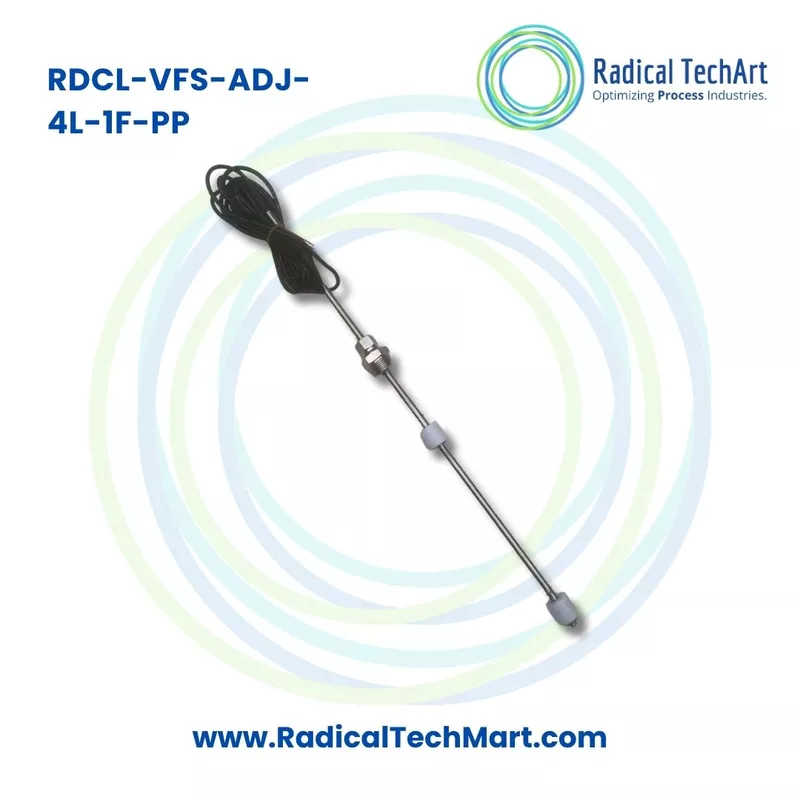


Onsite Adjustable Internal Top Mount Level Switch
Onsite adjustable internal top mount level switch is used for accurate liquid level detection where switching points need minor adjustment at the installation site. It is suitable for tanks, process vessels, water storage, oil tanks and industrial liquid level control applications.
Click here for Datasheet!!
Customize
Share :
A. Product Overview
The Onsite Adjustable Internal Top Mount Level Switch is a float-operated liquid level switch designed for applications where the switching level needs to be fine-tuned on site. The sensor is mounted from the top of the tank and the float moves with the liquid level to activate the reed switch at the desired point.
This series is available in full stainless steel construction or a hybrid version with stainless steel stem and plastic float. The stainless steel version is suitable for higher temperature and stronger industrial applications, while the plastic float version is useful for general liquid level detection where cost-effective operation is required.
The product is supplied with two hex nuts and washers for on-site level adjustment. Standard mounting is with M10 thread, and customized mounting such as M16 thread, BSP fitting or TC fitting can be provided as per requirement.
Key features include:
- Internal top mount installation
- Adjustable switching point on site
- SS 304 and SS 316 stem options
- SS 316L, nylon and polypropylene float options
- Suitable for high level, low level and customized switching points
- SPST NO and NC switching type
- Teflon cable with protection sleeve
- Teflon gasket or silicone gasket
- Compact design for tank level monitoring
B. Working Principle
The onsite adjustable internal top mount level switch works on the magnetic float and reed switch principle.
A float moves up and down along the stem as the liquid level rises or falls inside the tank. The float contains a magnet, and the stem contains a reed switch at the selected switching point. When the float reaches the switching area, the magnetic field activates the reed switch and changes the electrical contact position.
For example:
- In NO operation, the signal changes when the float reaches the switching level.
- In NC operation, the signal opens or closes depending on float movement and wiring requirement.
- The switching point can be adjusted on site by repositioning the float stop arrangement within the allowed adjustment band.
This makes the switch useful where exact tank dimensions or process level requirements may need correction during installation.
C. Why It Is Used
The onsite adjustable internal top mount level switch is used when liquid level control needs flexibility after installation. In many tanks, the required switching level may not be perfectly known before installation. This adjustable design allows the user to fine-tune the switching point at site without replacing the complete sensor.
It is commonly used for:
- Pump start and pump stop control
- High level alarm
- Low level alarm
- Tank overflow protection
- Dry run protection
- Liquid level indication
- Process level monitoring
- Storage tank automation
- Water, oil and chemical level control
This product is preferred because it provides simple installation, reliable switching, low maintenance operation and customizable construction based on the liquid and temperature condition.
D. Suitable Buyers
This product is suitable for buyers who need reliable and adjustable liquid level switching in tanks and process systems.
Ideal buyers include:
- Process plant operators
- Water treatment plant contractors
- Machine manufacturers
- Tank manufacturers
- OEM panel builders
- Pump automation suppliers
- Industrial maintenance teams
- Chemical plant buyers
- Pharmaceutical plant buyers
- Food and beverage plant buyers
- HVAC and utility system contractors
- Boiler and cooling system suppliers
- System integrators
- Instrumentation engineers
- Purchase managers looking for customized level switches
Frequently Asked Questions
1. What is an onsite adjustable internal top mount level switch?
It is a float type liquid level switch mounted from the top of the tank. The switching level can be adjusted on site within a specific range to match the required tank level condition.
2. Where is this level switch installed?
It is installed from the top side of the tank using a threaded connection such as M10. Customized mounting options like M16, BSP fitting or TC fitting can also be provided as per application requirement.
3. What is the main benefit of an adjustable level switch?
The main benefit is that the switching point can be fine-tuned after installation. This helps when the required high level or low level position needs minor correction at site.
4. Which materials are available for this level switch?
The stem is available in SS 304 and SS 316. Float options include SS 316L, nylon and polypropylene depending on the liquid, temperature and application requirement.
5. Can it be used for high temperature liquids?
Yes, the stainless steel float version can be used for higher temperature applications up to 135 degree Celsius. The plastic float version is generally suitable up to 100 degree Celsius.
6. What is the maximum operating pressure?
The stainless steel float version can handle pressure up to 4 Bar. The plastic float version is suitable for atmospheric pressure applications.
7. What switching output does this product provide?
It provides SPST switching with NO and NC contact options. The contact logic can be selected based on control panel and process requirement.
8. Can this switch be customized?
Yes, customization is available for stem length, float size, number of switching points, mounting connection and switching logic.
9. What applications are suitable for this product?
It is suitable for water tanks, oil tanks, chemical tanks, process tanks, sumps, storage vessels, pump control systems and industrial level monitoring applications.
10. Why should buyers choose this model instead of a fixed level switch?
Buyers should choose this model when the exact switching level may need adjustment during installation. It reduces rework and provides more flexibility for site commissioning.