

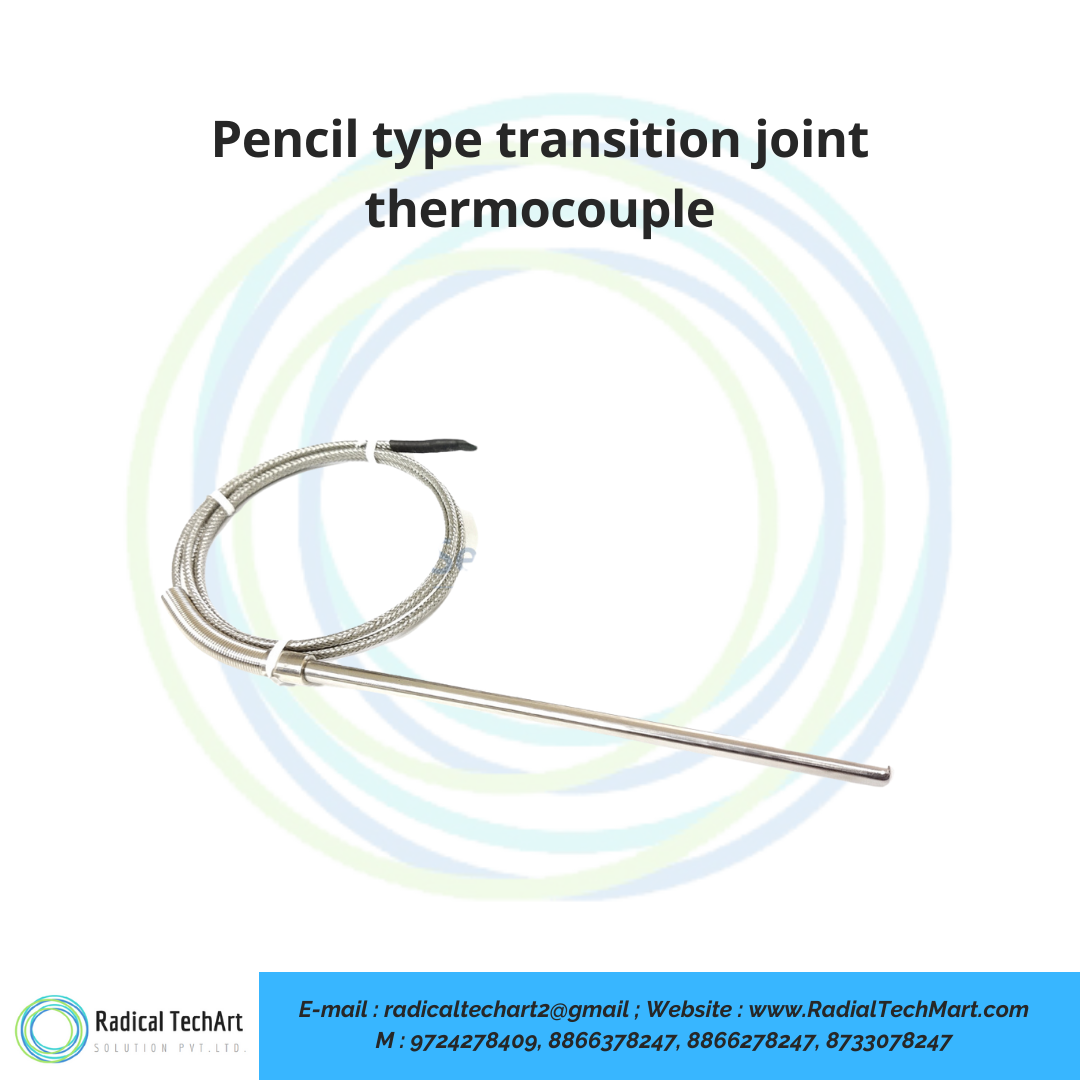


Pencil Type Transition Joint Thermocouple Sensor
Pencil type transition joint thermocouple is used for accurate temperature measurement in harsh industrial environments such as high temperature, corrosive, abrasive, dusty and radiation-prone areas. It is available in J, K, T, E and RTD options with grounded and ungrounded junctions, custom tip size, wire insulation and wire length.
Customize
Share :
A. Product Overview
A pencil type transition joint thermocouple is a compact industrial temperature sensor designed for reliable temperature measurement in difficult process conditions. It has a pencil-style probe tip and a transition joint where the thermocouple element is connected with the cable or extension wire.
This type of thermocouple is commonly used where normal temperature sensors may fail due to heat, vibration, corrosion, abrasion, moisture or harsh operating conditions. The sensor can be supplied in different thermocouple types such as J, K, T and E, and it can also be made in RTD construction as per application requirement.
The probe tip can be customized in diameter and length according to the installation area. Wire insulation options such as SS braided, Teflon and fiberglass make it suitable for different industrial environments.
Common specifications:
Type: J, K, T, E and RTD
Temperature Range: -50 to 500 °C
Tip Size: Diameter 3 to 12 mm and length 20 to 500 mm
Wire Insulation: SS braided, Teflon and fiberglass
Wire Length: 0.5 meter to 10 meter
Junction: Grounded and ungrounded
B. Working Principle
The pencil type transition joint thermocouple works on the thermoelectric principle. When two different metal wires are joined at one end and exposed to temperature, a small voltage is generated. This voltage changes according to the temperature at the sensing point.
In a transition joint thermocouple, the junction is usually made by welding or brazing dissimilar metals together. The sensing tip measures the process temperature, and the generated signal is carried through the connected wire to a temperature indicator, controller, transmitter or data acquisition system.
The instrument then converts this thermocouple signal into a readable temperature value. Depending on the requirement, the junction can be grounded for faster response or ungrounded for better electrical isolation and noise reduction.
C. Why It Is Used
Pencil type transition joint thermocouples are used because they provide stable and accurate temperature measurement in harsh industrial applications. Their compact pencil-type design allows easy installation in machines, process equipment, molds, dies, tanks and other limited-space areas.
They are useful where standard thermocouples may not perform properly due to high temperature, corrosive atmosphere, abrasive material, vibration or radiation exposure. The transition joint construction helps improve durability and allows the sensor to be customized for different process requirements.
This sensor is also preferred because it can be supplied with different wire insulation, probe sizes, junction types and thermocouple elements. This makes it suitable for both standard and custom industrial temperature measurement applications.
D. Suitable Buyers
This product is suitable for buyers who need accurate and durable temperature sensing in industrial environments.
Suitable buyers include:
Industrial automation companies
OEM machine manufacturers
Plastic machinery manufacturers
Process industries
Furnace and oven manufacturers
Heat treatment plants
Chemical industries
Pharmaceutical industries
Food processing plants
Aerospace industries
Power plants
Nuclear and radiation-related applications
Maintenance and instrumentation teams
Panel builders and control system integrators
Temperature sensor dealers and distributors
FAQ
1. What is a pencil type transition joint thermocouple?
A pencil type transition joint thermocouple is a compact temperature sensor with a pencil-style probe and transition joint construction. It is used for measuring temperature in industrial and harsh environment applications.
2. Where is this thermocouple used?
It is used in industrial processes, machinery, furnaces, ovens, plastic machines, chemical plants, aerospace applications, power plants and applications where harsh environmental conditions are present.
3. What temperature range does it support?
This thermocouple can generally measure from -50 to 500 °C, depending on the thermocouple type, probe material, wire insulation and application requirement.
4. Which thermocouple types are available?
It is available in J, K, T and E type thermocouple options. RTD construction can also be supplied as per requirement.
5. What is the difference between grounded and ungrounded junction?
A grounded junction gives faster response because the sensing junction is connected to the probe sheath. An ungrounded junction provides better electrical isolation and is suitable where signal noise or electrical interference is a concern.
6. Can the probe size be customized?
Yes, the tip diameter and length can be customized. Common tip diameter options range from 3 to 12 mm, and tip length can range from 20 to 500 mm.
7. Which wire insulation options are available?
Common wire insulation options include SS braided, Teflon and fiberglass. The correct insulation depends on temperature, flexibility, chemical exposure and installation environment.
8. Why should I choose a transition joint thermocouple?
You should choose it when your application requires a durable, compact and accurate temperature sensor for harsh conditions such as high temperature, corrosion, abrasion, vibration or moisture exposure.
9. Is this thermocouple suitable for control panels?
Yes, it can be connected to temperature controllers, PID controllers, indicators, transmitters and PLC systems through suitable input modules.
10. Can it be used in high-temperature industrial applications?
Yes, it is suitable for high-temperature applications up to 500 °C, provided the correct thermocouple type, probe material and wire insulation are selected.