

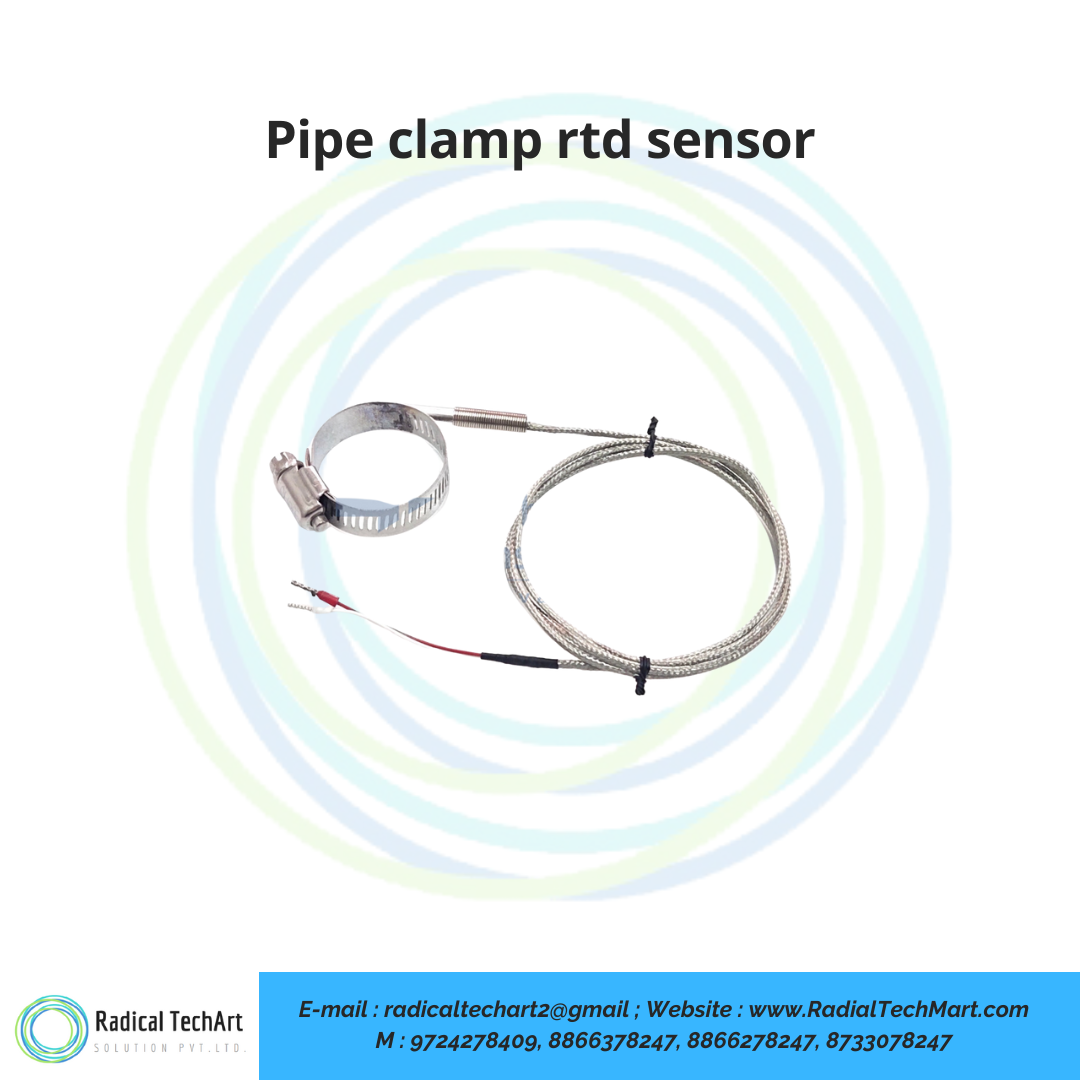
Pipe Clamp RTD Sensor for Pipe Surface Temperature Measurement
Customize
Share :
A. Product Overview
A Pipe Clamp RTD Sensor is a surface temperature sensor designed to measure the temperature of pipes, tubes, and cylindrical surfaces without cutting or drilling into the pipeline. The sensor is mounted directly on the pipe surface using a clamp mechanism, making it a practical and non-invasive solution for temperature monitoring.
This sensor typically consists of an RTD element housed inside a protective stainless steel sheath. Stainless steel provides durability, corrosion resistance, and long service life in industrial environments. The clamp arrangement helps maintain proper contact between the sensor and the pipe surface, allowing stable and accurate temperature measurement.
Pipe Clamp RTD Sensors are widely used where direct insertion sensors are not suitable or where quick installation and easy removal are required. They are commonly used in HVAC systems, industrial process control, heating systems, cooling lines, chemical processing, petrochemical plants, power plants, and food and beverage manufacturing units.
B. Working Principle
The Pipe Clamp RTD Sensor works on the principle of resistance temperature detection. The RTD element inside the sensor changes its electrical resistance according to the temperature of the surface being measured.
When the sensor is clamped onto a pipe, heat from the pipe surface is transferred to the RTD element through the stainless steel sheath. As the pipe temperature increases or decreases, the resistance value of the RTD element changes accordingly. This resistance signal is then sent to a temperature indicator, controller, transmitter, data logger, or automation system.
The spring-loaded clamp helps maintain constant pressure on the pipe surface. This improves thermal contact and allows the sensor to provide reliable surface temperature readings without entering the process line.
C. Why It Is Used
Pipe Clamp RTD Sensors are used because they provide an easy, safe, and cost-effective method for pipe surface temperature measurement. Unlike insertion-type sensors, they do not require pipe modification, welding, threading, or process shutdown during installation.
They are useful in applications where the process medium should not be disturbed or where frequent sensor removal and replacement is required. The clamp-on design makes installation faster and reduces maintenance effort.
Key reasons for using a Pipe Clamp RTD Sensor include:
- Non-invasive pipe temperature measurement
- Easy installation and removal
- No need for drilling or welding on the pipe
- Suitable for temporary and permanent temperature monitoring
- Good thermal contact with pipe surface
- Durable stainless steel construction
- Reliable measurement for HVAC and industrial processes
- Cost-effective alternative to insertion temperature sensors
- Suitable for pipes, tubes, and cylindrical equipment surfaces
D. Suitable Buyers
Pipe Clamp RTD Sensors are suitable for buyers who need accurate and easy-to-install temperature measurement solutions for pipes and cylindrical surfaces.
Suitable buyers include:
- HVAC contractors
- Industrial maintenance teams
- Process plant engineers
- Chemical plant operators
- Petrochemical industry buyers
- Food and beverage manufacturers
- Power plant maintenance teams
- OEM machine manufacturers
- Automation system integrators
- Boiler and heating system manufacturers
- Chiller and refrigeration system manufacturers
- Utility and facility management teams
- Instrumentation and control panel manufacturers
- MRO purchase teams
- Industrial equipment suppliers and dealers
FAQ
1. What is a Pipe Clamp RTD Sensor?
A Pipe Clamp RTD Sensor is a temperature sensor designed to measure the surface temperature of a pipe or cylindrical object by clamping directly onto its outer surface.
2. How does a Pipe Clamp RTD Sensor work?
It works by sensing the pipe surface temperature through an RTD element. The RTD element changes resistance based on temperature, and this signal is used by a controller, indicator, transmitter, or monitoring system.
3. Where is a Pipe Clamp RTD Sensor used?
It is used in HVAC systems, chemical plants, petrochemical plants, power generation, food and beverage industries, process control systems, heating lines, cooling lines, and industrial pipelines.
4. What is the main advantage of a Pipe Clamp RTD Sensor?
The main advantage is that it measures pipe temperature without cutting, drilling, or modifying the pipe. It is easy to install, easy to remove, and suitable for non-invasive temperature monitoring.
5. Is a Pipe Clamp RTD Sensor suitable for industrial use?
Yes, Pipe Clamp RTD Sensors are suitable for industrial use. They are commonly made with stainless steel sheaths and are designed for reliable performance in demanding industrial environments.
6. Can Pipe Clamp RTD Sensors be removed and reused?
Yes, most Pipe Clamp RTD Sensors can be removed and reused, depending on the clamp design and application condition. This makes them suitable for maintenance, testing, and temporary monitoring applications.
7. Is pipe modification required for installing this sensor?
No, pipe modification is not required. The sensor is installed by clamping it on the outer surface of the pipe.
8. What type of pipe can this sensor be used on?
It can be used on pipes, tubes, and cylindrical surfaces where proper clamp contact can be achieved. The clamp size should match the pipe diameter for accurate measurement.
9. Why is stainless steel used in Pipe Clamp RTD Sensors?
Stainless steel is used because it offers durability, corrosion resistance, mechanical strength, and good protection for the RTD element in industrial environments.
10. Can this sensor be connected to a temperature controller?
Yes, a Pipe Clamp RTD Sensor can be connected to compatible temperature indicators, controllers, transmitters, PLC systems, data loggers, and automation panels.