

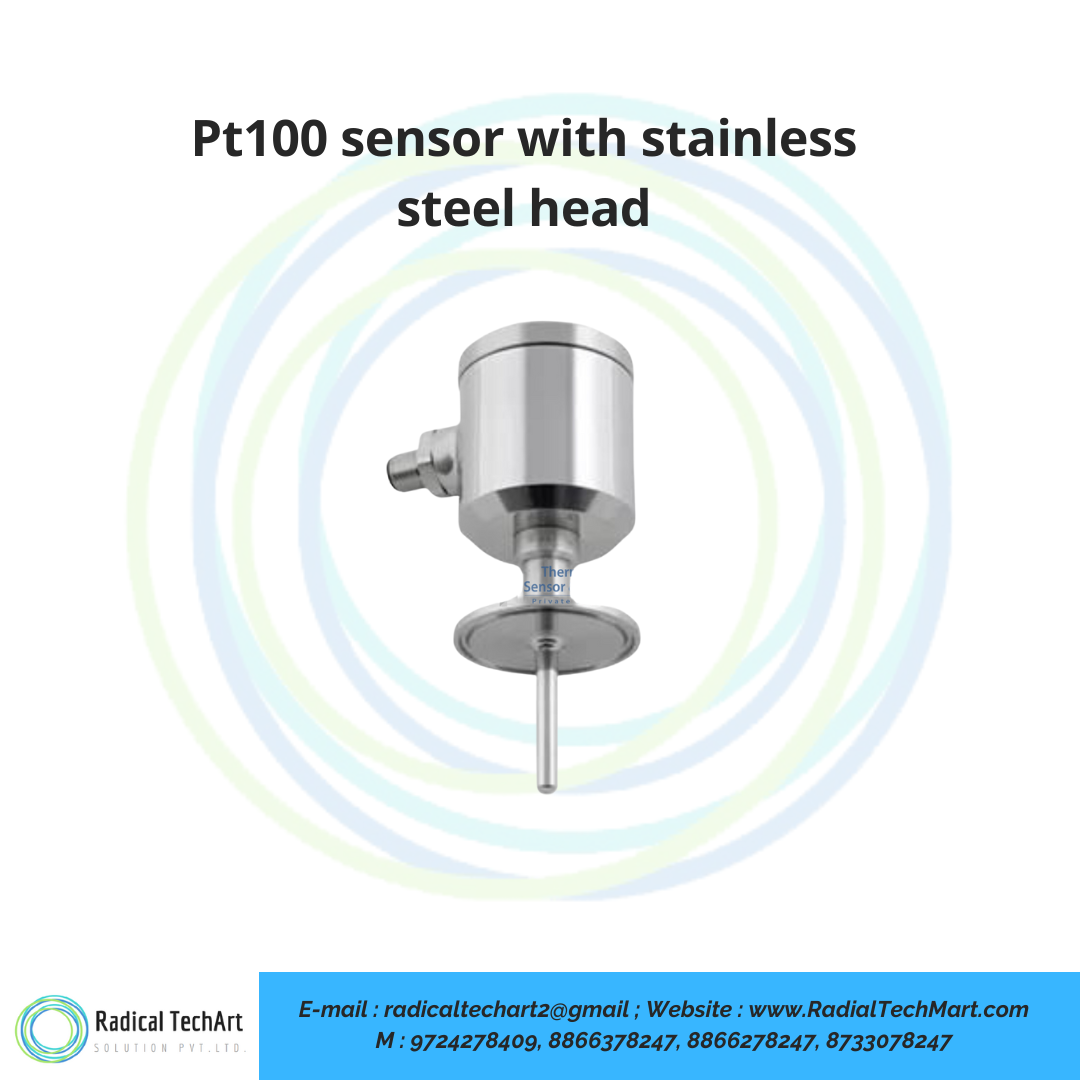
Pt100 RTD Sensor with Stainless Steel Head
Pt100 sensor with stainless steel head is an industrial RTD temperature sensor designed for accurate and stable temperature measurement in harsh environments. It comes with a corrosion-resistant stainless steel head, Pt100 sensing element, optional Simplex and Duplex configuration, SS316 or SS316L sheath and different probe sizes for use in HVAC, refrigeration, food processing, laboratory and process industries.
Customize
Share :
A. Product Overview
Pt100 sensor with stainless steel head is a Resistance Temperature Detector sensor used for precise temperature measurement in industrial applications. The sensor uses a platinum Pt100 element that gives accurate and repeatable temperature readings.
The stainless steel head protects the internal sensing element from dust, moisture, corrosion and mechanical damage. This makes the sensor suitable for harsh environments where normal temperature sensors may not perform reliably.
This sensor is commonly available in Simplex and Duplex types, with SS304 or SS316 head material, 6 mm and 8 mm probe diameter options, 50 mm, 100 mm, 150 mm and 200 mm probe length options and SS316 or SS316L sheath material. It can also be supplied with tri-clover connection sizes such as 1/2 inch, 1 inch, 1.5 inch and 2 inch depending on the application requirement.
B. Working Principle
The working principle of a Pt100 sensor is based on resistance change with temperature. The sensing element is made from platinum and has a resistance of 100 ohms at 0°C.
When the temperature increases or decreases, the resistance of the platinum element changes in a predictable way. This resistance change is measured by a temperature indicator, controller, transmitter or PLC system and converted into a temperature value.
Because platinum has excellent stability and accuracy, Pt100 RTD sensors are widely used where precise temperature monitoring is required.
C. Why It Is Used
Pt100 sensor with stainless steel head is used because it provides accurate temperature measurement, long service life and better protection in industrial environments.
It is preferred in applications where the sensor may be exposed to moisture, corrosion, vibration, process media or frequent cleaning. The stainless steel head gives strong protection to the terminal connection and sensing element, while the SS316 or SS316L sheath provides good resistance against corrosion and harsh process conditions.
This sensor is also useful where easy installation, safe connection and reliable temperature monitoring are required.
D. Suitable Buyers
This Pt100 RTD sensor is suitable for:
Industrial automation companies looking for reliable temperature sensors
Food processing plants requiring hygienic and accurate temperature measurement
Dairy plants using tri-clover type temperature sensors
Pharmaceutical industries needing stainless steel RTD sensors
HVAC and refrigeration system manufacturers
Laboratories and research facilities
Process industries using temperature indicators and controllers
Machine manufacturers and OEMs
Maintenance teams replacing existing RTD temperature probes
System integrators working on temperature monitoring panels
FAQ
1. What is a Pt100 sensor with stainless steel head?
A Pt100 sensor with stainless steel head is an RTD temperature sensor that uses a platinum sensing element and a stainless steel connection head for protection. It is used for accurate temperature measurement in industrial and process applications.
2. What does Pt100 mean?
Pt100 means the sensing element is made of platinum and has a resistance of 100 ohms at 0°C. The resistance changes according to temperature, allowing accurate temperature measurement.
3. Why is stainless steel head used in this sensor?
The stainless steel head protects the internal connections and sensing element from corrosion, moisture, dust and physical damage. It improves the durability of the sensor in harsh industrial environments.
4. Where is this Pt100 sensor commonly used?
This sensor is commonly used in HVAC, refrigeration, food processing, dairy, pharmaceutical, laboratory, chemical and general industrial temperature measurement applications.
5. What is the difference between Simplex and Duplex Pt100 sensor?
A Simplex Pt100 sensor has one sensing element, while a Duplex Pt100 sensor has two sensing elements inside the same probe. Duplex type is useful where two readings or backup temperature measurement is required.
6. Which sheath material is available for this sensor?
This type of Pt100 sensor is commonly available with SS316 and SS316L sheath material. These materials offer good corrosion resistance and are suitable for industrial and sanitary applications.
7. Is this sensor suitable for food and dairy applications?
Yes, Pt100 sensor with stainless steel head and tri-clover connection is suitable for food and dairy applications where hygienic installation and accurate temperature measurement are required.
8. What probe diameter options are available?
Common probe diameter options include 6 mm and 8 mm. The correct diameter depends on the installation area, response time requirement and process condition.
9. Can this sensor be used with a temperature controller?
Yes, Pt100 RTD sensors can be connected with compatible temperature indicators, temperature controllers, transmitters, PLC systems and data acquisition systems.
10. Why should buyers choose a Pt100 RTD sensor instead of a thermocouple?
Pt100 RTD sensors are preferred when higher accuracy, better stability and repeatable temperature measurement are required. Thermocouples are generally used for very high temperature applications, while Pt100 sensors are ideal for accurate industrial temperature monitoring.