

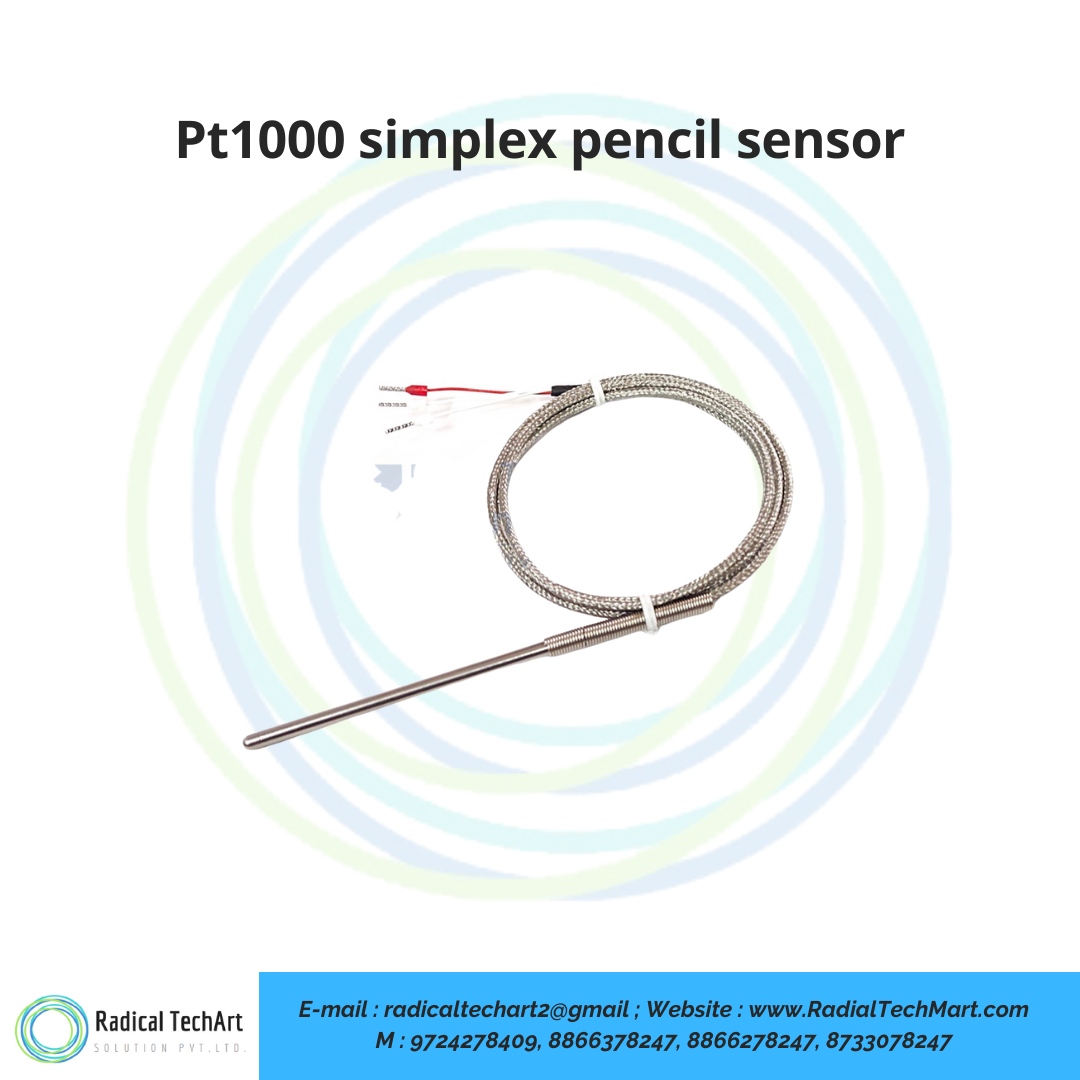
PT1000 Simplex Pencil Sensor
Pt100 and Pt1000 simplex pencil sensor is a compact RTD temperature sensor designed for accurate temperature measurement in narrow spaces, pipes, machinery, liquid tanks, gas lines and industrial process applications. It uses a platinum resistance element and is available with different wire configurations, probe sizes, insulation options and cable lengths.
Customize
Share :
A. Product Overview
Pt100 and Pt1000 simplex pencil sensor is a long and slim temperature sensor used for precise temperature measurement in industrial and process applications. The pencil-type design makes it suitable for easy insertion into small openings, pipes, ducts, tanks and machine parts.
The sensor contains one platinum sensing element, which is why it is called a simplex sensor. Pt100 means the sensor has 100 ohms resistance at 0°C, while Pt1000 means the sensor has 1000 ohms resistance at 0°C.
This sensor is commonly used where reliable and accurate temperature measurement is required in liquids, gases, machinery and process equipment.
Key Specifications
Element: Pt100 simplex and Pt1000 simplex
Temperature Range: -70 to 500°C
Tip Diameter: 3 mm to 12 mm
Tip Length: 20 mm to 500 mm
Wire Insulation: SS braided, Teflon and Fiberglass
Wire Length: 0.5 meter to 10 meter
Wire Configuration: 2 wire, 3 wire and 4 wire
B. Working Principle
Pt100 and Pt1000 simplex pencil sensors work on the RTD principle. RTD means Resistance Temperature Detector.
Inside the sensor, there is a platinum resistance element. When temperature changes, the resistance of the platinum element also changes. This resistance change is measured by a temperature controller, indicator, transmitter or PLC system and converted into a temperature reading.
For example, a Pt100 sensor gives 100 ohms resistance at 0°C, and a Pt1000 sensor gives 1000 ohms resistance at 0°C. As temperature increases, the resistance increases in a predictable manner. This makes Pt100 and Pt1000 sensors suitable for stable and accurate temperature measurement.
The pencil-style metal probe protects the sensing element and allows the sensor to be inserted directly into the measurement area.
C. Why It Is Used
Pt100 and Pt1000 simplex pencil sensors are used because they provide accurate, stable and repeatable temperature measurement. Their slim pencil design makes them useful in applications where space is limited or where the sensor needs to be inserted into a narrow area.
They are preferred in industrial applications because they offer better accuracy compared to many basic temperature sensors. The stainless steel probe gives mechanical strength, while different cable insulation options help the sensor perform in different temperature and environmental conditions.
This sensor is used to monitor process temperature, machine temperature, liquid temperature, gas temperature and equipment temperature. It helps in improving process control, product quality, safety and equipment performance.
D. Suitable Buyers
Pt100 and Pt1000 simplex pencil sensors are suitable for buyers who need accurate temperature sensing in compact spaces and industrial applications.
They are commonly purchased by:
Industrial automation companies
Machine manufacturers
Panel builders
Temperature controller manufacturers
Pharmaceutical plants
Food processing plants
Chemical industries
Plastic machinery manufacturers
HVAC system manufacturers
Laboratories and testing facilities
Maintenance engineers
Process equipment manufacturers
OEM machine builders
PLC and control panel integrators
FAQ
1. What is a Pt100 simplex pencil sensor?
A Pt100 simplex pencil sensor is an RTD temperature sensor with one platinum sensing element. It has 100 ohms resistance at 0°C and is designed in a slim pencil shape for easy insertion into narrow spaces.
2. What is a Pt1000 simplex pencil sensor?
A Pt1000 simplex pencil sensor is an RTD sensor with one platinum element that has 1000 ohms resistance at 0°C. It is used for accurate temperature measurement in industrial and process applications.
3. What does simplex mean in RTD sensor?
Simplex means the sensor has only one sensing element. It is used when only one temperature measurement point is required.
4. What is the temperature range of this pencil sensor?
The temperature range is generally -70 to 500°C, depending on probe construction, cable insulation and application conditions.
5. Where is a pencil type RTD sensor used?
Pencil type RTD sensors are used in pipes, tanks, ducts, machinery, laboratory equipment, industrial processes, liquid lines, gas lines and compact spaces where direct temperature measurement is needed.
6. What wire configurations are available?
This sensor is available in 2 wire, 3 wire and 4 wire configurations. 3 wire and 4 wire RTD sensors are preferred where better accuracy is required.
7. What insulation options are available?
Common wire insulation options include SS braided, Teflon and Fiberglass. The selection depends on temperature, flexibility, chemical exposure and mechanical protection requirements.
8. What is the difference between Pt100 and Pt1000?
Pt100 has 100 ohms resistance at 0°C, while Pt1000 has 1000 ohms resistance at 0°C. Pt100 is widely used in industrial applications, while Pt1000 can be useful where higher signal sensitivity is required.
9. Can this sensor be customized?
Yes, the Pt100 and Pt1000 simplex pencil sensor can be customized in probe diameter, probe length, wire length, insulation type and wire configuration as per application requirement.
10. Why should I use a pencil type RTD sensor?
A pencil type RTD sensor is useful when you need accurate temperature measurement in narrow spaces, compact machines or process lines. Its slim design makes installation easy and its RTD element provides stable temperature output.