

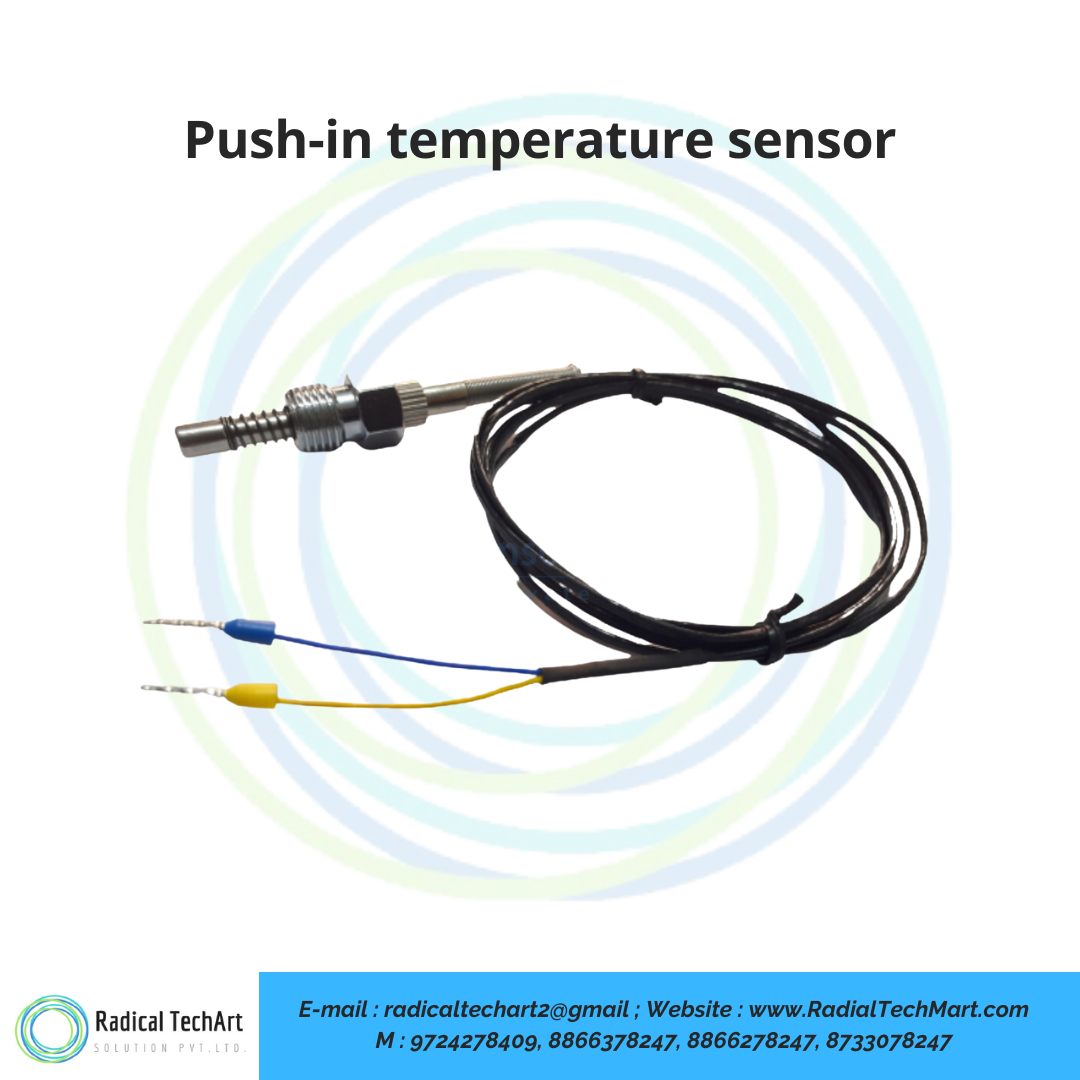
Push-in Temperature Sensor
Customize
Share :
A. Product Overview
A Push-in Thermocouple Sensor is a contact-type temperature sensor that can be inserted directly into a hole, opening or cavity of a machine, mould, heater block or process equipment. It works on the thermocouple principle and provides fast, reliable and durable temperature measurement in industrial applications.
The sensor probe is usually made from stainless steel, Inconel or other heat-resistant alloys, depending on the temperature range and working environment. The push-in construction makes it easy to install and remove without complex mounting arrangements. In many applications, the sensor is held in place by friction, spring tension or the fitment design of the hole.
Push-in thermocouple sensors are commonly used in heating systems, cooling systems, plastic processing machines, automotive engines, industrial machinery and equipment monitoring applications where direct contact with the measured surface or material is required.
B. Working Principle
A Push-in Thermocouple Sensor works on the thermocouple principle. It has two different metal wires joined together at the sensing tip. When this junction is exposed to temperature, it generates a small voltage signal. This voltage changes according to the temperature at the sensing point.
The generated signal is sent to a temperature controller, indicator, transmitter or monitoring system, where it is converted into a temperature reading.
Because the sensor is pushed directly into the hole or material opening, the sensing tip comes in close contact with the measured area. This helps provide faster response and more accurate temperature measurement compared to sensors that are mounted only on the surface.
C. Why It Is Used
Push-in Thermocouple Sensors are used where accurate and direct temperature measurement is required inside a machine, block, cavity, mould or process component. They are preferred because they are simple to install, easy to replace and suitable for compact spaces.
They are useful in applications where the sensor must stay firmly in position without additional mounting hardware. The push-in design helps reduce installation time while maintaining stable contact with the measured surface.
These sensors are also more durable than many surface-mounted sensors because they are less exposed to external damage, vibration and accidental displacement during machine operation.
Key benefits include:
- Easy push-in installation and removal
- Direct contact temperature measurement
- Fast response time
- Durable probe construction
- Suitable for high-temperature applications
- Customizable probe size and shape
- Stable fitment using friction or spring tension
- Suitable for industrial machines, heaters and moulds
- Available with waterproof or explosion-proof housing options
D. Suitable Buyers
Push-in Thermocouple Sensors are suitable for customers who need reliable temperature measurement in industrial equipment and process applications.
Suitable buyers include:
- Plastic injection moulding machine manufacturers
- Heater and furnace manufacturers
- Packaging machine manufacturers
- Automotive equipment manufacturers
- Industrial machinery manufacturers
- Process plant maintenance teams
- OEM machine builders
- Panel builders and automation system integrators
- HVAC and cooling system manufacturers
- Electrical and instrumentation contractors
- Factory maintenance engineers
- Purchase teams looking for replacement temperature sensors
FAQ
1. What is a Push-in Thermocouple Sensor?
A Push-in Thermocouple Sensor is a temperature sensor that is inserted directly into a hole, slot or opening to measure temperature using the thermocouple principle.
2. Where is a Push-in Thermocouple Sensor used?
It is used in industrial machines, heater blocks, moulds, automotive engines, heating systems, cooling systems and process equipment monitoring applications.
3. How does a Push-in Thermocouple Sensor work?
It works by generating a small voltage at the junction of two different metals. This voltage changes with temperature and is converted into a temperature reading by a controller or indicator.
4. Why is the push-in design useful?
The push-in design allows quick installation, easy removal and stable contact with the measured material. It is useful where threaded or surface-mounted sensors are not suitable.
5. Which materials are used for the probe?
The probe is commonly made from stainless steel, Inconel or other thermally conductive and heat-resistant alloys, depending on the temperature and application requirement.
6. Can the probe size be customized?
Yes, the probe diameter, length, shape and cable length can be customized as per the hole size, machine design and application requirement.
7. Is a Push-in Thermocouple Sensor suitable for high-temperature applications?
Yes, it can be designed for high-temperature applications depending on the thermocouple type, probe material and insulation used.
8. Does it require mounting hardware?
In many applications, the sensor is held in place by friction, spring tension or the fitment design. However, mounting accessories can be provided if the application requires additional support.
9. Can it be used in harsh industrial environments?
Yes, Push-in Thermocouple Sensors can be supplied with suitable sheath material, waterproof housing or explosion-proof housing for harsh environments involving heat, dust, moisture or hazardous areas.
10. Which thermocouple types are available?
Common options include Type K, Type J, Type T and other thermocouple types depending on the temperature range, accuracy requirement and process condition.