

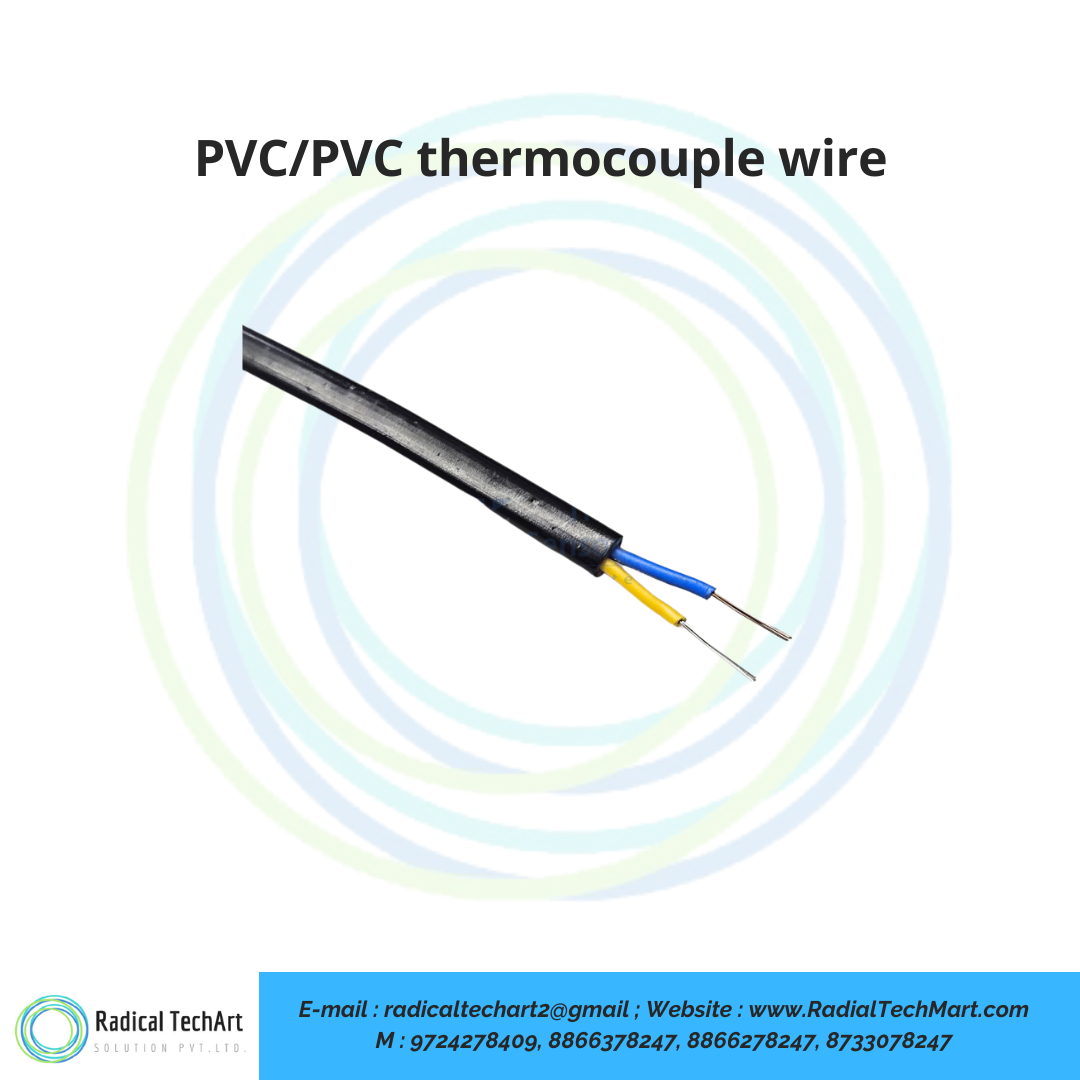
PVC Insulated Temperature Sensor Wire
PVC and PVC thermocouple wire is a cost-effective temperature sensing cable used for low-temperature and general industrial applications. It is suitable for thermocouple signal transmission, control panels, instrumentation wiring, and basic temperature measurement where high heat and strong chemical resistance are not required.
Customize
Share :
A. Product Overview
PVC and PVC thermocouple wire is a thermocouple cable insulated with PVC, also known as polyvinyl chloride. PVC is a commonly used insulation material because it is durable, flexible, affordable, and easily available.
This wire is used to connect thermocouple sensors with temperature indicators, controllers, transmitters, data loggers, and other temperature monitoring instruments. The PVC insulation protects the internal conductors from normal electrical contact, minor abrasion, and general environmental exposure.
PVC thermocouple wire is mainly used in applications where the working temperature is moderate and where extreme heat, aggressive chemicals, or harsh process conditions are not present. It is a practical choice for general-purpose temperature sensing and industrial instrumentation wiring.
B. Working Principle
A thermocouple works by using two different metal conductors joined at one sensing point. When this junction is exposed to temperature, it generates a small voltage signal. This signal changes according to the temperature difference between the sensing point and the measuring instrument.
In PVC and PVC thermocouple wire, the PVC insulation does not measure the temperature directly. Its role is to protect the thermocouple conductors and carry the temperature signal safely from the sensor to the connected instrument.
The wire helps transfer the thermocouple signal to devices such as:
- Temperature indicators
- Temperature controllers
- Temperature transmitters
- Data loggers
- PLC systems
- Monitoring panels
C. Why It Is Used
PVC and PVC thermocouple wire is used because it is economical, flexible, and suitable for many standard temperature measurement applications.
It is used for:
- Thermocouple sensor wiring
- Temperature signal transmission
- Control panel wiring
- Industrial instrumentation
- General temperature monitoring
- Low-temperature applications
- Commercial and light industrial equipment
- Testing and laboratory setups
- Machine wiring where high temperature is not present
PVC thermocouple wire is preferred when the application does not require special insulation like Teflon, Kapton, fiberglass, or ceramic fiber. It offers a good balance of cost, availability, flexibility, and basic insulation performance.
However, PVC insulation is not recommended for very high-temperature areas, strong chemical exposure, or applications where extreme heat resistance is required. For such conditions, Teflon, Kapton, silicone, or fiberglass thermocouple wire may be more suitable.
D. Suitable Buyers
PVC and PVC thermocouple wire is suitable for:
- Industrial automation companies
- Electrical panel builders
- Temperature sensor manufacturers
- Thermocouple suppliers
- Instrumentation engineers
- Maintenance teams
- OEM machine manufacturers
- HVAC equipment manufacturers
- Laboratory equipment suppliers
- Testing equipment manufacturers
- Process control system integrators
- Electrical contractors
- Small machine builders
- Commercial equipment manufacturers
It is especially useful for buyers looking for an affordable thermocouple wire for general-purpose temperature measurement and control applications.
FAQ
1. What is PVC and PVC thermocouple wire?
PVC and PVC thermocouple wire is a thermocouple cable with PVC insulation. It is used to transmit temperature signals from thermocouple sensors to temperature measuring instruments.
2. What is PVC insulation?
PVC stands for polyvinyl chloride. It is a synthetic plastic material commonly used for wire insulation because it is affordable, flexible, durable, and easy to use.
3. Where is PVC thermocouple wire used?
PVC thermocouple wire is used in temperature indicators, controllers, transmitters, data loggers, control panels, laboratory equipment, HVAC systems, and general industrial temperature measurement applications.
4. Is PVC thermocouple wire suitable for high-temperature applications?
PVC thermocouple wire is suitable for low-temperature and moderate-temperature applications. It is not recommended for extreme heat. For high-temperature applications, Teflon, Kapton, fiberglass, or ceramic insulated thermocouple wire is usually preferred.
5. Why is PVC thermocouple wire commonly used?
PVC thermocouple wire is commonly used because it is cost-effective, flexible, easily available, and suitable for many general-purpose temperature sensing applications.
6. Can PVC thermocouple wire be used in chemical environments?
PVC thermocouple wire can handle normal environmental conditions, but it is not suitable for harsh chemical exposure. For chemical-resistant applications, Teflon or Kapton insulated wire may be a better option.
7. What instruments can PVC thermocouple wire connect to?
PVC thermocouple wire can connect thermocouple sensors to temperature indicators, controllers, transmitters, data loggers, PLC systems, and monitoring panels.
8. Is PVC thermocouple wire suitable for control panels?
Yes, PVC thermocouple wire is suitable for control panels and instrumentation wiring where the temperature and environmental conditions are within the PVC insulation limit.
9. What is the difference between PVC thermocouple wire and Teflon thermocouple wire?
PVC thermocouple wire is more affordable and suitable for general applications. Teflon thermocouple wire offers better temperature resistance, chemical resistance, and electrical insulation for demanding applications.
10. Who should buy PVC and PVC thermocouple wire?
PVC and PVC thermocouple wire is ideal for OEMs, panel builders, thermocouple manufacturers, maintenance teams, instrumentation engineers, electrical contractors, and industrial buyers who need an economical wire for general temperature measurement.