

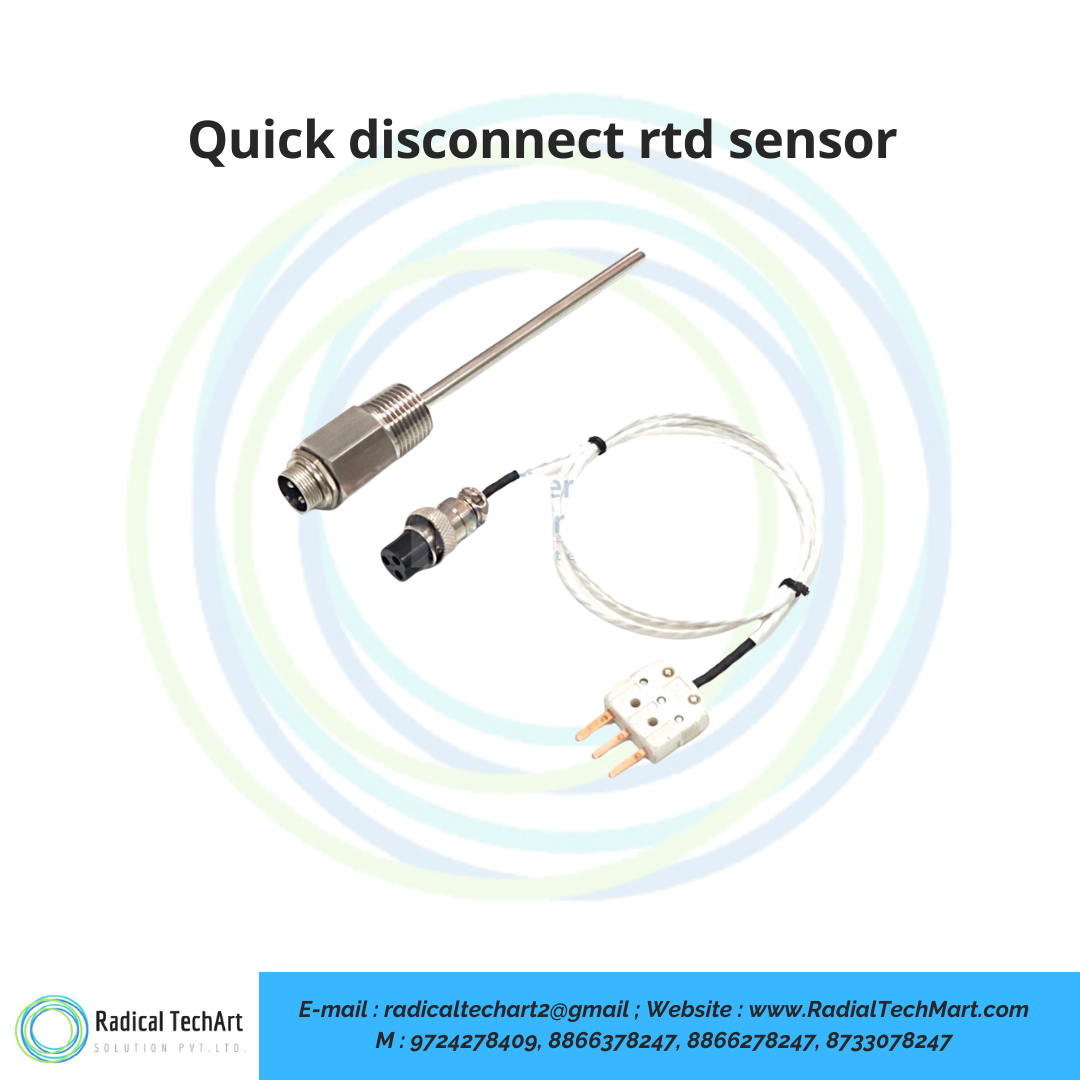


Quick Disconnect RTD Sensor Pt100 with 3 Pin Connector
Quick Disconnect RTD Sensor is a Pt100 temperature sensor designed for fast installation, removal, replacement, calibration and cleaning. It comes with a connector type design, stainless steel probe, optional 1/2 NPT connection, 3 pin flat connector and suitable wire length options for industrial temperature measurement in machinery, HVAC, food, pharmaceutical and process applications.
Customize
Share :
A. Product Overview
Quick Disconnect RTD Sensor is an industrial temperature sensor used for accurate and reliable temperature measurement where easy removal and quick replacement are required.
Unlike a normal RTD sensor with fixed wiring, this sensor comes with a quick disconnect connector. This allows the user to plug and unplug the sensor easily without disturbing the complete wiring system. It is especially useful in applications where sensors need regular maintenance, calibration, cleaning or replacement.
This sensor generally uses a Pt100 simplex RTD element inside a stainless steel probe. The probe is inserted into the process or equipment, while the connector provides a secure and removable electrical connection.
Typical specifications include:
Element: Pt100 Simplex
Temperature Range: Minus 50°C to 500°C
Tip Diameter: 6 mm or 8 mm
Probe Length: 50 mm to 200 mm
Connection: 1/2 NPT optional
Wire Length: 0.5 meter to 10 meter
Termination: 3 pin flat connector
This RTD sensor is suitable for industrial machines, process equipment, HVAC systems, food processing equipment, pharmaceutical machinery and general temperature monitoring applications.
B. Working Principle
Quick Disconnect RTD Sensor works on the resistance temperature detection principle.
The sensing element inside the RTD sensor is usually made of platinum. In a Pt100 RTD sensor, the resistance value is 100 ohms at 0°C. When the temperature increases, the resistance of the platinum element also increases in a predictable way. This resistance change is measured by a temperature controller, indicator, transmitter, PLC or data logger and converted into a temperature reading.
The quick disconnect feature does not change the temperature measurement principle. It only makes the electrical connection easier and faster. The sensor probe measures the temperature, and the connector transfers the signal to the control system through the mating cable.
The main parts of a quick disconnect RTD sensor are:
Sensor probe with Pt100 element.
Protective stainless steel sheath.
Connector mounted on the sensor side.
Mating connector or cable assembly.
Temperature controller, transmitter, PLC or display unit.
Because the connector can be removed easily, the sensor can be replaced or calibrated without rewiring the complete system.
C. Why It Is Used
Quick Disconnect RTD Sensor is used where accurate temperature measurement is required along with easy maintenance and fast replacement.
In many industrial applications, sensor failure, calibration requirement or cleaning work can stop the machine or process. A quick disconnect RTD sensor reduces this downtime because the sensor can be removed and replaced quickly.
It is mainly used for:
- Fast sensor installation and removal.
- Easy calibration without major wiring changes.
- Quick replacement during maintenance.
- Accurate temperature measurement in industrial machines.
- Reducing downtime in process applications.
- Easy cleaning in food and pharmaceutical equipment.
- Temperature monitoring in HVAC and machinery systems.
- Reliable connection between sensor and control panel.
This sensor is useful when frequent maintenance is expected or when the sensor location needs to be accessed regularly.
D. Suitable Buyers
Quick Disconnect RTD Sensor is suitable for buyers who need accurate temperature measurement with easy installation and replacement.
Suitable buyers include:
- Machine manufacturers.
- OEM equipment manufacturers.
- HVAC system manufacturers.
- Food processing plants.
- Pharmaceutical manufacturing units.
- Automotive component manufacturers.
- Industrial maintenance teams.
- Panel builders.
- Automation system integrators.
- Temperature controller users.
- Laboratory equipment manufacturers.
- Process industry buyers.
- Calibration service providers.
It is especially suitable for users who want to reduce wiring work, simplify maintenance and improve sensor replacement speed.
Frequently Asked Questions
1. What is a Quick Disconnect RTD Sensor?
A Quick Disconnect RTD Sensor is a temperature sensor with a connector type design. It can be easily connected and disconnected without removing the complete wiring.
2. What is the benefit of a quick disconnect connector?
The quick disconnect connector helps in easy installation, removal, calibration, cleaning and replacement of the RTD sensor. It saves maintenance time and reduces machine downtime.
3. What does Pt100 mean in this sensor?
Pt100 means the sensor uses a platinum RTD element with 100 ohms resistance at 0°C. Pt100 sensors are widely used for accurate industrial temperature measurement.
4. What is the temperature range of this Quick Disconnect RTD Sensor?
The typical temperature range is minus 50°C to 500°C, depending on the probe material, connector type, cable insulation and application condition.
5. Where is this sensor commonly used?
This sensor is commonly used in HVAC systems, food processing, pharmaceutical machinery, automotive manufacturing, industrial machines, process equipment and laboratory applications.
6. What is the difference between a normal RTD and a quick disconnect RTD?
A normal RTD sensor usually has fixed wiring, while a quick disconnect RTD sensor has a connector. This makes installation and replacement faster and easier.
7. Can this RTD sensor be used with a temperature controller?
Yes, this sensor can be connected to a temperature controller, temperature indicator, transmitter, PLC or data logger, depending on the wiring and input compatibility.
8. Why is a stainless steel probe used?
Stainless steel protects the RTD element from mechanical damage, corrosion, moisture and industrial process conditions. It also improves sensor durability.
9. Is this sensor suitable for regular maintenance applications?
Yes, this sensor is ideal for applications where regular maintenance, calibration or cleaning is required because it can be removed and reinstalled quickly.
10. Can the probe size and wire length be customized?
Yes, the probe diameter, probe length, wire length, connector type and process connection can usually be customized based on application requirement.