

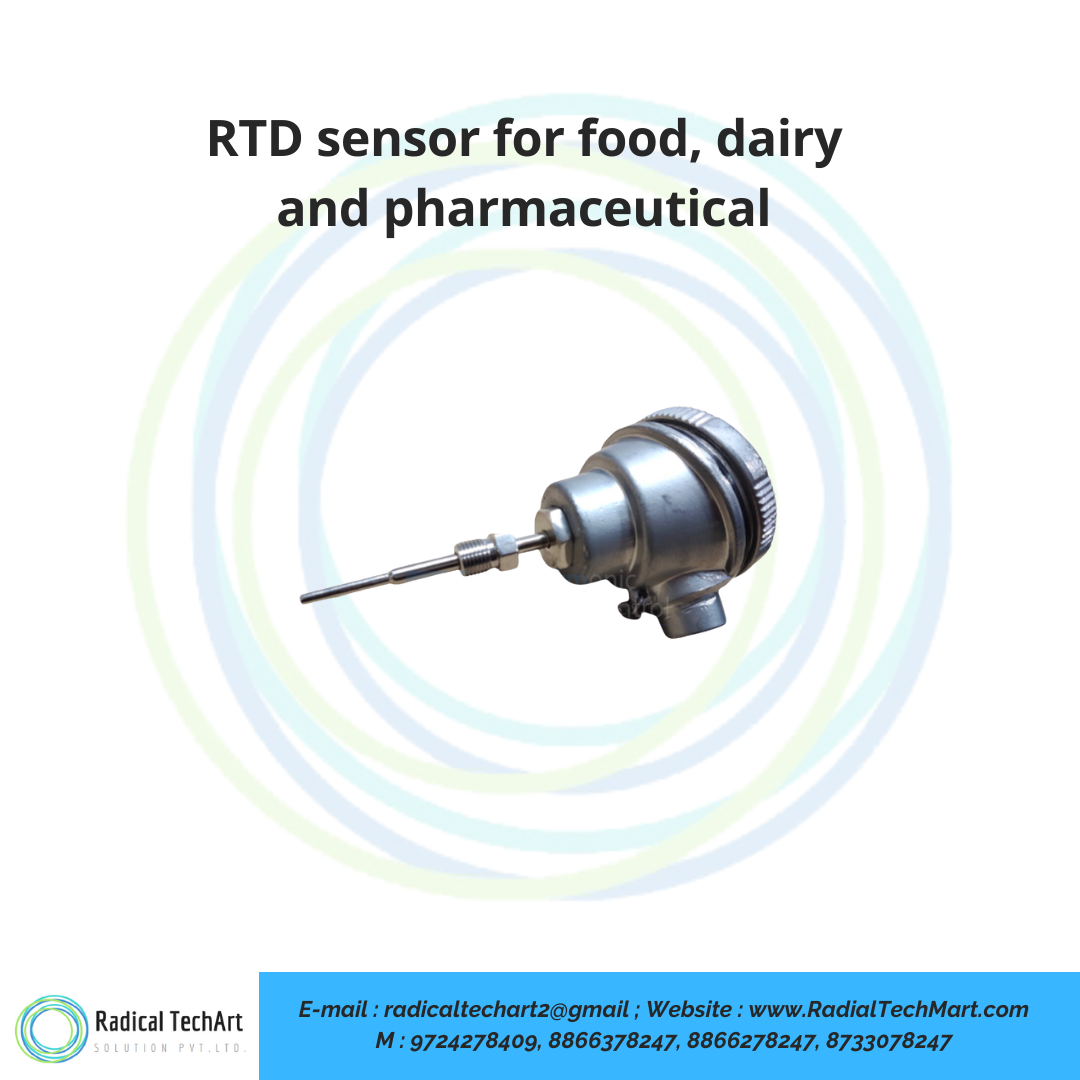
RTD Temperature Sensor for Food, Dairy and Pharma Industry
Customize
Share :
A. Product Overview
RTD sensors for food, dairy and pharmaceutical industries are specially designed temperature sensors used where hygiene, accuracy and product safety are important. These sensors are suitable for applications where the sensor may come in contact with food products, dairy products, pharmaceutical liquids or clean process media.
They are generally manufactured with stainless steel sheath material, which provides good corrosion resistance, strength and easy cleanability. In many applications, the sensor sheath is polished to improve hygiene and reduce product sticking on the sensor surface.
These RTD sensors are available in different configurations such as sanitary connection type, threaded type, flange type, quick disconnect type and customized process connection type. Depending on the application, they can be supplied with PT100 or PT1000 sensing elements for accurate and stable temperature measurement.
RTD sensors for food, dairy and pharmaceutical use are commonly installed in milk processing lines, pasteurization systems, storage tanks, pharma vessels, autoclaves, cleanrooms, cold storage, deep freezers, lyophilizers and CIP systems.
B. Working Principle
RTD stands for Resistance Temperature Detector. It works on the principle that the electrical resistance of platinum changes with temperature.
Inside the RTD sensor, a platinum sensing element such as PT100 or PT1000 is used. When the temperature increases, the resistance of the platinum element also increases. This change in resistance is measured by a temperature controller, transmitter, indicator or data logger and converted into a temperature reading.
For example, a PT100 sensor has a resistance of 100 ohms at 0 degree Celsius, while a PT1000 sensor has a resistance of 1000 ohms at 0 degree Celsius. Because platinum provides excellent stability, repeatability and accuracy, RTD sensors are widely used in critical food, dairy and pharmaceutical processes.
C. Why It Is Used
RTD sensors are used in food, dairy and pharmaceutical applications because they provide accurate, reliable and hygienic temperature measurement.
In these industries, temperature plays a very important role in product quality, safety and process control. Incorrect temperature measurement can affect product consistency, shelf life, sterilization, pasteurization and storage quality.
These sensors are used because they offer:
- Accurate temperature measurement for critical processes
- Hygienic design suitable for clean applications
- Stainless steel construction for corrosion resistance
- Easy cleaning and sanitization
- Compatibility with CIP and sanitary process systems
- Stable performance over long-term use
- Suitable design for food contact and pharma process applications
- Reliable monitoring during storage, transport and production
D. Suitable Buyers
RTD sensors for food, dairy and pharmaceutical industries are suitable for:
- Food processing plants
- Dairy plants
- Milk processing units
- Pharmaceutical manufacturing companies
- Cleanroom equipment manufacturers
- Pasteurization system manufacturers
- Autoclave manufacturers
- Storage tank manufacturers
- Skid and process equipment manufacturers
- OEM machine manufacturers
- System integrators
- Instrumentation engineers
- Maintenance teams
- Purchase managers
- Cold storage and freezer users
- Beverage processing plants
- Chemical and hygienic process industries
FAQ
1. What is an RTD sensor for food, dairy and pharmaceutical applications?
An RTD sensor for food, dairy and pharmaceutical applications is a temperature sensor designed for hygienic and accurate temperature measurement in clean process environments. It is commonly used in food processing, dairy plants, pharma production, storage tanks and sanitary pipelines.
2. Which sensing element is used in these RTD sensors?
These sensors usually use platinum sensing elements such as PT100 or PT1000. PT100 is one of the most commonly used elements for industrial temperature measurement because of its accuracy and stability.
3. Why is stainless steel used in food and pharma RTD sensors?
Stainless steel is used because it is corrosion resistant, durable and easy to clean. It is suitable for hygienic applications where the sensor may come in contact with food, dairy or pharmaceutical products.
4. What is the use of sanitary connection in RTD sensors?
A sanitary connection allows easy installation, removal and cleaning of the RTD sensor. It is commonly used in food, dairy and pharmaceutical processes where hygiene and cleanability are important.
5. Can these RTD sensors be used in CIP systems?
Yes, RTD sensors with suitable sanitary construction can be used in CIP systems. They are designed to withstand cleaning processes and provide reliable temperature measurement during production and cleaning cycles.
6. Where are RTD sensors used in dairy plants?
In dairy plants, RTD sensors are used in milk processing lines, pasteurizers, storage tanks, chilling systems, transfer pipelines and packaging systems for accurate temperature monitoring.
7. Are RTD sensors suitable for pharmaceutical applications?
Yes, RTD sensors are widely used in pharmaceutical applications such as autoclaves, reactors, cleanrooms, storage vessels, process pipelines and temperature-controlled production areas.
8. What is the difference between PT100 and PT1000 RTD sensors?
PT100 has a resistance of 100 ohms at 0 degree Celsius, while PT1000 has a resistance of 1000 ohms at 0 degree Celsius. Both are used for accurate temperature measurement, but the selection depends on the application and instrument compatibility.
9. Can RTD sensors be customized?
Yes, RTD sensors can be customized based on sheath length, diameter, process connection, cable length, head type, element type and application requirement.