

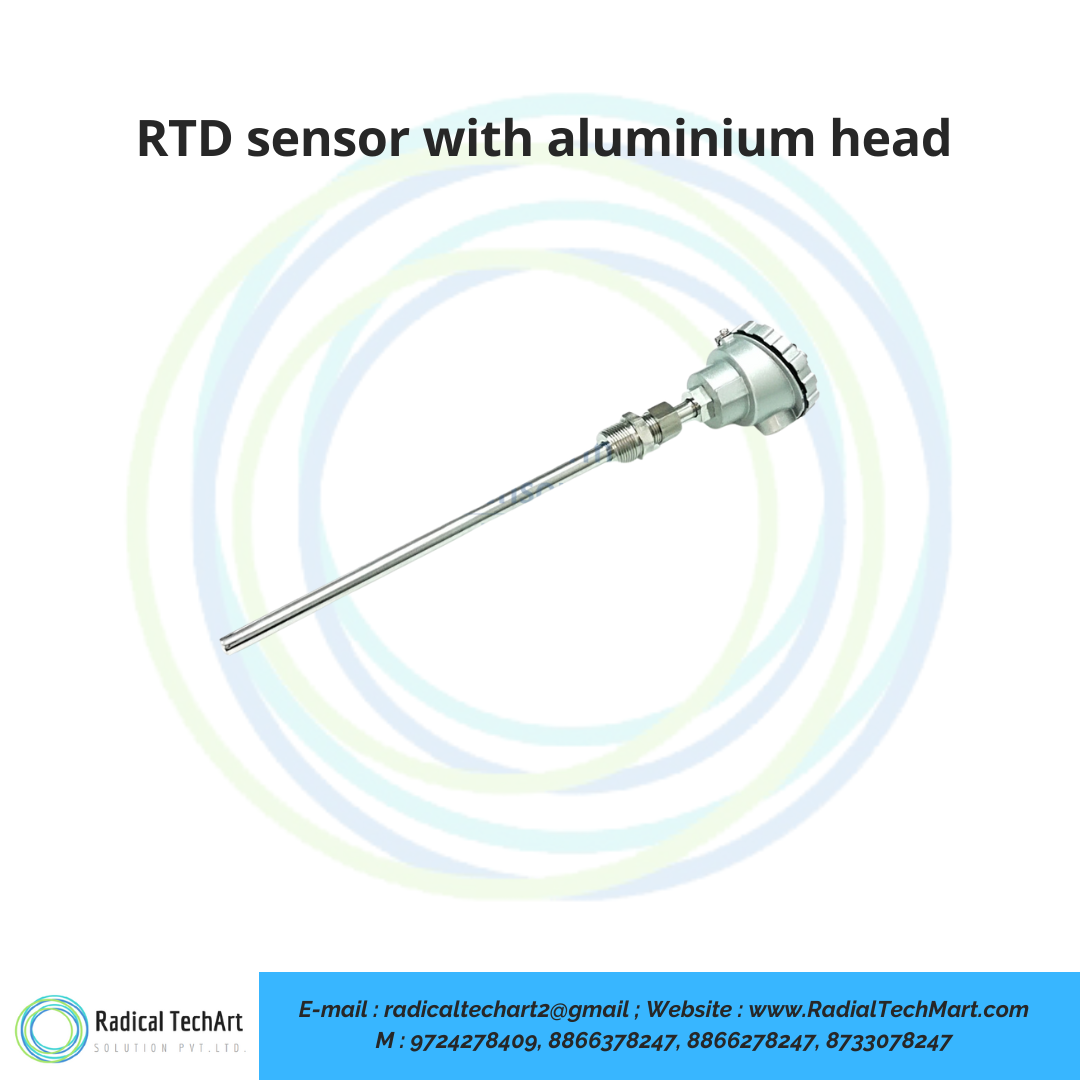
RTD Temperature Sensor with Aluminium Head
RTD and thermocouple sensor with aluminium head is an industrial temperature sensor designed for accurate and reliable temperature measurement in machinery, process plants, heating systems, furnaces, boilers, HVAC equipment and factory automation applications. The aluminium head protects the sensor connection from dust, heat, moisture and mechanical damage, while the stainless steel or Inconel probe ensures durability in demanding environments.
Customize
Share :
A. Product Overview
RTD and thermocouple sensor with aluminium head is used to measure temperature in industrial and process applications. It is available in Pt100, J type and K type options, depending on the required temperature range and application.
The sensor comes with an aluminium terminal head that provides strong protection for internal wiring and sensor connections. The probe is generally made from SS304, SS316, S310 or Inconel, making it suitable for normal, corrosive and high-temperature environments.
This sensor can be supplied in simplex or duplex construction. Simplex sensors have one sensing element, while duplex sensors have two sensing elements for backup measurement or dual control system connection.
Common specifications include probe diameter options such as 5 mm, 6 mm, 8 mm, 10 mm and 12 mm, probe length from 50 mm to 5000 mm and process thread options such as 1/4 inch, 3/8 inch, 1/2 inch and 3/4 inch in BSP and NPT.
B. Working Principle
In an RTD sensor, temperature is measured by detecting the change in resistance of a platinum element. Pt100 is one of the most common RTD elements, where the resistance is 100 ohms at 0°C. As the temperature increases, the resistance also changes in a predictable way. This change is converted into a temperature reading by a controller, indicator, PLC or transmitter.
In a thermocouple sensor, temperature is measured using two different metal wires joined at one end. When the sensing junction is heated, it generates a small voltage. This voltage is measured and converted into temperature. J type and K type thermocouples are commonly used for higher temperature applications.
The aluminium head acts as a connection enclosure. It protects the wiring terminals and allows safe connection between the sensor and control panel.
C. Why It Is Used
RTD and thermocouple sensors with aluminium head are used because they provide stable, accurate and durable temperature measurement in industrial environments.
They are useful when the sensor needs protection from dust, heat, vibration, moisture and rough handling. The aluminium head makes the sensor easy to install and maintain, while the threaded connection helps in secure mounting on tanks, pipelines, machines, ovens and process equipment.
RTD sensors are preferred where high accuracy and stability are required. Thermocouple sensors are preferred where higher temperature measurement is required. This makes the aluminium head design suitable for many industries and temperature measurement applications.
D. Suitable Buyers
This product is suitable for industrial buyers, maintenance teams, OEMs, machine manufacturers, panel builders, process plants, HVAC contractors and automation system integrators.
It is commonly purchased by companies working in chemical processing, pharma, food processing, plastic machinery, textile machinery, packaging machines, boilers, furnaces, heat treatment, refrigeration, HVAC, power plants, water treatment plants and general industrial automation.
It is also suitable for buyers who need a customized temperature sensor with specific probe length, thread size, sheath material, temperature range and sensing element.
FAQ
1. What is an RTD and thermocouple sensor with aluminium head?
It is a temperature sensor with a protective aluminium terminal head. It can be supplied with an RTD element such as Pt100 or a thermocouple element such as J type or K type for industrial temperature measurement.
2. Why is an aluminium head used in this sensor?
The aluminium head protects the sensor terminals and wiring from dust, heat, moisture and mechanical damage. It also provides easy access for wiring and maintenance.
3. Where is this sensor used?
It is used in boilers, furnaces, tanks, pipelines, HVAC systems, plastic machines, textile machines, packaging machines, chemical plants, pharma plants and other industrial equipment.
4. What is the difference between RTD and thermocouple?
RTD sensors offer better accuracy and stability, especially for moderate temperature ranges. Thermocouples are suitable for higher temperature applications and rugged industrial use.
5. What are the available sensor types?
Common options include Pt100 RTD, J type thermocouple and K type thermocouple. The sensor can also be made in simplex or duplex construction.
6. What is simplex and duplex sensor construction?
Simplex means the sensor has one sensing element. Duplex means the sensor has two sensing elements inside the same probe, which can be used for backup or two separate control systems.
7. What probe materials are available?
Common sheath materials include SS304, SS316, S310 and Inconel. The selection depends on temperature, pressure, corrosion and process conditions.
8. What thread sizes are available?
Common thread options include 1/4 inch, 3/8 inch, 1/2 inch and 3/4 inch in BSP and NPT thread types.
9. Can the probe length be customized?
Yes, the probe length can generally be customized from 50 mm to 5000 mm depending on the application requirement.
10. Which industries use this sensor?
Industries such as chemical, pharma, food, textile, plastic, HVAC, power, boiler, furnace, packaging and process automation commonly use RTD and thermocouple sensors with aluminium head.