

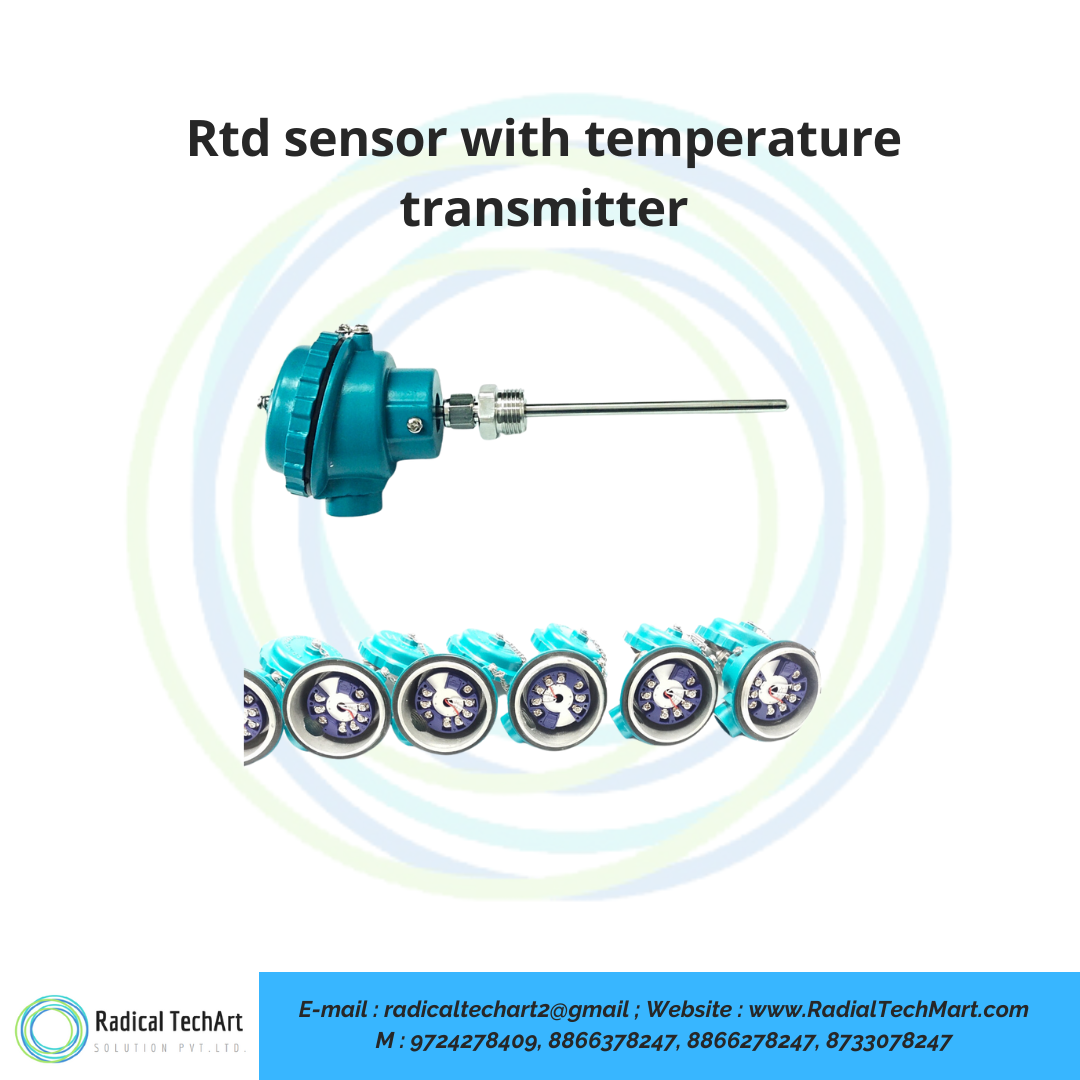
RTD Sensor with Temperature Transmitter
RTD Sensor with Temperature Transmitter is used for accurate industrial temperature measurement and easy signal transmission to PLC, DCS, SCADA, indicators and control systems. It converts the RTD temperature signal into a standard 4-20mA output, making it suitable for process automation, machinery, tanks, pipelines, HVAC and industrial monitoring applications.
Customize
Share :
A. Product Overview
RTD Sensor with Temperature Transmitter is a temperature measurement solution that combines a Pt100 RTD sensor and a temperature transmitter in one assembly. The RTD sensor measures the process temperature, while the transmitter converts the sensor signal into a standard industrial output such as 4-20mA.
This type of sensor is widely used in industrial applications where accurate temperature measurement and long-distance signal transmission are required. It is suitable for direct connection with PLC, DCS, SCADA, digital indicators, PID controllers and other automation systems.
The sensor is available in simplex and duplex options, with different probe diameters, thread sizes and connection types such as without connection, fixed connection and adjustable connection. This makes it flexible for different tanks, pipelines, machines and process equipment.
B. Working Principle
An RTD sensor works on the principle of resistance change with temperature. The Pt100 sensing element inside the probe changes its electrical resistance as the temperature changes.
When the process temperature increases, the resistance of the Pt100 element also increases in a predictable manner. This resistance signal is normally very small and cannot always be transmitted over long distances without signal loss or electrical noise.
The temperature transmitter converts this RTD resistance signal into a standard 4-20mA output signal. This output can be easily transmitted to a control room, PLC panel, SCADA system, DCS system or temperature indicator.
The transmitter also helps improve signal stability and reduces the effect of electrical interference in industrial environments.
C. Why It Is Used
RTD Sensor with Temperature Transmitter is used when accurate temperature measurement and reliable signal transmission are both required. A normal RTD sensor gives a resistance signal, but a transmitter converts that signal into a strong and standard 4-20mA output.
This makes the sensor more suitable for industrial automation and process control applications. It helps in monitoring temperature from a distance, connecting with control systems and maintaining better process accuracy.
It is commonly used in tanks, pipelines, vessels, furnaces, boilers, HVAC systems, chemical plants, pharmaceutical plants, food processing units and general industrial machinery.
D. Suitable Buyers
This product is suitable for:
Industrial automation companies
Process industries
Chemical plants
Pharmaceutical manufacturers
Food processing units
Beverage plants
HVAC contractors
Machine manufacturers
OEM equipment manufacturers
Panel builders
PLC and SCADA system integrators
Boiler and furnace manufacturers
Tank and pipeline manufacturers
Maintenance departments
Production departments
Utility departments
Temperature control system suppliers
Key Features
Pt100 RTD sensing element
Simplex and duplex options available
Built-in temperature transmitter
Standard 4-20mA output
Suitable for PLC, DCS and SCADA integration
Available with fixed, adjustable and without connection options
Different probe diameter options available
BSP and NPT thread options available
Suitable for industrial temperature monitoring
Reliable signal transmission over long distance
Useful for process control and automation applications
Common Specifications
Type: Pt100 RTD, simplex and duplex
Temperature Range: -50°C to 500°C
Connection: Without, fixed and adjustable
Probe Diameter: 5 mm, 6 mm, 8 mm, 10 mm and 12 mm
Transmitter Output: 4-20mA
Thread Size: 1/4 inch, 3/8 inch, 1/2 inch and 3/4 inch in BSP and NPT
Application: Industrial temperature measurement and process control
FAQ
1. What is an RTD Sensor with Temperature Transmitter?
An RTD Sensor with Temperature Transmitter is a temperature sensor assembly that measures temperature using an RTD element and converts the signal into a standard 4-20mA output for control systems.
2. Why is a transmitter used with an RTD sensor?
A transmitter is used to convert the RTD resistance signal into a strong and standard output signal. This makes it easier to connect the sensor with PLC, DCS, SCADA, indicators and controllers.
3. What is the output of this sensor?
The common output is 4-20mA, which is widely used in industrial automation and process control systems.
4. What is Pt100 in an RTD sensor?
Pt100 is a platinum RTD element that has 100 ohms resistance at 0°C. It is commonly used because of its accuracy, stability and reliability.
5. Where is RTD Sensor with Temperature Transmitter used?
It is used in tanks, pipelines, machines, HVAC systems, furnaces, boilers, chemical plants, pharmaceutical plants, food processing units and process industries.
6. Can this sensor be connected directly to a PLC?
Yes. The 4-20mA output from the transmitter can be connected directly to a PLC analog input module, depending on the system requirement.
7. What is the benefit of 4-20mA output?
4-20mA output is stable, noise-resistant and suitable for long-distance signal transmission in industrial environments.
8. What is the difference between simplex and duplex RTD?
Simplex RTD has one sensing element, while duplex RTD has two sensing elements inside the same sensor assembly. Duplex type is useful where backup measurement or dual signal output is required.
9. What connection options are available?
Common connection options include without connection, fixed connection and adjustable connection. Thread options can include BSP and NPT types.
10. Why should I choose an RTD sensor with transmitter instead of a normal RTD sensor?
You should choose an RTD sensor with transmitter when you need better signal transmission, easy control system integration and reliable temperature monitoring over longer distances.