

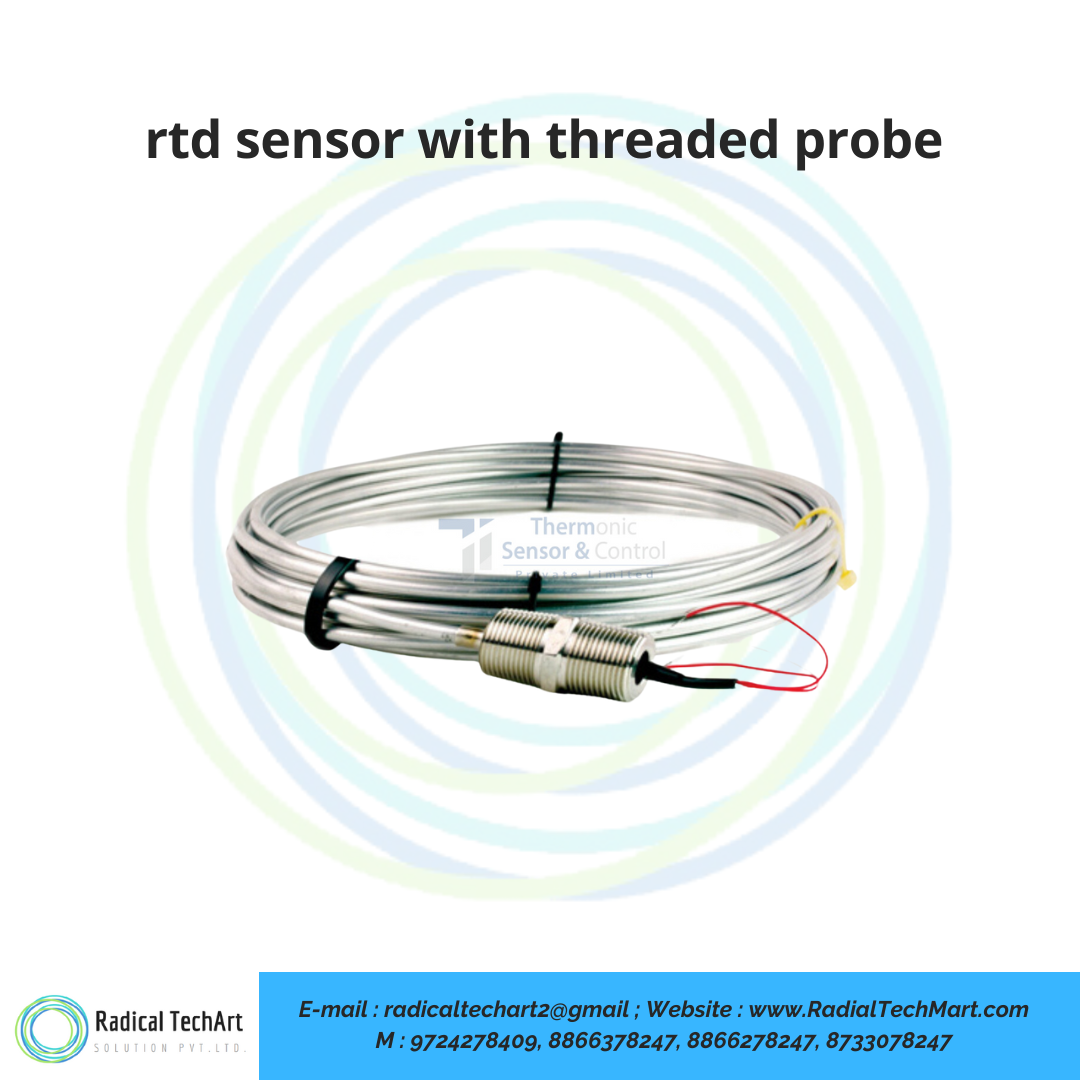
Mineral Insulated RTD Sensor with Threaded Probe
Mineral insulated RTD sensor with threaded probe is designed for accurate and stable temperature measurement in industrial process applications. It uses a Pt100 RTD element with stainless steel construction, threaded mounting, and optional wire configurations for secure installation in pipes, tanks, vessels, machines, HVAC systems, food processing, pharmaceutical plants, and process control systems.
Customize
Share :
A. Product Overview
A mineral insulated RTD sensor with threaded probe is an industrial temperature sensor used to measure temperature accurately in process and machinery applications. The sensor probe is generally made from stainless steel and is designed with a threaded connection, allowing it to be directly installed into a threaded hole, nozzle, thermowell, pipe fitting, tank, or vessel.
This type of RTD sensor is suitable for applications where a strong, stable, and leak-resistant mounting arrangement is required. The mineral insulated construction provides better mechanical strength, good thermal conductivity, and reliable performance in demanding industrial environments.
The sensor is available in Pt100 simplex and duplex options, with temperature range up to 600°C, probe diameter options such as 6 mm and 8 mm, and wire configurations such as 2-wire, 3-wire, 4-wire, and 6-wire.
B. Working Principle
An RTD sensor works on the principle that the electrical resistance of a metal changes with temperature. In most industrial RTD sensors, a Pt100 element is used. Pt100 means the sensor has a resistance of 100 ohms at 0°C.
When the temperature increases, the resistance of the Pt100 element also increases in a predictable way. This resistance change is measured by a temperature indicator, controller, transmitter, PLC, or data acquisition system and then converted into a temperature value.
In a threaded probe design, the RTD sensing element is placed inside a stainless steel probe. The threaded portion helps the sensor remain fixed in the process connection, ensuring good contact, stable measurement, and reliable temperature monitoring.
C. Why It Is Used
Mineral insulated RTD sensor with threaded probe is used because it provides accurate, stable, and repeatable temperature measurement in industrial applications. The threaded design makes installation simple and secure, especially where the sensor needs to be mounted directly into a process connection.
It is preferred in applications where temperature monitoring is important for process control, safety, product quality, and equipment protection. The mineral insulated construction improves durability and helps the sensor perform well in high-temperature and vibration-prone environments.
This sensor is commonly used for measuring temperature in pipelines, tanks, vessels, heating systems, process machines, hydraulic systems, food processing equipment, pharmaceutical equipment, HVAC systems, and general industrial automation systems.
D. Suitable Buyers
This product is suitable for:
Industrial automation companies looking for reliable temperature sensors.
Panel builders who require RTD sensors for temperature controllers and PLC panels.
Process industries that need accurate temperature monitoring in tanks, pipes, and vessels.
Pharmaceutical companies requiring stable temperature measurement in production areas.
Food and beverage plants using temperature sensors in processing and heating applications.
HVAC contractors who need threaded temperature probes for heating, ventilation, and cooling systems.
Machine manufacturers and OEMs who need RTD sensors for equipment temperature monitoring.
Maintenance teams replacing damaged or old temperature sensors in industrial plants.
Chemical plants, power plants, textile units, packaging machines, and engineering industries using process temperature measurement.
FAQ
1. What is a mineral insulated RTD sensor with threaded probe?
A mineral insulated RTD sensor with threaded probe is a temperature sensor designed with a stainless steel probe and threaded mounting connection. It is used for accurate temperature measurement in industrial process applications.
2. What is the use of threaded connection in an RTD sensor?
The threaded connection allows the RTD sensor to be easily screwed into a process fitting, pipe, tank, thermowell, or machine body. It provides a secure and stable installation.
3. What is Pt100 in an RTD sensor?
Pt100 is a platinum-based RTD element that has 100 ohms resistance at 0°C. It is widely used for accurate and stable temperature measurement.
4. What is the temperature range of this RTD sensor?
The temperature range can be up to 600°C, depending on the sensor design, sheath material, element type, and application requirement.
5. What wire configurations are available?
This RTD sensor can be available in 2-wire, 3-wire, 4-wire, and 6-wire configurations. The selection depends on accuracy requirement, cable length, and control system compatibility.
6. Where can this RTD sensor be used?
It can be used in pipelines, tanks, vessels, HVAC systems, food processing plants, pharmaceutical industries, chemical plants, power plants, machinery, and process control systems.
7. What is the difference between simplex and duplex RTD sensor?
A simplex RTD sensor has one sensing element, while a duplex RTD sensor has two sensing elements inside the same probe. Duplex sensors are used where two separate signals are required from one temperature point.
8. Why is mineral insulation used in RTD sensors?
Mineral insulation provides good heat transfer, electrical insulation, mechanical strength, and better durability in industrial applications.
9. Which material is commonly used for the probe?
Stainless steel is commonly used for the probe because it offers good strength, corrosion resistance, and suitability for many industrial environments.
10. Who should buy this RTD sensor?
This sensor is suitable for OEMs, panel builders, automation companies, maintenance teams, pharmaceutical plants, food industries, HVAC contractors, chemical plants, and process industries requiring accurate temperature measurement.