

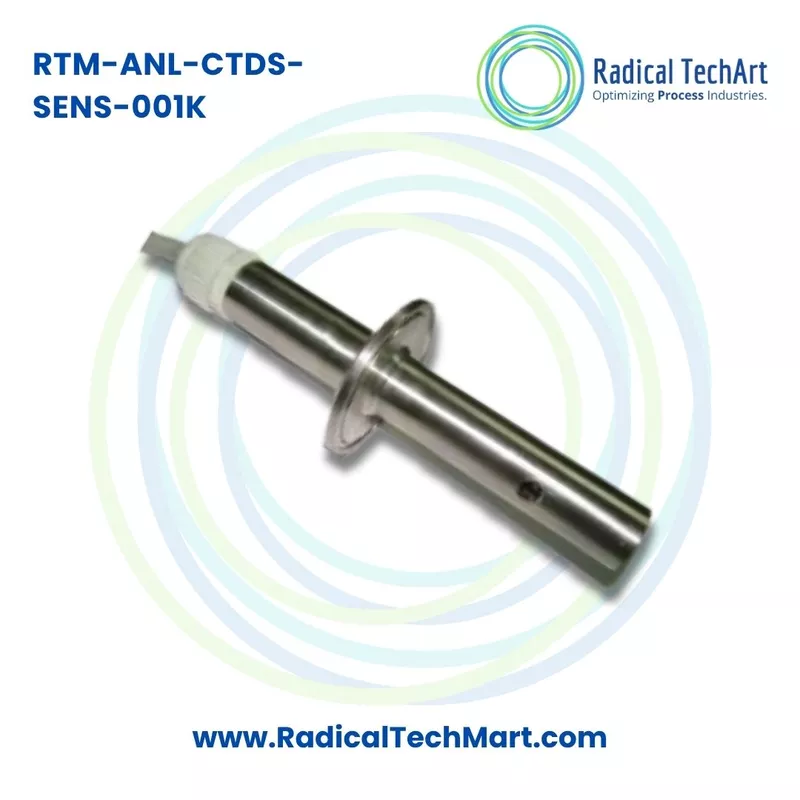


RTM Conductivity Sensor Cell Constant
RTM Conductivity Sensor is used for online conductivity measurement in water, pure water, RO water, DM water, process water, wastewater and high conductivity liquids. It is available with 0.01K, 0.1K, 1K and 10K cell constant options, with suitable material combinations such as S.S. 316, Teflon, Nylon, ABS, PP, PVDF and Titanium depending on the application.
Download the Catalog here!!
Customize
Share :
A. Product Overview
The RTM Conductivity Sensor is an industrial conductivity cell designed to measure the electrical conductivity of liquids in water treatment and process applications. It is available in multiple cell constant options to cover different conductivity ranges, from ultrapure water to high conductivity liquids.
The sensor is available in different model variants including:
RTM-ANL-CTDS-SENS-001K
RTM-ANL-CTDS-SENS-01K
RTM-ANL-CTDS-SENS-1K
RTM-ANL-CTDS-SENS-10K
Cell constant options include:
0.01K for ultrapure water and very low conductivity measurement
0.1K for pure water, RO water and DM water
1K for general water treatment and process water
10K for high conductivity liquids, wastewater, chemical process water and saline applications
The sensor body and contact parts are available in combinations such as S.S. 316, Teflon, Nylon, ABS, PP, PVDF and Titanium. Connection options include 1 inch TC, 3/4 inch thread and 3/4 inch BSP male depending on the selected model. PT-100 temperature output is available for temperature compensation.
B. Working Principle
The RTM Conductivity Sensor works by measuring how easily electric current passes through a liquid. Conductive ions present in the liquid allow current to flow between the sensor electrodes. The higher the ion concentration, the higher the conductivity value.
The sensor is connected to a conductivity controller, transmitter or analyzer. When the sensor is placed in the liquid, the instrument applies a small electrical signal across the electrodes. The response is measured and converted into conductivity units such as µS/cm or mS/cm.
The cell constant defines the measuring range and sensitivity of the conductivity sensor. Lower cell constants such as 0.01K and 0.1K are used for low conductivity liquids like pure water and DM water. Higher cell constants such as 1K and 10K are used for general water, process water, wastewater and high conductivity liquids.
The PT-100 temperature output helps compensate for changes in liquid temperature, improving conductivity measurement accuracy.
C. Why It Is Used
RTM Conductivity Sensor is used to monitor water purity, dissolved ionic content and process liquid quality. Conductivity measurement helps users understand whether the liquid is clean, contaminated, concentrated, diluted or suitable for the required process.
It is commonly used for:
RO plant conductivity monitoring
DM water plant monitoring
Pure water and ultrapure water systems
Water treatment plants
Wastewater treatment systems
Boiler water and cooling tower monitoring
Chemical process liquid monitoring
Pharma water systems
Food and beverage process water
Laboratory and industrial liquid analysis
Saline water and high conductivity liquid measurement
The sensor helps operators maintain process quality, protect equipment, reduce contamination risk and control dosing, treatment or purification systems.
D. Suitable Buyers
This product is suitable for:
Water treatment plant manufacturers
RO plant manufacturers
DM plant and softener system suppliers
Pharma and clean utility plants
Chemical process industries
Food and beverage plants
Boiler and cooling tower maintenance teams
Wastewater treatment plants
System integrators and panel builders
Instrumentation engineers
OEM machine manufacturers
Industrial automation suppliers
Laboratory and process monitoring users
Maintenance and utility departments
FAQ
1. What is the use of an RTM Conductivity Sensor?
RTM Conductivity Sensor is used to measure the electrical conductivity of liquids. It helps monitor water quality, water purity, dissolved salts and process liquid condition.
2. Which cell constant options are available?
The sensor is available in 0.01K, 0.1K, 1K and 10K cell constant options.
3. Which cell constant should I select for pure water?
For pure water, RO water and DM water, 0.1K is commonly preferred. For very low conductivity or ultrapure water, 0.01K is more suitable.
4. Which cell constant is suitable for general water treatment?
For general water treatment, process water and normal conductivity measurement, 1K cell constant is commonly used.
5. Which cell constant is suitable for high conductivity liquids?
For high conductivity liquids, wastewater, saline water and chemical process applications, 10K cell constant is suitable.
6. What materials are available in this conductivity sensor?
Material options include S.S. 316, Teflon, Nylon, ABS, PP, PVDF and Titanium depending on the selected model and application requirement.
7. What connection options are available?
Connection options include 1 inch TC, 3/4 inch thread and 3/4 inch BSP male depending on the model.
8. Does the sensor support temperature compensation?
Yes, PT-100 temperature output is available, which can be used for temperature compensation with a suitable conductivity transmitter or controller.
9. Can this sensor be used in RO plants?
Yes, it can be used in RO plants for monitoring inlet water, outlet water, permeate water and treated water conductivity.
10. Can this sensor be used in chemical applications?
Yes, suitable material selection is important for chemical applications. Depending on the liquid compatibility, S.S. 316, PP, PVDF, Teflon or Titanium options can be selected.
11. Is this an online conductivity sensor?
Yes, this type of conductivity sensor is suitable for continuous online conductivity measurement when connected with a compatible conductivity controller, transmitter or analyzer.
12. What details should be shared before selecting the sensor?
For correct selection, share the application, liquid type, expected conductivity range, temperature, pressure, mounting connection, required cell constant, cable requirement and controller or transmitter model.