

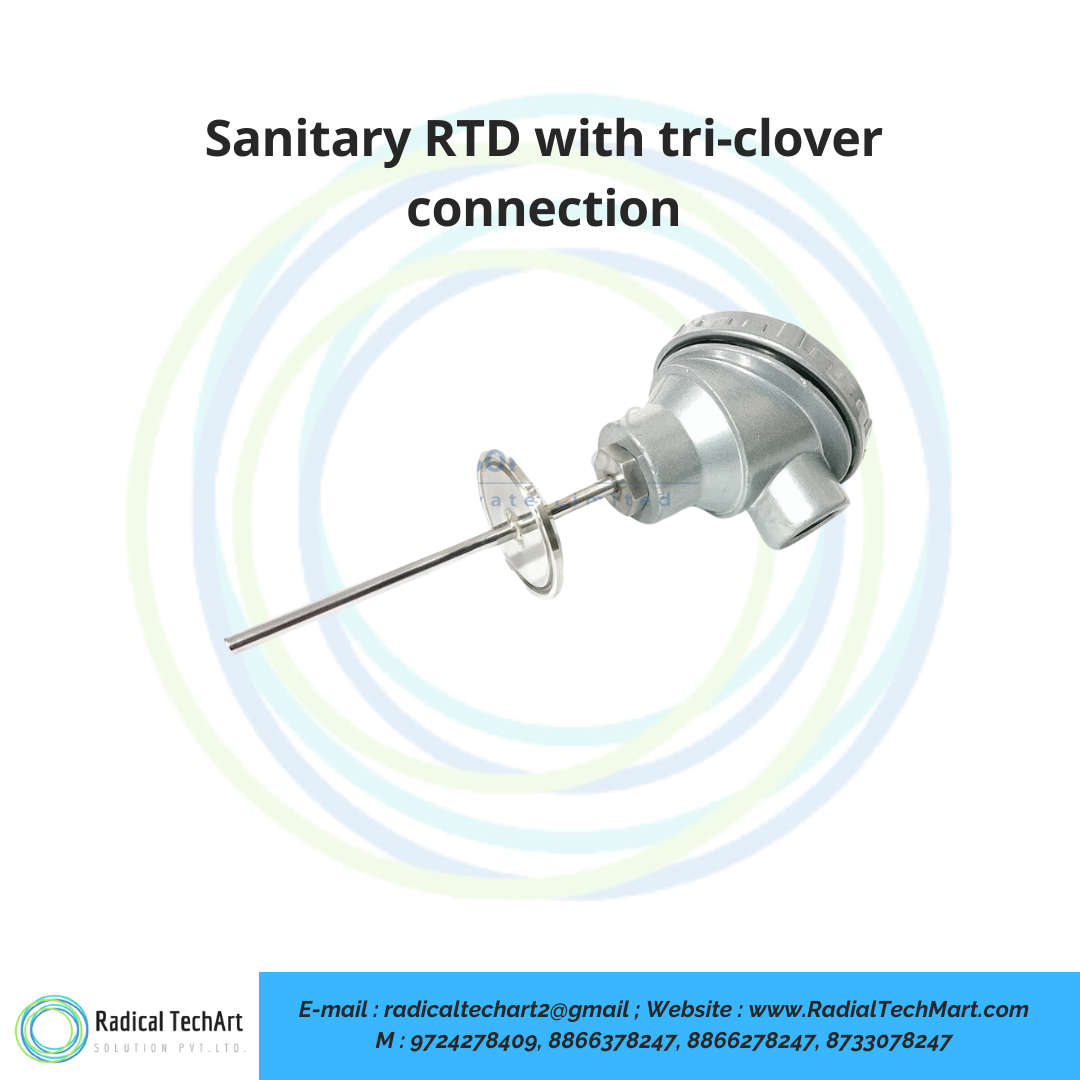
Sanitary RTD Sensor with Tri-Clover Connection
Sanitary RTD Sensor with Tri-Clover Connection is designed for accurate and hygienic temperature measurement in food, beverage, dairy, pharmaceutical and clean process industries. Its stainless steel probe, Pt100 sensing element and quick clamp connection make it suitable for applications where cleanliness, easy installation and reliable process temperature monitoring are important.
Customize
Share :
A. Product Overview
Sanitary RTD Sensor with Tri-Clover Connection is a hygienic temperature sensor specially designed for clean process applications. It is commonly used in food, beverage, dairy, pharmaceutical and chemical industries where contamination control and accurate temperature measurement are critical.
The sensor uses a Pt100 RTD element, available in simplex or duplex configuration, to measure process temperature with high accuracy and stability. The Tri-Clover connection, also known as Tri-Clamp connection, allows the sensor to be installed and removed quickly without threaded mounting. This makes it easy to clean, inspect and maintain.
The probe is generally made from SS316 or SS316L stainless steel, which provides good corrosion resistance and is suitable for sanitary process environments. The smooth probe surface helps reduce product build-up and supports hygienic cleaning practices.
B. Working Principle
A sanitary RTD sensor works on the resistance temperature detection principle. Inside the sensor, a Pt100 element changes its electrical resistance according to the process temperature.
When the temperature increases, the resistance of the Pt100 element also increases in a predictable way. This resistance change is measured by a temperature transmitter, controller, indicator or PLC. The device then converts the resistance value into a temperature reading.
In this design, the RTD probe is inserted into the process pipe, tank or vessel through a Tri-Clover connection. The probe comes in direct contact with the process liquid or medium, allowing fast and accurate temperature sensing. The Tri-Clover clamp provides a secure and hygienic connection while allowing quick removal for cleaning or calibration.
C. Why It Is Used
Sanitary RTD Sensor with Tri-Clover Connection is used where accurate temperature measurement and hygienic installation are both required. In food, dairy, beverage and pharmaceutical processes, regular threaded sensors may create cleaning difficulties or contamination risks. A Tri-Clover RTD sensor solves this problem with a smooth, easy-to-clean and removable design.
It is used for monitoring and controlling temperature in tanks, pipelines, processing vessels, mixing systems, pasteurization lines, CIP systems and clean production areas. The stainless steel construction makes it suitable for applications where the sensor comes into direct contact with liquid, semi-liquid or clean process media.
This sensor helps improve process quality, temperature control, product safety and hygiene compliance.
D. Suitable Buyers
This product is suitable for:
Food processing plants
Dairy plants
Beverage manufacturers
Pharmaceutical manufacturing units
Chemical process industries
Clean process equipment manufacturers
Skid manufacturers
Process automation companies
OEM machine manufacturers
Pasteurization system manufacturers
CIP system manufacturers
Tank and vessel manufacturers
Maintenance teams
Temperature control system integrators
Quality control and production departments
Key Features
Pt100 RTD sensing element
Simplex and duplex options available
Tri-Clover and Tri-Clamp type connection
Suitable for hygienic and sanitary applications
SS316 and SS316L stainless steel probe material
Easy installation and removal
Suitable for food, dairy, beverage and pharmaceutical processes
Smooth probe design for easy cleaning
Useful for temperature monitoring and control
Suitable for connection with transmitter, controller, indicator or PLC
Common Specifications
Type: Pt100 RTD, simplex or duplex
Temperature Range: -70°C to 500°C
Probe Diameter: 6 mm and 8 mm options
Probe Length: 50 mm, 100 mm, 150 mm, 200 mm and customized options
Tri-Clover Size: 1/2 inch, 1 inch, 1.5 inch, 2 inch and other sizes
Sheath Material: SS316 and SS316L
Application: Hygienic temperature measurement
FAQ
1. What is a Sanitary RTD Sensor with Tri-Clover Connection?
A Sanitary RTD Sensor with Tri-Clover Connection is a hygienic temperature sensor used for measuring temperature in clean process applications. It is commonly used in food, beverage, dairy and pharmaceutical industries.
2. Why is Tri-Clover connection used in RTD sensors?
Tri-Clover connection is used because it provides quick installation, easy removal and hygienic cleaning. It does not require threading and is suitable for sanitary process lines.
3. Where is this sanitary RTD sensor used?
It is used in food processing plants, dairy plants, beverage production, pharmaceutical manufacturing, clean process tanks, pipelines, pasteurization systems and CIP systems.
4. What is the sensing element used in this RTD sensor?
This sensor commonly uses a Pt100 RTD element. Pt100 is widely used because it offers accurate and stable temperature measurement.
5. What is the benefit of SS316L material in sanitary RTD sensors?
SS316L stainless steel provides corrosion resistance, good hygiene compatibility and durability in clean process environments. It is suitable for direct contact with food, beverage and pharmaceutical media.
6. Can this sensor be removed for cleaning?
Yes. The Tri-Clover clamp design allows the sensor to be easily removed, cleaned, inspected or calibrated without major process modification.
7. Is this sensor suitable for food and dairy applications?
Yes. The sanitary design, stainless steel construction and Tri-Clover connection make it suitable for food, dairy and beverage applications.
8. Can it be connected to a temperature controller or PLC?
Yes. The RTD sensor can be connected to a temperature transmitter, digital temperature indicator, PID controller or PLC for monitoring and control.
9. What probe sizes are available?
Common probe diameter options include 6 mm and 8 mm. Probe length options can include 50 mm, 100 mm, 150 mm, 200 mm and customized lengths based on application needs.
10. Why should I choose a sanitary RTD sensor instead of a normal RTD sensor?
A sanitary RTD sensor is better for clean process applications because it is easier to clean, reduces contamination risk and supports hygienic installation. Normal RTD sensors may not be suitable where food safety, pharma hygiene and clean process standards are required.