

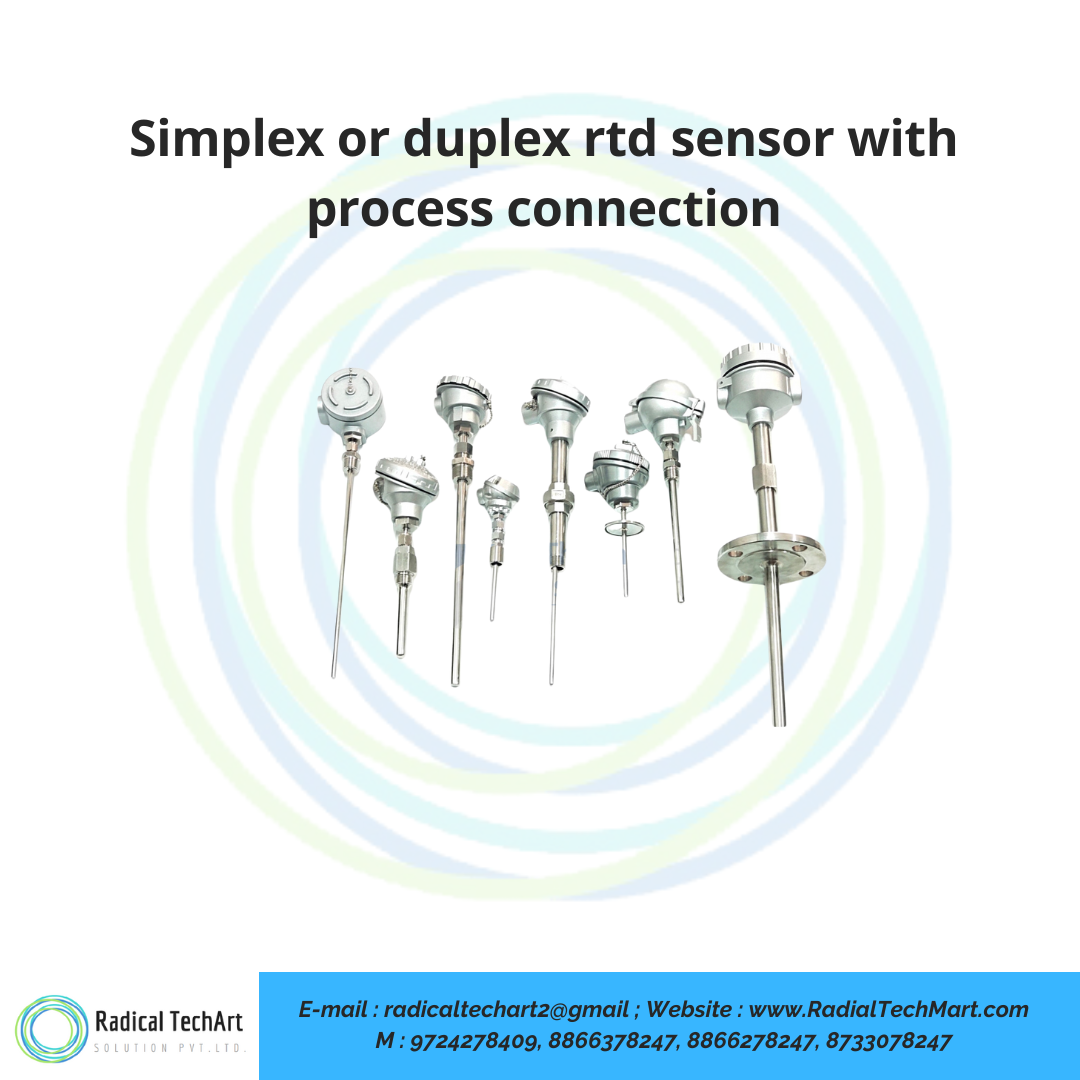
Simplex and Duplex RTD Sensor with Process Connection
Simplex and Duplex RTD Sensor with Process Connection is used for accurate and reliable temperature measurement in industrial processes. It is available with Pt100 sensing element, simplex or duplex configuration, different probe diameters, long probe lengths, Class A or Class B accuracy, and sheath material options such as SS304, SS316, SS310 and Inconel.
Customize
Share :
A. Product Overview
Simplex and Duplex RTD Sensor with Process Connection is an industrial temperature sensor designed for measuring process temperature in tanks, pipelines, vessels, reactors, machinery and process equipment.
A simplex RTD sensor has one sensing element, while a duplex RTD sensor has two sensing elements inside the same probe. Duplex type sensors are preferred where backup sensing, dual signal output or higher process reliability is required.
The sensor is available with different process connection options such as threaded connection, flanged connection, compression fitting or customized mounting as per application requirement. It can be supplied with Pt100 RTD element and, depending on requirement, J type or K type temperature sensing options may also be available.
Technical Specifications
Type: Pt100, J type or K type
Configuration: Simplex or Duplex
Temperature Range: -50 to 500°C, 0 to 600°C or 0 to 1200°C
Probe Diameter: 6 mm to 16 mm, optional
Probe Length: 50 mm to 5000 mm
Accuracy: Class A or Class B as per IEC 60751
Sheath Material: SS304, SS316, SS310, Inconel and other suitable materials
B. Working Principle
In a Pt100 RTD sensor, the temperature is measured based on the change in electrical resistance of the sensing element. Pt100 means the sensor has a resistance of 100 ohms at 0°C. As the temperature increases, the resistance of the platinum element also increases in a predictable manner.
This resistance change is measured by a temperature indicator, controller, transmitter, PLC or data acquisition system. The instrument then converts the resistance value into a temperature reading.
In simplex RTD sensors, one sensing element gives one temperature signal. In duplex RTD sensors, two sensing elements are installed in the same probe, allowing two separate outputs or one working sensor and one standby sensor.
C. Why It Is Used
Simplex and Duplex RTD Sensors with Process Connection are used because they provide accurate, stable and repeatable temperature measurement in industrial applications.
They are useful where direct installation into the process is required. The process connection helps the sensor stay securely mounted in tanks, pipelines, chambers or machines. The stainless steel or Inconel sheath protects the sensing element from pressure, vibration, heat and process conditions.
Duplex RTD sensors are especially useful in critical applications where process shutdown due to sensor failure must be avoided. If one element fails, the second element can be used as a backup.
D. Suitable Buyers
This product is suitable for:
Process industries
Chemical plants
Pharmaceutical plants
Oil and gas industries
Food and beverage plants
Power plants
Boiler and furnace manufacturers
Machine manufacturers
Automation system integrators
Panel builders
HVAC and utility equipment manufacturers
Water treatment plants
Plastic and rubber processing industries
OEMs and maintenance teams
Common Applications
Temperature measurement in tanks
Temperature monitoring in pipelines
Boiler temperature monitoring
Reactor temperature measurement
Process vessel temperature monitoring
Furnace and oven temperature sensing
Heat exchanger temperature measurement
Industrial machinery temperature monitoring
PLC and control panel temperature feedback
Critical process temperature monitoring using duplex sensing
FAQ
1. What is a Simplex RTD Sensor?
A Simplex RTD Sensor has one temperature sensing element inside the probe. It gives one temperature signal and is suitable for standard industrial temperature measurement applications.
2. What is a Duplex RTD Sensor?
A Duplex RTD Sensor has two temperature sensing elements inside the same probe. It is used where two separate temperature signals are required or where one element is kept as a backup for safety and reliability.
3. What is the use of process connection in an RTD sensor?
The process connection is used to mount the RTD sensor securely into the process. It can be threaded, flanged or compression type depending on the installation requirement.
4. Which is better, simplex or duplex RTD sensor?
Simplex RTD sensor is suitable for normal temperature measurement. Duplex RTD sensor is better for critical applications where backup sensing or dual output is required.
5. What is Pt100 in an RTD sensor?
Pt100 refers to a platinum RTD element that has 100 ohms resistance at 0°C. It is widely used in industrial temperature sensors because of its accuracy, stability and repeatability.
6. What is the temperature range of this RTD sensor?
The available temperature ranges include -50 to 500°C, 0 to 600°C and 0 to 1200°C depending on the sensor type, sheath material and application requirement.
7. Which sheath materials are available?
The sensor can be supplied with SS304, SS316, SS310, Inconel and other suitable sheath materials based on temperature range and process conditions.
8. Where is a Duplex RTD Sensor commonly used?
Duplex RTD sensors are commonly used in chemical plants, pharma plants, oil and gas systems, boilers, reactors, process vessels, power plants and critical industrial temperature monitoring applications.
9. Can this RTD sensor be customized?
Yes, the RTD sensor can be customized in terms of probe diameter, probe length, process connection, sheath material, accuracy class, head type and wiring configuration.
10. Can this sensor be connected to a PLC or controller?
Yes, this RTD sensor can be connected to a temperature controller, indicator, transmitter, PLC or automation system for temperature monitoring and control.