

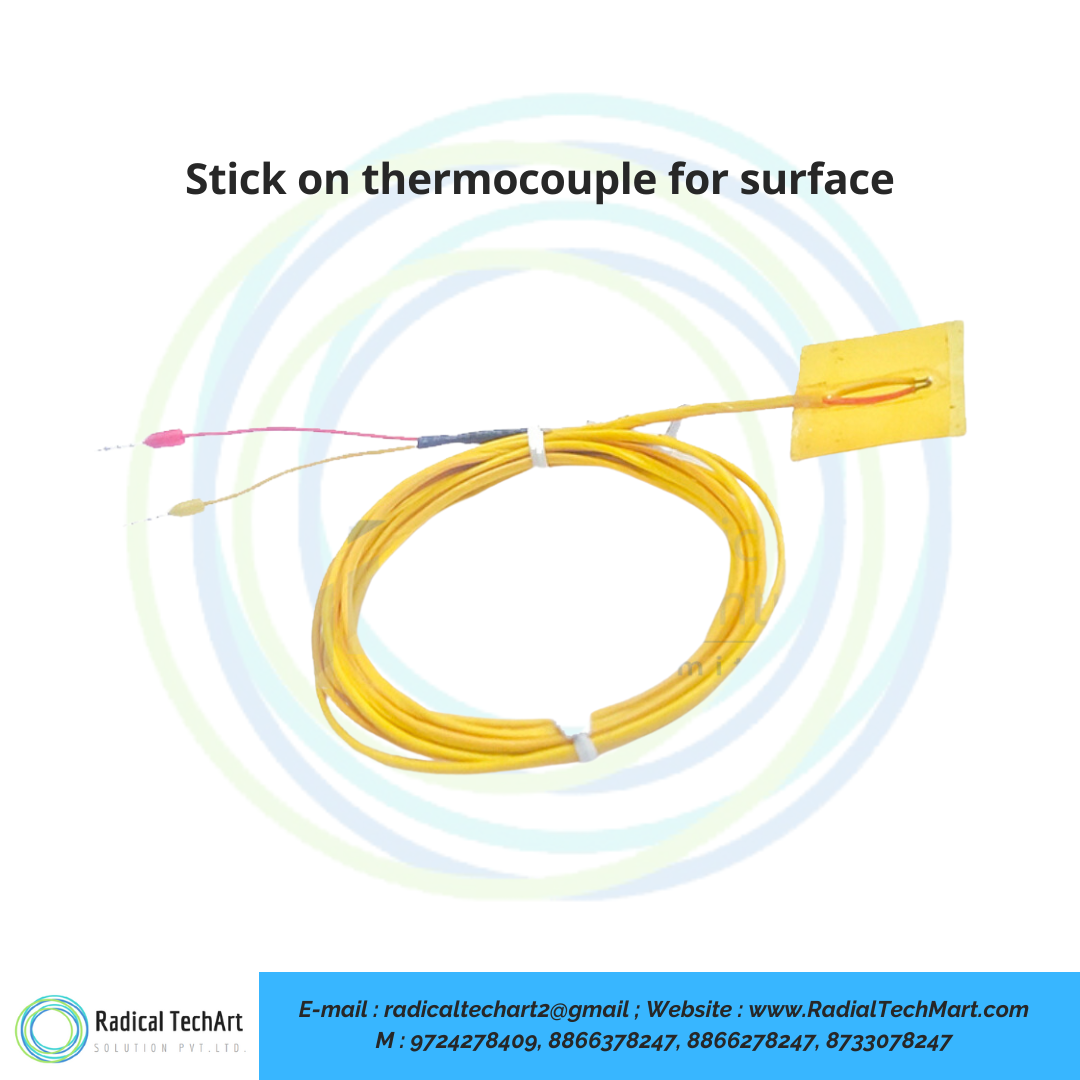


Stick-On Thermocouple Sensor for Industires
Stick-on Temperature Sensor is a compact adhesive-backed sensor used for accurate surface temperature measurement on flat and curved surfaces. It is suitable for industrial machines, heat treatment, welding, metalworking, laboratory testing and equipment monitoring applications.
Customize
Share :
A. Product Overview
Stick-on Temperature Sensor is designed to measure the temperature of a surface by directly attaching the sensor to the required location. It uses an adhesive backing, usually with Kapton tape, which allows easy mounting on flat or curved surfaces.
This sensor is useful where drilling, threading or permanent mounting is not possible. It provides quick and convenient surface temperature monitoring for industrial and testing applications.
Stick-on Temperature Sensors are commonly available in K type, J type and RTD options. The typical temperature range is -70 to 260°C. It can be supplied with Teflon and Kapton wire insulation, 0.5 meter to 10 meter wire length and grounded or ungrounded junction options.
B. Working Principle
A stick-on thermocouple works on the thermoelectric principle. It contains two different metal wires joined together at one end to form a temperature-sensitive junction.
When the junction is attached to a surface and exposed to heat, it generates a small voltage. This voltage changes according to the surface temperature. The signal is then sent to a temperature controller, indicator, data logger, PLC or monitoring system, which converts it into a readable temperature value.
In RTD-type stick-on sensors, the sensor element changes resistance when temperature changes. The monitoring device reads this resistance change and converts it into temperature.
C. Why It Is Used
Stick-on Temperature Sensor is used when surface temperature needs to be measured without drilling, welding or mechanical modification. It is easy to install, lightweight and suitable for both temporary and continuous monitoring.
It is especially useful for surfaces that are difficult to access with regular probes. It can be applied on machine surfaces, pipes, panels, heaters, molds, metal parts and test components.
Proper surface temperature monitoring helps improve process control, prevent overheating, support maintenance inspection and improve product quality in industrial operations.
D. Suitable Buyers
Stick-on Temperature Sensor is suitable for:
Industrial maintenance teams
Machine manufacturers
Heat treatment plants
Welding and metalworking industries
Plastic machinery users
Mold and die manufacturers
HVAC service teams
Laboratory testing teams
Research and development departments
Electrical panel manufacturers
Equipment testing engineers
Production quality control teams
OEM machine builders
Automation system integrators
Temperature controller panel makers
Industrial automation suppliers
FAQ
1. What is a Stick-on Temperature Sensor?
A Stick-on Temperature Sensor is an adhesive-backed sensor used to measure the surface temperature of machines, pipes, panels, molds and industrial components.
2. Where is this sensor used?
It is used in industrial machines, heat treatment, welding, metalworking, HVAC systems, laboratory testing, equipment monitoring and research applications.
3. Can it be used on flat and curved surfaces?
Yes. Stick-on Temperature Sensors can be applied on both flat and curved surfaces, depending on the surface condition and installation requirement.
4. Does it require drilling or welding?
No. It is attached using adhesive backing, so it does not require drilling, welding, threading or mechanical mounting.
5. Which sensor types are available?
It is commonly available in K type, J type and RTD options.
6. What is the temperature range of this sensor?
The typical temperature range is -70 to 260°C, depending on the sensor type, tape material and wire insulation.
7. What tape material is used in this sensor?
Kapton tape is commonly used because it can withstand heat and provides good surface attachment for temperature sensing.
8. What wire insulation options are available?
The sensor is generally available with Teflon and Kapton wire insulation.
9. What wire length is available?
Wire length is generally available from 0.5 meter to 10 meter, depending on the application and installation distance.
10. What is the difference between grounded and ungrounded junction?
A grounded junction gives faster response because the junction is connected to the sheath or contact surface. An ungrounded junction provides better electrical isolation and helps reduce electrical noise interference.
11. Can this sensor be used for industrial surface temperature monitoring?
Yes. It is suitable for industrial surface temperature monitoring on machines, metal parts, heaters, pipes, panels and production equipment.
12. Why should I use a Stick-on Temperature Sensor?
You should use it when you need quick, simple and non-invasive surface temperature measurement without modifying the machine or component.