

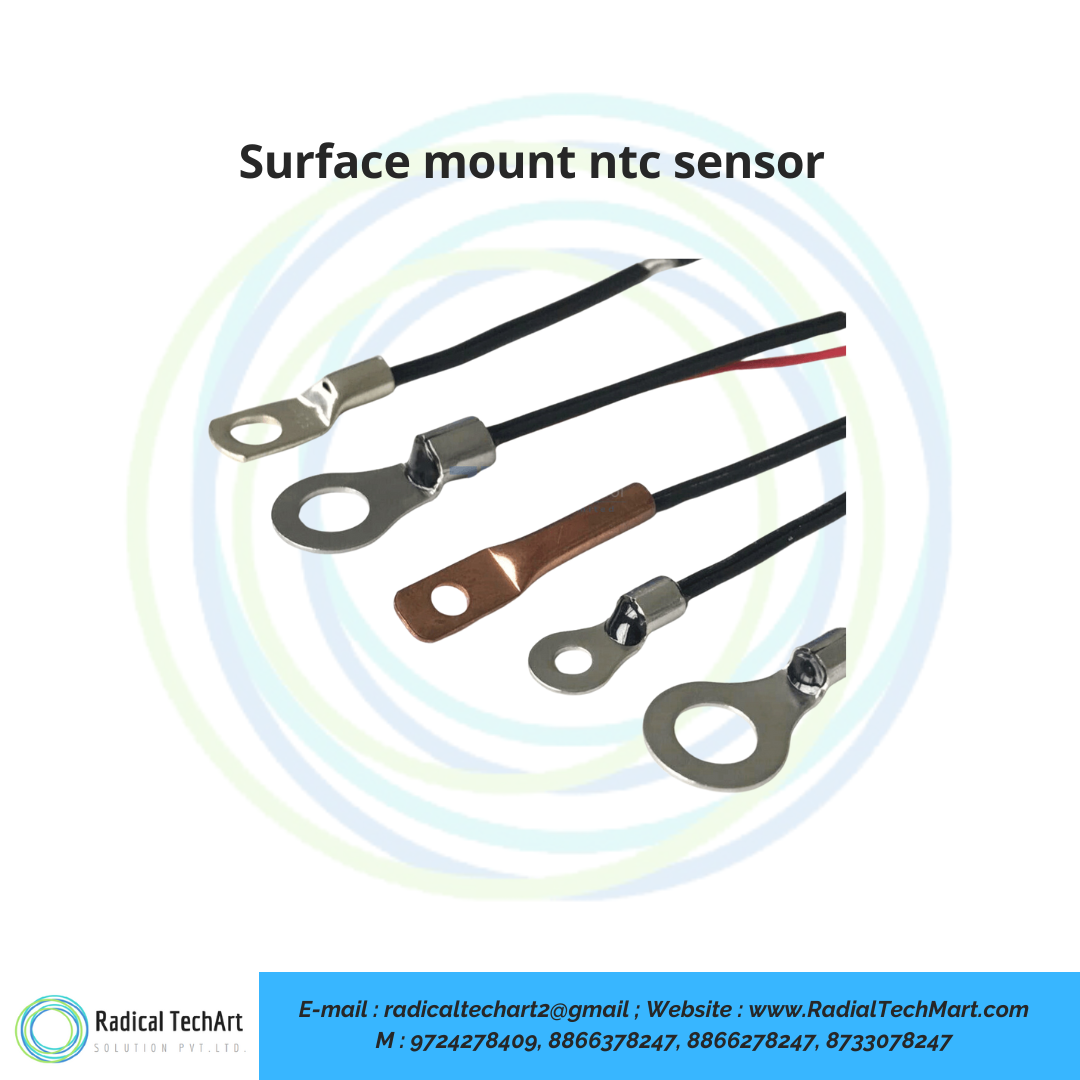
Surface Mount NTC Temperature Sensor for PCB Applications
Surface mount NTC sensors are compact thermistor based temperature sensors used for accurate PCB temperature sensing, thermal monitoring, and temperature compensation in electronic circuits. They are suitable for consumer electronics, industrial automation, automotive electronics, medical devices, and other compact applications where space saving and precise temperature measurement are required.
Customize
Share :
A. Product Overview
A Surface Mount NTC Sensor is a compact temperature sensor that uses a Negative Temperature Coefficient thermistor to measure temperature changes. It is designed to be mounted directly on the surface of a printed circuit board or other electronic surface using soldering techniques.
These sensors are commonly used in applications where space is limited and accurate temperature monitoring is required. They are available in different sizes, shapes, resistance values, and temperature ranges to match different circuit and application requirements.
Surface mount NTC sensors are widely used in electronic temperature sensing, temperature compensation, PCB thermal protection, battery monitoring, power supply monitoring, automotive electronics, medical equipment, industrial control systems, and compact consumer devices.
B. Working Principle
A surface mount NTC sensor works on the resistance change principle. The sensor contains an NTC thermistor element whose resistance changes according to temperature.
When the temperature increases, the resistance of the NTC thermistor decreases. When the temperature decreases, the resistance increases. This resistance change is measured by the electronic circuit, controller, or monitoring system and converted into a temperature reading.
In PCB applications, the sensor is soldered directly onto the board surface. It continuously monitors the temperature of the circuit board, nearby electronic components, or surrounding area. Based on the temperature reading, the system can control cooling, activate protection, adjust performance, or provide temperature compensation.
C. Why It Is Used
Surface mount NTC sensors are used because they provide accurate temperature measurement in a very compact size. Their small design makes them ideal for modern electronic devices where board space is limited.
They help protect electronic circuits from overheating, improve product reliability, and support stable performance. In many applications, temperature changes can affect circuit accuracy, battery life, power supply performance, and component safety. A surface mount NTC sensor helps monitor these temperature changes in real time.
These sensors are preferred because they are compact, sensitive, reliable, cost effective, and suitable for automated PCB assembly. They can also provide fast response because they are mounted close to the heat source or critical component.
D. Suitable Buyers
Surface mount NTC sensors are suitable for:
Electronic product manufacturers
PCB assembly manufacturers
Consumer electronics manufacturers
Industrial automation companies
Automotive electronics manufacturers
Medical device manufacturers
Battery pack manufacturers
Power supply manufacturers
Sensor module manufacturers
Research and development labs
OEM equipment manufacturers
Electronic component suppliers
Control panel and embedded system manufacturers
These sensors are suitable for buyers looking for SMD NTC sensors, SMT NTC thermistors, PCB temperature sensors, compact thermistor sensors, and electronic temperature monitoring solutions.
FAQ
1. What is a Surface Mount NTC Sensor?
A Surface Mount NTC Sensor is a compact temperature sensor that uses an NTC thermistor to measure temperature changes and is mounted directly onto a PCB or electronic surface.
2. What does NTC mean?
NTC means Negative Temperature Coefficient. It means the resistance of the sensor decreases when the temperature increases.
3. Where are surface mount NTC sensors used?
They are used in PCB temperature monitoring, electronic circuits, consumer electronics, industrial automation, automotive electronics, medical devices, battery packs, power supplies, and compact electronic products.
4. Why is a surface mount NTC sensor used on a PCB?
It is used to monitor board temperature, protect electronic components from overheating, provide temperature compensation, and improve system reliability.
5. How does a surface mount NTC sensor work?
The sensor changes its resistance according to temperature. The electronic circuit reads this resistance change and converts it into a temperature value.
6. What is the advantage of a surface mount NTC sensor?
The main advantages are compact size, accurate temperature sensing, fast response, easy PCB mounting, and suitability for space limited electronic applications.
7. Can surface mount NTC sensors be used in automotive electronics?
Yes, they can be used in automotive electronics for temperature monitoring, thermal protection, battery systems, control modules, and other vehicle electronic applications.
8. Are these sensors suitable for medical devices?
Yes, surface mount NTC sensors are suitable for medical electronics where compact size, accuracy, and stable temperature monitoring are required.
9. What temperature range is available?
Surface mount NTC sensors are commonly available for ranges such as -40°C to 125°C or higher, depending on the sensor design and application requirement.
10. What should be checked before selecting a surface mount NTC sensor?
Before selecting, check resistance value, B value, tolerance, operating temperature range, package size, mounting method, accuracy requirement, response time, and circuit compatibility.
11. Can incorrect installation affect performance?
Yes, incorrect soldering, poor placement, or mechanical stress can affect accuracy, response time, and sensor life. Proper PCB mounting and soldering process should be followed.
12. Is this sensor suitable for compact electronic devices?
Yes, surface mount NTC sensors are specially useful for compact electronic devices because they require very little space and can be placed close to critical heat generating components.