

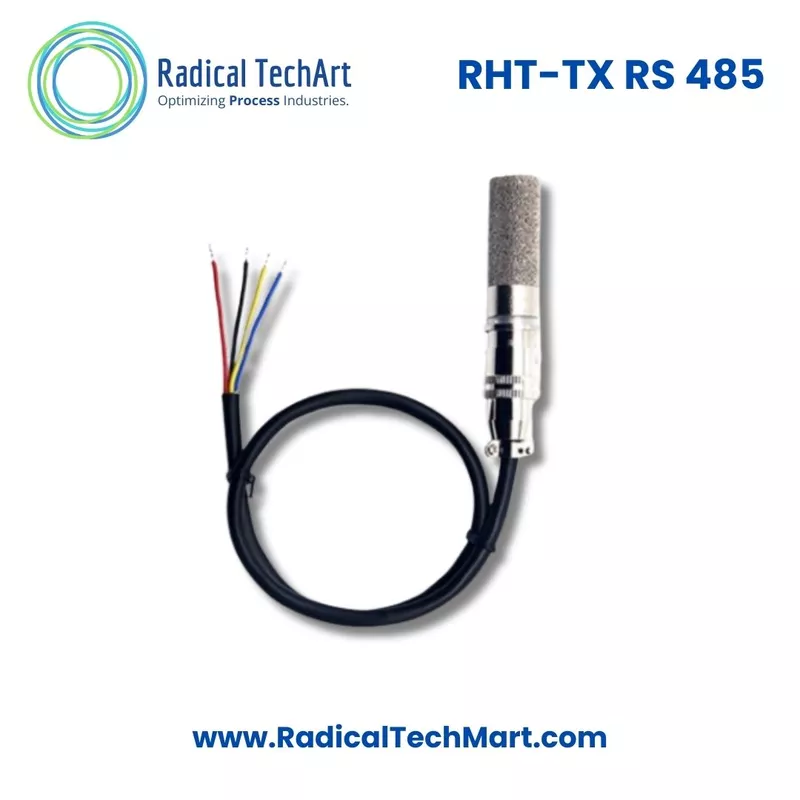


Temperature and Humidity Sensor with Modbus RS485 for Industrial Control Systems
Customize
Share :
A. Product Overview
A temperature and humidity sensor with Modbus RS485 is a field-mounted transmitter designed to provide stable, digital environmental measurements to PLC/SCADA and building/utility control systems. It is commonly deployed in communication rooms, warehouses, building automation, and automatic control installations where continuous monitoring is required for equipment reliability and product/storage quality. The manual describes a rugged construction intended for high-humidity and demanding locations, including a waterproof shell and internal PCB protection, supporting use in outdoor or humid industrial areas where condensation and corrosion are common failure drivers.
B. Working Principle
The sensing element measures ambient temperature, and the relative transmitter converts these readings into Modbus RTU register values accessible over an RS485 bus. A Modbus master (PLC, gateway, or BMS controller) polls the device using standard function codes (e.g., Read Holding Registers), and the sensor returns scaled measurement data for humidity and temperature. This digital method reduces analogue noise pickup across long cable runs and helps standardise integration across multiple zones using address-based multi-drop wiring.
C. Key Applications (Typical Industrial Use)
Control panel and MCC room monitoring for utilities, power, and process plants
Warehouse and finished-goods storage monitoring in **pharma, food, and engine
HVAC/BMS integration for commercial/industrial HVAC and clean utility areas
Process-area chemical, oil & gas, and water/wastewater facilities
Communication and instrumentation shelters to prevent condensation-related faults **Use This Product**
Humidity and temperature excursions directly impact electrical reliability. High humidity increases risks of condensation, corrosion, insulation breakdown, and nuisance trips; it also affects storage-sensitive materials (packaging, powders, and electronics). A Modbus RS485 sensor supports preventive maintenance by enabling continuous trending, alarm thresholds, and remote visibility—reducing manual checks and helping avoid downtime caused by moisture ingress or overheating. The device’s RS485 multi-drop capability enables multiple sensors on one bus, supporting standardised plant monitoring architectures used by OEMs and system integrators.
E. Suitable Buyers
OEMs building HVAC, AHU/FAHU, dehumidification, and environmental monitoring panels
EPC contractors and system integrators deploying PLC/SCADA/BMS with Modbus RTU networks
Maintenance and utility teams rems, compressor rooms, and instrumentation shelters
Plant engineering and procurement teams standardizing sensors for spares and retrofits (commonly used for replacement where analog sensors or consumer-grade devices fail)
Quick Answers
What is a temperature and humidity sensor with Modbus RS485?
It is a digital transmitter that measures ambient temperature and relative humidity and communicates the readings over RS485 using Modbus RTU register formation.
Where is the temperature and humidity sensor with Modbus RS485 used?
Used in control rooms, warehouses, communication/server rooms, HVAC utilities, and industrial automation sites where continuous environmental monitoring and alarms are
Why is a temperature and humidity sensor with Modbus RS485 required in industry?
It helps prevent condensation and overheating-related failures by enabling continuous monitoring, trending, and alarm logic through PLual checks and downtime risk.
Who typically uses a temperature and humidity sensor with Modbus RS485?
OEMs, BMS/HVAC integrators, EPC contractors, plant utility teams, and maintenance/procurement teams standardising environmental monitoring across multiple areas.
FAQ Section
1) How do I read temperature and humidity values on Modbus RS485?
The manual specifies to read holding registers. Humidity is available at register 0x0012 and temperature at 0x0013, with values typically scaled to one decimal place (example: 607 = 60.7 %RH, 276 = 27.6 °C). Use a PLC/SCADA Modbus master to read two registers.
2) What power supply and ranges does this sensor support?
The instruction manual lists DC supply in the 5–24 V range (with a wide input mention up to 30 V in the wiring context), humidity range 0–100 %RH, and temperature range of -40 to +120 °C (customisable). These values make it suitable for general industrial ambient monitoring rather than high-temperature processes.
3) What should I check before adding it to an existing RS485 Modbus network?
Confirm the baud rate, parity/frame format, and the device address to avoid conflicts on a multi-drop bus. The manual notes address uniqueness and cautions about correct A/B wiring. Ensure proper termination and shielding practices as per your panel standard, especially in VFD-heavy environments.
4) Is this suitable for high-humidity or outdoor installations?
The manual indicates a waterproof shell and internal PCB waterproofing intended for high-humidity and demanding environments. For outdoor use, ensure cable glands, junction boxes, and mounting orientation prevent water ingress and allow airflow to the sensing area for accurate humidity response. 5) What are common installation mistakes that cause wrong readings?
Typical issues include mounting near direct moisture sources (sprays/steam), placing the probe in stagnant air pockets, running RS485 cables alongside power cables without separation, and incorrect A/B wiring. Incorrect addressing or serial settings can also appear as “no data” in PLC polling.
6) Can this replace an older temperature/humidity transmitter in a retrofit?
Yes, it is commonly used in retrofit projects where plants are standardising on Modbus RTU for centralised monitoring. Match supply voltage and mounting/probe style, and confirm the PLC has RS485 Modbus capability. Validate register mapping (0x0012/0x0013) and scaling during commissioning to ensure tolds are set correctly.